


[D]UMMERSTON — Alex Wilson’s version of a “This Old House” episode might include net-metered solar panels, cork insulation and high-tech quadruple-glazed windows.
He might also hire a construction crane to set the house aside during foundation work.
Wilson, a pioneer and prominent advocate in the green building movement, brought all of that and more to the recent renovation of a historic farmhouse in Dummerston. The result is a home that’s producing more electricity than it uses, with enough surplus energy to power the family’s hybrid car for thousands of miles this year.
Additionally, Wilson and his wife, Jerelyn — also a green building leader — say they are erasing as much of their carbon footprint as possible by finding solutions for home heating, driving and even air travel.
As Vermont strives toward obtaining 90 percent of its energy via renewable sources by 2050, Alex Wilson said he hopes the efforts at Leonard Farm might serve as a model both for green building enthusiasts and those who have doubts about conservation and renewables.
“That’s a big priority of what we’ve done here,” he said. “We want to show what’s possible.”
He is a nationally recognized expert in energy conservation, renewable generation and environmentally friendly construction. He started BuildingGreen Inc. in 1985 and founded the Environmental Building News in 1992.
Four years ago, he started the nonprofit Resilient Design Institute. Like BuildingGreen, the institute is based on Birge Street in Brattleboro.
The Wilsons have lived for decades in nearby Dummerston. About five years ago, they bought an old farmhouse down the road from their house; before moving in, they decided to transform the property using the principles Alex Wilson has based his career on.

“I’ve been writing about energy for 30-plus years, so I used the house as an opportunity to practice what I’ve been preaching for a long time and also try out new ideas — sort of use ourselves as guinea pigs,” he said.
They preserved the basic structure of the home, which dates to the early 1800s. But after “a lot of planning and thinking,” they undertook something more akin to a rebuild than a renovation.
One major early decision was to create a new foundation. “Then the decision was, do we jack up the house and work underneath it, or something more dramatic?” he recalled while sitting at his kitchen table on a recent morning. “And we ended up having a crane come in and pick up the house and put it over there in the yard.”
Builders followed a principle in the new basement that would extend throughout the house: Insulate as much as possible. In addition to conventional fiberglass insulation, they also did some experimenting with a 6-inch layer of cork.
Some of the home’s windows were enlarged to let in more daylight. But the couple also opted for triple- and even quadruple-glazed windows that further the insulation theme.
Leading the Leonard Farm project was Eli Gould, who has a trio of Brattleboro green building ventures: Ironwood Brand, PreCraft and STIX L3C. Gould said he was honored to work with the Wilsons but acknowledged the project stretched his abilities.
“This was the biggest challenge of my career because of the overlay of historic features, the depth of thought and care they put into their decisions and the outreach to companies to participate and innovate with us,” Gould said.
The Wilsons’ project, Gould said, has spurred further innovation by encouraging development of “more affordable and factory-built versions of each system — from foundation insulation to walls, roofs and advanced mechanical.”
In addition to conservation, Alex Wilson’s interest in resiliency also drove the project. “I wanted to demonstrate some issues with that — to get a house well enough insulated that, if there’s an ice storm that knocks out power for two weeks in the winter, we’d be able to be totally comfortable here,” he said.
Near the kitchen table is a small wood stove; he proudly proclaims that it’s “the only combustion in the house … and we don’t use it much at all.” The 1,500-square-foot home’s main source of warmth also is in the kitchen — a single air-source heat pump.

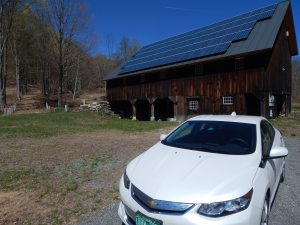
Hot water also comes via a heat pump system. So aside from the wood stove, the home is all electric, and Alex Wilson said a solar array on a nearby barn roof is making all the power they need.
The net-metered system’s output is shared with a neighbor, but Wilson calculates that his share still came out to 12,457 kilowatt-hours of electricity for the 12-month period ending in October. That’s about 3,700 kilowatt-hours more than the couple used.
The Wilsons bought a Chevy Volt last year, and they can charge the hybrid car in their garage. The excess electricity produced on site “will power about 9,000 hours of driving, which will be all of our local driving,” Alex Wilson said.
He believes they’ll also have enough excess power for a planned cold-storage room on the property.
There are, however, still some tradeoffs and concessions to a busy life. There’s an older Subaru Forester alongside the Volt in the garage; while the Wilsons try to drive it as little as possible, winter road conditions and/or hectic schedules sometimes make the second car a necessity.
A larger issue is work-related long-distance travel. Alex Wilson called that “the big nut still to crack,” though he is planning to begin purchasing carbon offsets to balance the impact of flying. He’s asking those who host his appearances in other cities to take similar measures.
“You send money to an organization or company that pledges to take that money and invest it in improvements that will reduce carbon emissions,” he said. “It could be planting trees, it could be retrofitting buildings, it could be paying to weatherize affordable housing.”
While he says carbon offsets are relatively inexpensive, he knows that not everyone can afford the energy measures he and his wife have taken. Their home renovations alone, he estimated, ended up costing about $275 per square foot.
That’s why he’s also offering green building and conservation tips on a smaller scale:
• Getting a home energy audit is an important first step, “then dealing with air leakage, which is often the biggest culprit.”
Even if a homeowner simply seals a few windows, “there are always things that can be done, on any budget,” he added.
• Sometimes, he said, it makes sense to borrow in order to fund energy-saving improvements. “There are programs around to borrow money at affordable rates,” he said. “We’re actually working on some financing options that will hopefully make it possible to do a deep energy retrofit for a homeowner.”
• When building new, it costs more to go green. “But my argument is, think harder about how much space you need,” he said. “The money you’ll save in an overall smaller footprint, you can put into better materials, higher insulation levels, better windows.”
• Hybrid vehicles come at a premium: Chevy says the Volt, without a tax credit figured in, costs more than $30,000. But Alex Wilson argued that “there are huge differences in the vehicles out there. Often, the fairly efficient vehicles are the lower-cost vehicles anyway.”
“The other argument is to drive less — bicycle, walk, get exercise,” he added.

