

Editor’s note: This article is by Matt Hongoltz-Hetling, of the Valley News, in which it was first published Feb. 23, 2016.
[L]EBANON — Though he had taken his sleeping pills, after going to bed on Sunday night, John Caswell woke up in the darkness, cold, thinking about what the police had said to him.
It was 1:38 Monday, according to his alarm clock. Several hours remained until dawn, but the 60-year-old couldn’t get back to sleep, despite the soothing sound of the water flowing in a small brook just outside.
The brook had chunks of ice in it, a sign of the sub-freezing temperatures, and that was a problem, because Caswell had no heat source and little insulation from the cold. The moonlight lit up his walls — flimsy gray plastic tarps — and allowed him to see his breath against the dark shadows of the haphazard array of branches that held the tarps in place.
When the Lebanon police visited Caswell Saturday afternoon, they told him he would have to take the makeshift shelter down or else it would be taken down for him. About a week ago, Caswell built it in a visible spot just off a main trail at the base of the Storrs Hill ski area, which had shut down for the season. When ski area staff noticed the structure, they called the officers to ask Caswell to move along, according to Richard Mello, Lebanon’s police chief.
After the police left, Caswell began to transition to another spot deeper in the woods where he thought authorities would be less likely to bother him, but he gave up the idea quickly.
Caswell suffers from chronic obstructive pulmonary disease, and it had been such an effort to get all of his belongings to the current site that he didn’t have the energy to do it all over again so quickly.
“Could you imagine untying all these knots?” he asked, lying prone in the structure on Monday afternoon, gesturing to the ropes that bound the tarps to the branches. “I’m not 18 anymore.”
He doesn’t like that the officers told him he couldn’t camp here. To Caswell, it was a bad choice of words.
“I’m not camping,” he said. “I’m surviving.”
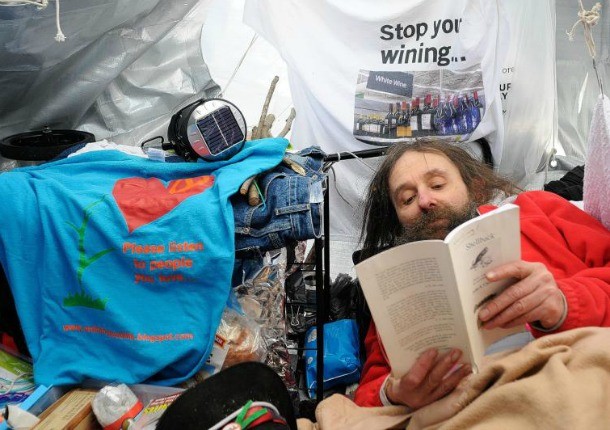
He had run out of water earlier on Monday, but didn’t dare leave. What if the police came back and made good on their promise to take his shelter away? It contained everything he owns — clothes, copies of a book of his poems and prose, a pair of glasses, crates of odds and ends, a loaf of bread, empty bottles of seltzer water, a Snickers bar.
An upbeat personality, Caswell referred to his site as “Camp Thriving Spirits,” with no sense of irony.
Less than 5 miles away, at the White River Junction-based Upper Valley Haven, Executive Director Sara Kobylenski said there was a warm cot available for Caswell at the group’s seasonal shelter.
“We know John,” she said, “and he is welcome here.”
But Caswell falls into a category of homeless people that can be among the most difficult for social service agencies to help.
He said he suffers from schizophrenia, a condition that makes it difficult for him to fit into a group living environment.
Less than a week ago, he left the Haven’s Hixon House Adult Shelter, which has 10 bedrooms, because he found it difficult to live under the same roof as 20 other people.
“It’s the stimulation, the overstimulation of being there,” he said.
According to state counts, there were 3,681 homeless people in the Twin States on a single night in January 2015. Nearly a third of them, like Caswell, identified themselves as having a serious mental illness, and about 10 percent of the total were staying in a place not intended for human habitation.
“Without my commenting on that specific individual (Caswell), I can say that as a society, we have not lived up to our obligation to help those who do not choose the limited community mental health resources that we do have available as their pathway to a safe and stable life experience,” Kobylenski said.
Kobylenski said the percentage of homeless suffering from mental illness likely is higher than the self-reported measure indicates.
“Based on our experience, based on people who come through our doors, mental health issues probably affect at least half of people who are homeless,” she said.
Caswell is bright and talkative; he speaks with pride of his writings, his strong work ethic, and of his self-taught graphic design skills, which have resulted in him producing books, clothing and other items printed with positive, uplifting messages meant to help those suffering from substance abuse. Caswell said he was addicted to alcohol and drugs at one point, but he’s been sober for 25 years.
But despite Caswell’s talent and charisma, and despite him holding an associate’s degree in human services, mental illness has made it difficult for him to get ahead in life.
Born and raised in Lebanon as one of six children, he worked mostly construction jobs early in his life. It seemed he always was in a state of transition — while battling addiction, he would leave town to get away from bad influences, and then come back because he missed his friends.
In the late 1980s, his wife and children moved away, and he began working as a janitor. But in the late ’90s, he quit that job to earn his degree, and began living in a subsidized one-bedroom apartment, an arrangement that lasted for 14 years. In 2012, he made an attempt to start a new life in Nebraska, but he decided to return to the Upper Valley a few months later. Because his lease had lapsed, he moved into the Hixon House and stayed there for 14 months. He said he was having difficulty getting a Vermont driver’s license, and so he left the Hixon House to establish a residence in New Hampshire, where he already had a license. Eventually, he moved back into the Hixon House and stayed there until just last week; that’s when he built the little shelter on Storrs Hill.
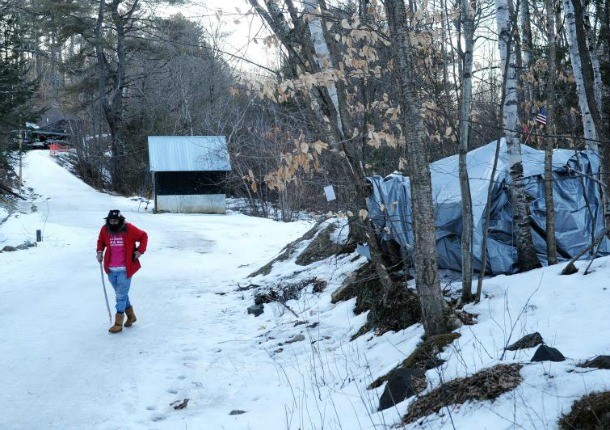
He doesn’t want to live in the crowded quarters at the Haven. He would like to take another stab at subsidized housing, but it’s a long waiting list.
Kobylenski said that if support services had more resources, they could provide a wider range of options that would help to convince more people to come in from the cold.
“If someone isn’t ready to enter the bureaucracy, then there are no good alternatives available,” she said. “The capacity of the system doesn’t match the need.”
The balancing act is made more difficult, she said, because it’s important to uphold the individual’s right to make his or her own decisions. For example, she said, there’s a fine line between encouraging and forcing a person to access mental health services.
“It’s also tricky because sometimes when they get into housing, they sometimes walk away because it doesn’t feel right,” she said.
The system carries with it an assumption that people will make sensible choices, Kobylenski said.
“We’ve created a paradox,” she said. “We’re asking them to make choices that you can only make if you’re not looking through the lens they’re looking through.”
Mello said Lebanon police officers often are caught in a bind when they’re asked to relocate someone like Caswell, whose ability to function and make decisions prevents societal institutions from imposing decisions on them. You can’t force people into treatment unless they’re going to hurt themselves, he said.
“A lot of people in this state fall in a gray area between a person whose mental health problem makes them unable to take care of themselves and someone who is completely able to take care of themselves,” Mello said.
Mello said that since Caswell hasn’t followed the officers’ instructions, they likely would revisit the site. First, he said, they would do outreach to see if Caswell has relatives in the area who will take him in.
“We don’t want to get to the point where he’s in handcuffs and we’re arresting him because he’s trespassing,” Mello said.
Mello said the city of Lebanon might provide resources to help shelter Caswell as a last resort.
“There might be some options at city hall,” he said. “They’re aware of the homeless problem and want to help. Maybe we can figure something out.”
As the sun set on Monday evening, darkening Caswell’s structure, he answered a call from the Valley News on his cellphone.
In the morning, he said, he planned to walk into town and buy himself breakfast. He said he would call state services in Vermont and ask them to transfer his state benefits to New Hampshire.
“I don’t know how I’ll do that, with this address,” he said.
Shortly after 9 p.m., Caswell reported he had received another visit from the Lebanon police, and that they told him they would be checking back on Tuesday to ensure that he was gone from the site.
Caswell, who buys his food and other items with a disability check, said that the officers were rude to him, and had told him to get a job.
Lebanon Police Sgt. Jeffrey Perkins on Monday night declined to answer questions about the interaction with Caswell, and suggested that Mello would be able to give an official update this morning.
Caswell had been garrulous earlier in the day, but during the Monday night call, he quickly excused himself.
“My cellphone is down to just one bar,” he said.
He hung up, planning to wait out another long, cold night.
