

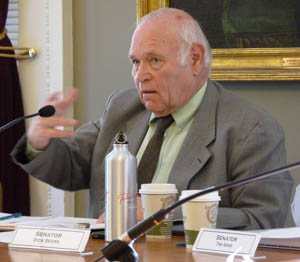
Sen. Dick Sears, D-Bennington, asked the Senate Judiciary Committee — and later, a Democratic caucus — to add language that would move a quarter of the tax money brought in by legal pot to the state’s general fund; bar people from growing the plant at home; and beef up penalties for adults who sell the drug to minors.
Sears said he won’t vote for the final bill if it allows homegrown marijuana. “I’ve come a long way from last October,” Sears said. “If I vote no, I’ll still live. If I vote yes, I’ll live too.”
He pointed to Colorado, a state that allows people to grow their own marijuana. Homegrown pot created a “gray market” in Colorado, he said, where some of what is legally grown but not regulated is easily sold on the black market.
Gov. Peter Shumlin highlighted Sears’ bill at a press conference on Tuesday and said he supports the legislation on the whole. He said he is open to debate about whether the state should allow homegrown marijuana.
“I’ve never supported homegrown, indoor grown,” Shumlin said. “I think as the bill travels, there’s a conversation about wether you have a plant or two in your garden, during grow months, where you’re not facing all the indoor growing problems the state is facing, all sorts of mold problems, all kinds of problems. I’m willing to listen to that debate.”
Speaking to his committee, Sears was careful to follow the prerequisites Shumlin laid out for legalization during his State of the State address and instructed his committee to do the same. “Gov. Shumlin offered five principles,” he said. “This committee will be guided by those principles.”
Shumlin said any marijuana law must keep the drug away from kids; wipe out the black market; provide revenue to expand addiction prevention; strengthen enforcement against impaired drivers; and ban the sale of edible marijuana products until other states show it can be done right.
Under the new provisions, tax profit would be split four equal ways: a quarter each to prevention and treatment of marijuana use; a quarter for police to enforce drugged driving laws and battle the black market; and a quarter to the general fund.
Senate Democrats held a caucus Tuesday to hear Sears’ proposals. Lawmakers expressed support for the bill and his proposed changes.
Sen. Tim Ashe, D/P-Burlington, told the caucus that after he spoke to high school students at Peoples Academy in Morrisville, the students made clear to him that “it’s insanely easy to get marijuana” at the school.
“We’ve been hearing the same thing from people all across the state for the past 30 years,” said Sen. Claire Ayer, D-Addison.
‘DART BOARD’ TIMELINE
Should the law pass, a major regulatory and rule-making challenge awaits state agencies. Sears offered a timeline for implementing the law, with the disclaimer that it is up in the air.
“It’s like a dart board,” he said. “You can throw whatever you want at it and what you hit could change.”
Under his timeline, stores wouldn’t begin legally selling marijuana and adults couldn’t legally use the drug until Jan. 1, 2018.
The chief agency involved in regulating marijuana would be the Department of Public Safety. Immediately after passage of the bill, that department would begin working on a regulatory framework. By mid-March 2017, the department would have a complete rulebook.
To get the legal market off the ground, from mid-March to mid-April 2017 the department would first vet and then issue between 10 and 20 licenses for businesses that want to grow marijuana for the legal market.
Three months later, retail marijuana businesses would also go through a licensing process, but this time the department would issue 20 to 40 licenses.
The law would also create a commission made up of two doctors and a nurse who would make recommendations to lawmakers about how the drug can be used medically.
The commission would meet for the first time in October of this year and issue a final report to the Legislature two years later.
ACLU WEIGHS IN
In testimony to the Senate Judiciary Committee, Allen Gilbert, executive director of the Vermont chapter of the American Civil Liberties Union, asked lawmakers to consider why marijuana is illegal when drugs that he said are equally dangerous — if not more dangerous — such as tobacco and alcohol remain legal.

National data suggests that whites and blacks use marijuana at very similar rates, he said.
Gilbert said Shumlin was correct in his State of the State address when he said the war on drugs has failed. “The question is not whether to legalize but how to regulate,” Gilbert said.
Gilbert supports allowing homegrown marijuana. “We still allow people to grow hops and home-brew beer,” he said.
UPDATED: A longer quote from Gov. Peter Shumlin regarding his stance on homegrown pot was added to this story.

