


[R]epublican candidates for governor are calling on Gov. Peter Shumlin to audit the state’s Medicaid program.
The program now insures nearly one-third of Vermonters and will cost the state and federal government around $1.7 billion this year.
This year and next, the state’s Medicaid program, which has been expanded over the past several years, is facing cost overruns. The Medicaid budget gap is $30 million to $40 million in fiscal year 2016 and between $50 million and $60 million in fiscal year 2017.
Financial officials in October said the gap is the result of poor projections that led the state to under budget for Medicaid.
The state has two options: raise taxes or cut benefits.
Gov. Peter Shumlin, who is not running for re-election, said he will not cut benefits because it would be “cruel” to the people whom the state promised health insurance. Nor will the governor re-introduce his proposal for a 0.7 percent payroll tax on employers to fund Medicaid.
Instead, Shumlin said he would “let brighter minds, I guess, try to figure that out.”
Now, Bruce Lisman, a former executive for Bear Stearns on Wall Street who is seeking the Republican nomination, is calling for an internal or external audit of the entire program. He said the information is crucial to understanding how to manage the program.
Other candidates for governor agree the program has challenges that should be fixed, including screening for eligibility. Because of ongoing technical problems with the Vermont Health Connect website, the state isn’t in compliance with federal eligibility regulations.
Not all candidates for governor support a full audit of Medicaid, and none said they would raise taxes to pay for the increasing costs.
“We need to know better what’s happening within the expanded Medicaid pool. Are they healthier?” Lisman said. “Do they have access to care? Does that matter? Are we actually saving money if (every expense) is counted, because this was designed to capture more of the uninsured?”
“If we have enough information, we can make important and significant decisions, hopefully without destroying the value of the program,” Lisman said. “But without information and without data I don’t know how you would do that.”
Lisman does not support raising payroll taxes, income taxes, or gas taxes, to fund Medicaid because he said he wants more information. As governor, he said having the right data would help him hire the right people to manage Medicaid.
“Sure, there’s a cost to gathering more data, but your choice is fairly simple,” Lisman said. “The lights are off and I can’t see where I’m going. It costs a small amount of money to turn the lights on and get out the door.”
Scott wants to review previous audits
Lt. Gov. Phil Scott, the leading Republican candidate for governor, says the Medicaid program should be closely examined and “internal-type audits” should be done on a cyclical basis “that would give us the comfort of knowing everyone in the program should be in the program.”
Scott said he hadn’t reached out to Doug Hoffer, the state auditor, but before calling for a full-blown external audit, he said there may be recommendations from audits that have already been performed that the state isn’t acting on.
“I want to take a look at the audits that have to be done,” Scott said. “We may not need another audit at this point in time. Let’s look at the one that was just done and how recent that just was.”
He also said: “Audits are expensive, and again if you’re not going to follow through and utilize the benefit of the audit, then you have to ask yourself why are you going through the exercise.”
Scott also pointed to one of the more controversial factors in the Medicaid puzzle: A waiver from the U.S. Centers for Medicare and Medicaid Services has allowed Vermont to automatically re-enroll people in Medicaid for the past two years without checking through the Department of Labor whether they were eligible.

Lawrence Miller, the chief of health care reform for the Shumlin administration, said the administration doesn’t know how many ineligible people remain on Medicaid, because “If we knew that, they wouldn’t be on Medicaid.”
Vermont Health Connect has been checking eligibility based on federal tax data, Miller said, but that system does not comply with federal Medicaid rules. The website will be in compliance once the site finishes setting up technology to check income based on wage data from the Vermont Department of Labor, whose information is more current and will better reflect whether someone got a raise or a new job.
The Shumlin administration started re-assessing individual Medicaid accounts for people with disabilities last year and began checkiing eligibility for income-based accounts this month in a process called redetermination. Miller estimates the administration will continue checking 9,000 accounts per month from January to October.
The Department of Vermont Health Access estimates that redeterminations will save the whole program $422,890, the administration says, and the state’s savings would be just $190,174 out of the $1.7 billion Medicaid budget. However, Miller said only after that process is over will the administration know how many people were on Medicaid and who shouldn’t have been on Medicaid.
Scott said the state should make sure the amount of money they will save is accurate, and he said checking eligibility is about accountability. “With one third of our population in the program, we need to make sure that all of those who are in there are eligible,” he said.
Scott is opposed to raising taxes to pay for Medicaid, including Shumlin’s proposal last year to raise payroll taxes by 0.7 percent. He did not support other revenue sources, either, such as a capital gains tax or income tax. Instead Scott said the state should raise revenue “naturally, with the existing system that we have by focusing on and growing our economy.”
Hoffer: Medicaid audit a ‘monstrous’ undertaking
In an interview, Hoffer, a Democrat and Progressive, pointed to audits that a private firm conducts every year to determine if Vermont is managing federal money in compliance with federal laws. The most recent is in 2014, and the audit looked at Medicaid eligibility, matching and procurement issues, among other things.
In 2006, the Vermont State Auditor’s office conducted a performance audit on Medicaid Pharmacy, and another audit related to Medicaid in 2007. The Vermont Health Connect audit from April 14 touches on Medicaid because the exchange is a Medicaid eligibility determination system. The update to that audit on Nov. 18 also raises serious questions about Vermont’s ability to determine Medicaid eligibility.
“The state is not in compliance with Medicaid billing procedures,” Hoffer said. “A number of people have been allowed to remain signed up for Medicaid even though (they are not eligible).The system is a mess. We’re aware of that.”
Even though it’s generally called a “Medicaid program,” the money coming in from the federal government funds dozens of programs, many staff positions, and several mental health agencies, among other things. The programs in question may help someone with disabilities get health care or help a child—but not her parents—get coverage.
Hoffer said it would be a “monstrous undertaking” for his staff to audit Medicaid, and he said the increased costs are also part of the rising cost of health care. “I appreciate people’s concerns, but I don’t know that an audit is going to answer all their questions.”
“You gotta keep in mind, as scary as it sounds … $40 million out of a billion does not mean the world is coming to an end,” he said. “It’s a problem to be resolved.”
Democrats: Health care costs driving up Medicaid
Gov. Peter Shumlin, the incumbent Democratic governor who is not seeking re-election, said in a news conference that Republicans like Lisman have been saying “for years” they could make the government more efficient, but “if it were that simple, it would’ve been done by now.”
Shumlin said he has been a “broken record” on lowering health care costs in Vermont. He said problems with Vermont Health Connect hampered the state’s ability to check eligibility, and that the focus on eligibility and compliance issues are a distraction from the real health care problems.
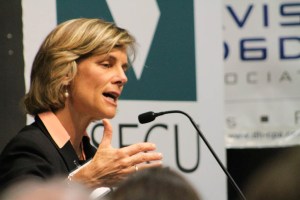
Sue Minter, the former secretary of the Agency of Transportation who is running for the Democratic nomination, said the state should not have ineligible people on Medicaid and that the state is currently re-reviewing accounts.
But she would not support “a whole audit,” and she also did not back any specific revenue sources. She echoed the auditor and Shumlin, saying that the growing costs have less to do with Medicaid and are more about the growing cost of health care.
“The real issue is the cost drivers of health care, and it isn’t just Medicaid,” she said. “We need to look holistically at how do we address the cost drivers. I am supportive of the payment reform program and the all-payer waiver that the Green Mountain Care Board is pursuing.”
According to an expenditure report by the board, which regulates hospital spending and health insurance premiums, Vermonters spent $5.3 billion on health care in 2013. That number has increased every year, and now the board is negotiating terms to create an all-payer model (often called an all-payer waiver) to slow the growth to 3.5 percent per year.
“One of our biggest cost drivers are the aging population,” Minter said. “It’s about prevention and caring for people before they get sick, particularly some of our most expensive or costly recipients of care.”

Matt Dunne, a Google executive who is also seeking the Democratic nomination, said he expects that information from the Medicaid eligibility redetermination process from January to October will be made public. He said that information will help determine whether a full audit is necessary.
Dunne, who sat on the board of directors for Dartmouth-Hitchcock Medical Center from 2012 to 2015, also declined to name a revenue source for funding Medicaid. He said hospitals continuously worry about bringing in enough patients to meet their budgets. The Green Mountain Care Board has been advocating for health care payments that encourage doctors and hospitals to promote disease prevention.
“I think there are a number of ways that we could actually pay health systems to be able to take care of patients, and what that would do is fundamentally flip the incentive structure so there was the right health care delivered to people at the lowest-cost time,” Dunne said.
He said of potential taxes: “If we’re seeing cost continue to escalate in health care as they have across the board, it would be very difficult to raise revenue until we knew what the actual long-term cost was going to be. Otherwise you would be coming back, I think, every year, raising revenue year after year.”

