

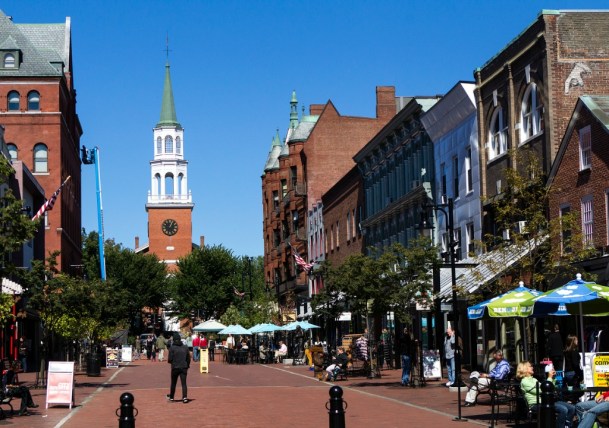
[B]URLINGTON — City and state officials are challenging U.S. Census Bureau estimates suggesting the population of Vermont’s largest city is shrinking.
According to Census estimates, Burlington’s population has decreased from 42,417 in 2010 to 42,211 in 2014.
State officials in the Department of Housing and Community Development questioned the estimates because state indicators suggest the city is growing. As it turns out, the Census Bureau didn’t have accurate housing permit data because the city had neglected to fill out annual surveys.
The city has submitted new data to the bureau. But even if there are small gains in population as a result of city’s challenge to the estimates, a UVM economist says it won’t change a demographic trend that has been affecting the Queen City for decades: a lack of housing is limiting its growth.
Noelle MacKay, the department’s commissioner, and her staff took a deeper look at the Census data, after reading a commentary by UVM professor Art Woolf in the Burlington Free Press about the state’s stagnant population. Woolf highlighted census data that shows Vermont’s cities — Barre, Bennington, Brattleboro, Bellows Falls, Montpelier, Rutland, Springfield, Windsor, St. Johnsbury, St. Albans City, Winooski and Burlington — all have fewer residents than they did in 2010.
Ten-year census figures come from a detailed on-the-ground survey work, but interim annual population estimates are based largely on self-reported figures from municipalities.
Among the data are the number of new residential building permits issued by cities and towns. Officials discovered that Burlington hadn’t reported residential building permit numbers to the federal government since 2006. The U.S. Census Bureau sent housing permit surveys to the city, but no one had responded, according to David White, Burlington’s director of zoning and planning.
A city review of Census estimates versus the actual number of residential building permits issued from 2009 through 2013 showed that the estimates were off by 41 permits (22 in the Census estimate versus 63 that were actually issued during that time).
City and state officials huddled with officials from the U.S. Census Bureau, and White said he was encouraged to submit a formal challenge to the population estimates. He sent a letter to the bureau’s population division in July, but has yet to hear back, he said.
“It sounds like a big deal to challenge this, but they’re basically saying send us this data to make sure our projecting and estimating tools are as accurate as can be,” White said. “We collect this information, so let’s provide them with the best information we possibly can.”
The Census also looks at how many houses are demolished as an indicator of growth, and in the absence of reported data applies a standardized methodology, according to state officials.
The housing stock in Burlington, and Vermont generally, is older than in many other parts of the country, so it’s also likely that Census estimates for the number of housing units demolished by the city are off as well, according to John Adams, a planning coordinator in the Department of Housing and Community Development.
“We know that Burlington isn’t demolishing that many housing units,” and a city ordinance actually requires units that are demolished to be replaced, he said. “We don’t have any figures suggesting that Burlington is actually losing population.”
Adams points out that in 2009 the Census estimated Burlington’s population at 38,647. The next year when the actual 2010 figures were released as part of the 10-year census, Burlington’s population was counted at 42,211 — a difference of 3,564.
When municipalities don’t report accurate information, the inaccuracy of the Census estimates can snowball. Adams said it’s possible that other cities and towns across the state aren’t reporting information that could improve Census estimates. His department is working with the Vermont State Data Center at the University of Vermont to look into whether that’s the case.
Michael Moser, a research specialist at the data center, said an inquiry in 2014 found that at least 35 municipalities weren’t reporting complete data to the Census.
“The state’s goal is to develop and build our downtowns to increase our population, and if we don’t have accurate information we won’t know if we’re accomplishing that goal,” MacKay said.
Moser and state officials are working with several larger cities and towns to try and improve data collection. It’s important to have the best data possible because government programs, nonprofits and business groups rely on population data for eligibility requirements, grant proposals and business plans, he said.
Woolf argues that Burlington’s growth is underwhelming. Even if the census estimates are understated by several hundred people — and in light of the city not reporting data to the Census he agrees they likely are — Burlington’s growth has still lagged behind Vermont and Chittenden County over the last 20 to 40 years, he said.
“Vermont has grown significantly since 1970, and Burlington has grown only marginally,” he said. According to Census figures, Vermont’s population grew 29 percent from 1970 to 2010; Chittenden County’s population grew by 27 percent; and Burlington’s population grew by 9 percent.
Much of Burlington’s growth is the result of more students at UVM and Champlain College, Woolf said. Students are counted in the Census, but aren’t permanent residents and don’t make the same economic contribution to a city.
“To be fair, that’s true in most cities,” Woolf said. “Suburban areas have grown, the counties where cities are located have grown, but the city core’s have remained stagnant.”
Downtown development
In Woolf’s estimation, it’s not that people don’t want to live in Burlington — housing data shows the city has a 1 percent vacancy rate for renters — or even just that housing is expensive — though typical renters spend 44 percent of their income on rent, according to a 2014 city report.
Woolf believes an onerous permitting process and the high costs of developing housing in Burlington have led developers to focus their efforts in nearby towns that are commuting distance from the Queen City.
Of 2,840 units of multifamily housing built in Chittenden County between 2002 and 2013 only 20 percent or 551 were in Burlington, and only 8 percent of those were downtown.
“There’s no question that building in downtown Burlington is a challenge,” said Peter Owens, director of Burlington’s Community and Economic Development Office.
Downtown development has been a high priority for Mayor Miro Weinberger. Owens points to new apartments on North Winooski Avenue and a mixed-use student housing at the intersection of King and Pine streets as examples of new construction downtown.
The city wants to streamline zoning rules and the permitting process, so that “if a developer is delivering what we say we want in the (city’s) master plan,” they can’t be “held hostage by a single person who has a problem with it,” Owens said.
A joint City Council and Planning Commission has been working since last year to develop “form based” codes that are prescriptive but avoid a lengthy review process.
Erik Hoekstra, a developer with the firm Redstone, applauded the city’s long-term planning efforts, and a policy change that did away with a requirement for downtown development to be 50 percent commercial space. That will make building housing downtown easier, though it hasn’t led directly to any new projects, he said.
But even with the zoning changes, the economics of building in Burlington, especially downtown, aren’t favorable, Hoekstra said. “I don’t think you can zone your way out of the problem,” he added.
Hoekstra was behind the new development on North Avenue, which was in the works before Weinberger took office, he said. The projects were made possible by low interest rates, but higher property taxes than he anticipated have made him “pessimistic” about future development in Burlington even if the cost of borrowing money remains cheap, he said.
Building in downtown Burlington is like a scaled down version of building in downtown Boston, according to Hoekstra, because the land being developed is closely surrounded by existing structures making construction tricky and expensive.
That puts upward pressure on rents for newly built housing, and is part of the reason the housing supply isn’t meeting demand, Hoekstra said. At the same time, the demand for living space that’s keeping rental vacancies at 1 percent is allowing landlords to charge higher rents for existing housing.

