

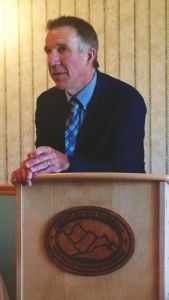
New data from the Castleton Polling Institute shows Lt. Gov. Phil Scott with an early advantage in the race for Vermont’s next governor.
“It is still 14 months away from the election, so there is ample time for everyone to catch up,” Scott told VTDigger.
Scott, a Republican, had both the highest name recognition and the best favorability rating according to the poll.
Forty percent of respondents had a “somewhat favorable” view of Scott, with another 30 percent giving him a “very favorable” rating, according to the poll, which collected responses from 617 Vermonters between Aug. 24 and Sept. 14.
“While it’s good news, it means my campaign team and I still need to catch up and reach out to those folks who don’t know who I am,” Scott said.
Scott said he was in the early stages of his campaign, and that he wouldn’t start really gearing up until later this year. He said his official campaign kickoff would likely occur in late November or early December.
The second-most-popular gubernatorial candidate in the poll was Democratic House Speaker Shap Smith, with 40 percent of those polled giving him “somewhat favorable” marks and another 20 percent recording “very favorable” responses.
Smith told VTDigger that while the poll numbers were promising, he won’t be putting much stock in opinion polls until closer to Election Day.

“My view is the poll that is really going to matter is the poll that is going to be taken in August of 2016,” Smith said of the primary election date.
Another Democratic hopeful, former Secretary of Transportation Sue Minter, received a “very favorable” rating from 16 percent of respondents, but only 38 percent of respondents said they knew who she was.
Dunne had a higher recognition rating than Minter, with 57 percent, but Dunne scored a lower favorability rating, with 8 percent giving a “very favorable” response.
Rich Clark, who directs polling efforts at Castleton University, said the poll was conducted chiefly to set an initial benchmark of where the candidates stand. He expects the numbers to change dramatically throughout the campaign.
“I take issue with the idea that this has any sort of predictive value,” Clark said. “It was a chance for us to get a baseline before the campaigns got started to see who people knew and what they thought about them.”
Republican Scott Milne, who barely lost to Shumlin in 2014 but has not announced a 2016 run, was the second-most-recognized candidate after Scott. He also recorded strong favorability ratings, with 38 percent of respondents giving him “somewhat favorable” remarks.
Milne said he was happy with the poll numbers, but not surprised that he was still a recognizable and supported entity following his 2014 election fight.
He wouldn’t say if the poll had any influence on whether he would run in 2016, and said the strong support for Scott was heartening.
“The numbers validate that Phil is electable if he runs a good campaign, that’s good news,” Milne said.
Republican Bruce Lisman recorded the lowest level of recognition, but part of the poll was conducted before he announced his bid.
Clark said that in a small state like Vermont, name recognition won’t likely pose a problem for the candidates as Election Day approached.
“If I were Bruce Lisman I wouldn’t look at this as a negative, instead I would see it as a starting point and run with it there,” he said.
While the election is more than a year away, candidates are already holding town meetings and reaching out to voters. And while some are a bit wary of the lengthened political season, Smith said it was generally healthy for the state.
“My sense is that Vermonters really appreciate the accessibility to their elected officials,” Smith said. “There are some people on occasion who say it’s a bit early, but most welcome the opportunity to weigh in on the issues.”

