

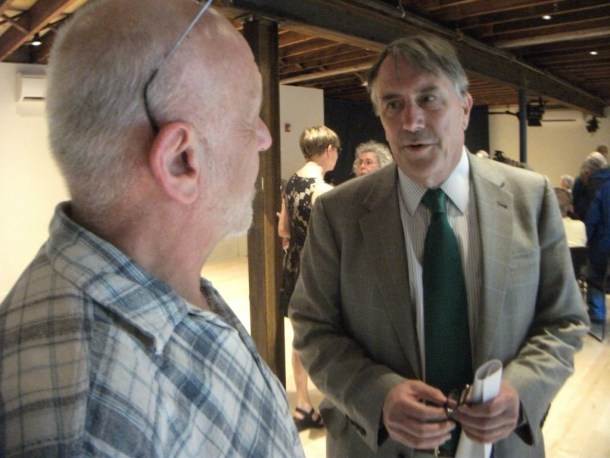
[W]hen Peter Galbraith talks about whether a proposed Iran nuclear accord will help or harm this nation and the world, he can cite his experience as a former U.S. ambassador and United Nations diplomat. But when the Townshend resident voiced his views to a Windham County crowd of nearly 100 people over the weekend, the former Vermont state senator offered some local perspective, too.
“My strongest impression of Iran,” he said of a recent trip there, “is it’s a place where the regime has lost control of large segments of the country.”
Galbraith noted many Iranian women who wear mandatory headscarves outside take them off at home, while men are plugging into Western technology such as cellphones.
“On speed dial is their alcohol dealer,” he said. “But you’d get a better deal in New Hampshire.”
Once the laughter subsided, Galbraith explained why such observations are signs the proposed agreement is in everyone’s best interests.
Many attendees of the Windham World Affairs Council’s Friday night “Hot off the Press” talk at Brattleboro’s 118 Elliot hall knew all the arguments against the deal reached this month by Iran, the United States and five other world powers.
Galbraith, a Democrat who served during the Clinton administration as the first U.S. ambassador to the Republic of Croatia, expressed a more positive take on a plan to reduce Iran’s nuclear program in exchange for relaxing international sanctions.
“No negotiated agreement does everything that you want,” he said. “The measure is not whether the United States did everything it wanted to do. The measure is, is it better than the alternative? The agreement itself is, in fact, quite significant.”
Under the accord, Iran must destroy 98 percent of its stockpile of enriched uranium and decrease its number of related centrifuges by two-thirds. In exchange, it will receive relief from a U.S. and European Union oil embargo and other economic sanctions.
The deal, negotiated in part by President Barack Obama’s administration, is drawing criticism from Republicans in Congress and on the 2016 presidential campaign trail.
(“Unfortunately,” Galbraith said as an aside, “Donald Trump won’t be the nominee.”)
Some complain the agreement isn’t indefinite, with several provisions expiring after a decade. Galbraith isn’t one of those grousing.
“If we thought the current regime was going to last for 10 to 18 years,” he said, “that might be a problem.”
But during his recent trip to Iran, the Vermonter saw signs that the country could shift politically the way the Soviet Union and several Communist counterparts in Eastern Europe did a generation ago.
“We simply waited out the Soviet Union, and I am quite confident we can wait out this system in Iran,” he said. “The hard-liners have lost control of the society. The values of the Islamic Revolution are no longer shared by the population. The Iranian people are the most pro-American in the Middle East. I think the country is on the verge of very significant changes.”
Even so, Galbraith has heard all the questions: Won’t Iran just funnel all its new wealth into terrorism?
“Spending lots of money doesn’t get you better terrorism,” he replied. “Terrorism is a low-cost activity. You don’t need a billion dollars. There’s no evidence that finance is a constraint.”
And with a provision that gives Iran up to 24 days to grant access to inspectors, won’t it simply try to circumvent the system?
“Could Iran cheat?” Galbraith said. “Of course. But from an Iranian point of view, cheating is a risky thing.”
The country would face more crippling sanctions, he explained. And even if it built a bomb, it wouldn’t be any more secure.
“Iran has been two or three months from having a nuclear weapon for the last 20 years. The issue is not just how long it would take them to develop one nuclear weapon, because from a strategic point of view, one is not very useful. The question is how long would it take them to develop a nuclear arsenal?”
Galbraith says for all its posturing, Iran has little reason to seek a stockpile when it’s currently being taken seriously for its capabilities to make a bomb yet not facing the consequences for manufacturing one.
The Vermonter couldn’t say whether negotiators from the U.S., Britain, China, France, Germany and Russia could have come up with a better deal. But he does believe the accord is preferable to not having one.
“In the most optimistic scenario, the sanctions would continue, but the Iranians might just go for a nuclear weapon, and then what are your alternatives? The critics have not explained what they would do. But do we think the American people and world opinion would tolerate a sustained bombing campaign?”
Galbraith has spent much of the past year in Kurdish-controlled parts of Iraq and Syria fighting the Islamic State also known as ISIL or ISIS. He believes an agreement will help the United States and Iran cooperate in opposing such extremists threatening both countries.
“I think the agreement,” he concluded, “is absolutely necessary.”
Galbraith, who served in the Vermont Senate from 2011 to last year, has been rumored to be a potential candidate for governor to succeed the outgoing Peter Shumlin.
If the former diplomat has plans for 2016, “I’m not disclosing them yet,” he said.
Galbraith, who hasn’t updated his public blogs since January, said people shouldn’t run for office unless they had something they wanted to accomplish. But rather than cap the conversation with that, he proceeded to talk about the need to “pay people decently.”
“There are things I think should happen,” he said before departing.
Kevin O’Connor, a former staffer of the Rutland Herald and Barre-Montpelier Times Argus, is a Brattleboro-based writer. Email: kevinoconnorvt@gmail.com
