


[G]ov. Peter Shumlin’s planned departure clears the way for other candidates, and no fewer than nine are now considering the 2016 race for governor: Four Democrats, three Republicans, one independent and a Progressive.
An open seat for governor could spark at least two primaries and inevitably a competitive horse race in the general election.
The Republican possibilities include: Lt. Gov. Phil Scott, former state Sen. Randy Brock, and Scott Milne, who nearly defeated Shumlin in 2014.
Among the Democrats? Rep. Peter Welch, D-Vt., House Speaker Shap Smith, Doug Racine, a former lieutenant governor and state senator, and former state senator Matt Dunne. The latter two ran in the 2010 Democratic primary against Shumlin, and Racine was hired and then fired by Shumlin as secretary of the Agency of Human Services.
Bruce Lisman, a Wall Street mogul and native Vermonter, is another potential contender with conservative leanings.
And then there is Sen. Anthony Pollina, a Progressive from Washington County, who made a failed bid for governor in a three-way race with Gov. Jim Douglas and former House Speaker Gaye Symington in 2008.
Eric Davis, a retired professor of political science from Middlebury College, says Dunne and Racine, who have already lost two statewide races, stand less of a chance in a Democratic gubernatorial primary. Smith, on the other hand, is the face of an institution — the Vermont Legislature — which is, as Davis puts it, “not the most popular organization.”
If Scott clears the GOP field, a contested Democratic primary could sap money and resources from the winner who goes into the general election, he said.
Likewise, Welch’s entry in the gubernatorial race could sweep the Democratic field.
Bob Rogan, the chief of staff for Welch, says it’s likely the congressman will seek re-election to his U.S. House seat, “but this news comes as a surprise, so he will be taking the time he needs to thoughtfully consider how he can best serve Vermonters.”

If Welch should decide to run for governor, Bill Lofy, a former adviser to Shumlin, told the National Journal that he would be “the prohibitive favorite.” Welch has served five terms in the U.S. House, and he was the Vermont Senate president pro tem for four years before he was elected to Congress.
Buzz has been swirling about Dunne’s entering the race for several months. The former Democratic state senator, Google executive and two-time candidate for statewide office (he has made failed bids for lieutenant governor and governor), will likely join what is shaping up to be a primary fight. “I am absolutely considering a run,” Dunne said.
Racine, a former secretary of the Agency of Human Services, says he hadn’t “actively considered” a run until Monday when Shumlin stepped out of the race. “I’ve run before and came close and I have to think about it,” Racine said. The former lieutenant governor and state senator lost the primary to Shumlin in 2010 by 203 votes. He also made a failed bid against Douglas in 2002.
A few hours after Shumlin’s news conference Monday, Speaker of the House Shap Smith, D-Morrisville, called reporters to his office in the Statehouse to announce that he is considering a bid for the Fifth Floor.
Smith has previously said that he would not be interested in seeking the Democratic nomination for governor if it meant a contest against Shumlin. However, he added, “I was also pretty clear that I was interested in running for statewide office.”
Smith, who is in his seventh term in the House of Representatives, was reluctant to get into specifics, but said that, should he become governor, he would be able to pick up in some places where Shumlin left off.
“There’s a lot to build off of,” Smith said. “I think he’s done a great job setting the foundation and I would continue to work to make sure that we’re an economically prosperous state and that it’s a place that people want to live.”
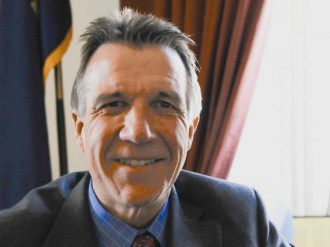
Lt. Gov. Scott has made public statements recently that he’s giving serious consideration to a gubernatorial bid, but the lack of an incumbent will have “no bearing” on his decision whether to run, Scott said in an interview Monday.
The only thing that’s changed is the frequency and urgency of text messages and calls from supporters urging him to throw his name in the hat, Scott said, adding that his phone was blowing up Monday. But Scott said he still has no timeframe for announcing his intentions, and while his supporters are “well meaning,” he doesn’t feel any urgency.
“Certainly in the last three hours the knee-jerk reaction from many is that this just opens the door up and I have no choice but to run, but that’s just not the case,” Scott said, adding that he needs to keep his family and his business in mind as he works toward a decision.
Scott said he’s aware of critics who describe him as a reluctant candidate.
“I’ve heard the same thing about me and stock car racing, too, but obviously I’ve been pretty successful doing that,” he said, acknowledging that being governor would likely spell the end of his racing career.
Davis says Scott, as a Republican, faces an additional hurdle: He would need to persuade Democrats who will likely cast votes for Hillary Clinton in November 2016 to vote a split ticket, just as they did in 2004 when Jim Douglas carried a third of the Democratic voters who cast ballots for Democratic presidential candidate John Kerry.
Looking at the potential field, Scott said the plans of Smith, other Democrats or potential primary challengers from his party would have no impact on his decision.
“No other candidate would affect my decision one way or the other,” he said. “If I decided to run I would think I could beat them, because I don’t get into races I don’t think I can win.”
Scott said that if he runs he will be mindful not to promise miracles.

“I’m a fairly steady person, but when I set my mind to doing something I obviously try to succeed,” he said. “I certainly wouldn’t promise more than I can deliver. [Shumlin] promised a lot, and hasn’t delivered on some. That’s something I would try desperately not to do.”
Milne, the Republican businessman who pressed the Legislature in January to elect him over Shumlin, said he would be back on the campaign trail in 2016, as a candidate or a campaigner, and said he is considering another run for governor.
Milne said he announced his candidacy too late in 2014 and would announce earlier if he does run in 2016. “We’ll see what happens,” Milne said. He added that he has “a lot of respect” for Smith and Scott.
“I think if you look at the November election, of the folks that voted, more than half of the folks who voted, voted for change,” Milne said. “The majority of people who want change is much stronger than it was in November.”
“Peter Shumlin’s done a lot of great things in his life,” Milne said. He said that the way Shumlin managed state government is “clearly something that should not be on his resume.”
Pollina, P/D-Washington, said that with Shumlin’s departure he sees room in the Democratic field for a “strong Progressive candidate.”
He has not decided whether he will volunteer to fill that role yet.

“I’ve been hearing from people,” Pollina said. “It’s definitely something that I’m interested in.”
However, he added, “I would say that I’m not desperate to jump into a race anytime soon.”
Pollina said he believes that Vermonters will be looking for a change in the next governor.
“Part of what Vermonters are going to look for I would guess in this next election would be a way to restore trust in the executive branch and make sure that they’re not just getting a lot of promises,” Pollina said.
Calls to Brock and Lisman were not immediately returned.
Editor’s note: Erin Mansfield, Morgan True and Elizabeth Hewitt contributed to this report.
