


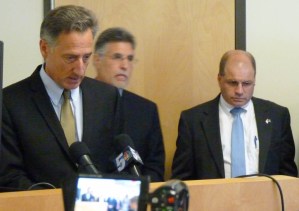
WINOOSKI — Gov. Peter Shumlin stood flanked by Vermont Health Connect officials Monday in the same conference room where eight months earlier he announced the exchange was going offline, but this time he had good news.
VHC successfully deployed new technology over the weekend that is expected to improve customer service and general operations, Shumlin said, thereby meeting a deadline he set in March.
Shumlin applauded the state workers and contractor, Optum. He said he remains “cautiously optimistic” that his administration will deliver a functioning and sustainable exchange before the year is out.
To those calling for Vermont to transition to some version of the federal exchange, Shumlin had a message: “There is no better solution for Vermont than to have our website work. Full stop.
“If there were the ability to partner with other states, we would have done that already,” he said.
The governor said he has “real concerns” that the U.S. Supreme Court will rule against the Obama administration in King v. Burwell, preventing the federal exchange from offering subsidies to millions of people nationwide. A ruling is expected this month.
Such an outcome could leave other states scrambling to cobble together exchanges, making Vermont’s decision, however difficult, look prescient, Shumlin said — especially as VHC functionality improves.
Despite the high cost of developing the exchange, which is expected to reach $200 million, Vermont has done well to leverage federal money to improve its Medicaid program in the process, the governor said.
Making changes more quickly and accurately
VHC now has a functioning tool for making automated changes to customer information, Shumlin said, adding that “as we get it up and running” the outcome will be a “much smoother system that’s been evading us since we launched.”
Subscribers still need to call or fill out an online form, but the changes they seek are expected to be effectuated more quickly and accurately, officials said, though it will take time to train staff and process a massive backlog of existing requests.
Previously, when a customer reported a change of circumstance — a new dependent, new address or new income — there was a “cumbersome and complex” manual process to have that change reflected in their coverage, said Cass Gekas, VHC operations director.
Entering a change in the VHC system used to involve eight to 10 staff and could take up to two hours; then a specialized team of 15 to 20 would need to ensure the change was reflected in myriad other systems of record — including a third-party payment processor and the insurance carriers, she said.
That process took months, and it’s the reason VHC has had a backlog of such requests since going live.
It’s also the primary reason some customers were forced to “delay obtaining needed care” or make out-of-pocket payments for medical services — despite paying thousands in premiums — and others have paid incorrect premium amounts, sometimes for months on end, according to a recent state auditor’s report.
Inputting changes that previously took two hours (the first step in the process described above) was happening in as little as 10 minutes during testing, Gekas said.
The state completed “a handful” of test transactions over the weekend using the new automated tool, officials said. At the Monday news conference, Don George, the CEO of Blue Cross Blue Shield of Vermont, could confirm that the company had received the information, but could not say whether it had been transmitted accurately.
Blue Cross is one of two insurers participating in the exchange, and has roughly 90 percent of the individual market. The other insurer is MVP Health Care.
Over the next “several weeks,” VHC will train its staff to use the automated function for increasingly complex cases with the intention that they will eventually be processed as received and will be reflected in the next billing cycle, officials said.
It will, however, take two to three months for the state to work down the existing backlog of more than 10,000 change requests. That means customers who may have dealt with the most frustration to this point are likely to be among the last to see relief.
People with pending changes who must file new ones should expect a similar timeframe to others in the backlog queue, officials said.
The state will wait until October to allow customers to input their own changes online, said Lawrence Miller, chief of Health Care Reform, but that is the ultimate goal.
“The last thing we want to do after frustrating people for this much time is screw their case up in a new way,” Miller said of the cautious rollout of the new technology.
October is the state’s second self-imposed deadline for an automated renewal process. That process is pivotal to a sustainably functioning exchange.
Programmers and the technical team that has forgone weekends and holidays to deliver the automated change function have already begun working on that next step, Miller said.
Payments still in limbo
VHC has not changed the practice of holding partial payments with its third-party processor, a business process Miller said he identified as problematic close to a year ago.
When premium payments are even just a few cents off, they’re held until the balance is paid in full. That’s left millions of dollars in a VHC account with Nebraska-based payment processor Benaissance.
Most of that money is owed to Blue Cross. A VHC official said Monday that it only has between $1 million and $1.5 million in premium payments that haven’t been remitted. He later clarified that was only outstanding payments from 2014. What’s owed for 2015 is still being calculated, he said.
“I wouldn’t say that number is agreed to, but that is only 2014,” Blue Cross CEO George said. While the two sides may be close to reconciling 2014 payments, documents provided to VTDigger in March show Blue Cross has $9 million and counting in unreconciled 2015 payments.
Miller said the state will eventually need to address the problem created when VHC collects people’s money, but the carriers are left with the legal and fiduciary responsibility to recoup outstanding balances.
For its part, George said Blue Cross intends to hold VHC — not their customers — accountable for any payments that are outstanding once the reconciliation process is complete.
A favorable deal from the Affordable Care Act?
The governor argues that Vermont got more mileage out of the Affordable Care Act than most states by using the exchange to support its Medicaid program.
The state was able to leverage what’s expected to be $200 million in federal funds to build an exchange and improve the delivery of Medicaid services, he said.
The costs associated with VHC have been unfairly maligned by the media and others, Shumlin said, adding that Vermont’s exchange has comparable operating costs to Rhode Island’s and is “significantly” cheaper than Connecticut’s — two nearby states that built their own exchanges as well.
That comparison doesn’t account for the substantially larger market in Connecticut or the fact that both states have built and operate small business exchanges. Vermont is still relying on its insurers to offer those services, and will do so for at least another year, officials said.
Vermont also decided to embed the state exchange within its Medicaid agency, while Rhode Island and Connecticut created quasi-governmental entities. That makes comparing Vermont’s exchange with the two other states extremely difficult.
“They’re clearly not apples to apples,” Miller acknowledged, however, he and the governor pointed out that VHC is costing less to operate than the state projected in 2013.
The governor’s budget for Vermont Health Connect was revised down from $52 million in October to $48 million after new projections based on enrollment as of April. That’s the figure that lawmakers and others responded to with concern during this year’s budgeting process.
Because the exchange is part of Medicaid, it’s eligible for a federal match, bringing the anticipated state costs to $25 million. That’s less than the $29 million projected by the state in 2013 (the confusion resulted because VHC didn’t originally report to lawmakers the combined state and federal cost).
The portion of the exchange that supports the commercial plans is only $6 million and is not eligible for federal match. Those costs are expected to equalize at $5 million going forward in the state’s “sustainability budget.”
That compares favorably with the “sustainability budget” for Rhode Island ($11 million) and Connecticut ($26 million), according to numbers from the Joint Fiscal Office.
Whether Vermont has gained any efficiencies in its Medicaid program (Vermont still has another $100 million planned for Medicaid technology upgrades), or what comparable costs are in Rhode Island or Connecticut, is unclear from figures provided by the state.
What is clear is that the feds are picking up a bigger part of the VHC tab, on an ongoing basis, than anticipated. That’s because fewer people bought insurance and more qualified for Medicaid than the state projected. Post-ACA, nearly a third of Vermonters are on Medicaid.
The state has thrown up its hands when it comes to calculating how much of the $200 million it received from the feds paid for missteps along the way.
“Have you looked at the accounting system at the Agency of Human Services?” Miller asked, when a reporter inquired if those costs could be calculated.
“I think the short answer is no,” he said.
