

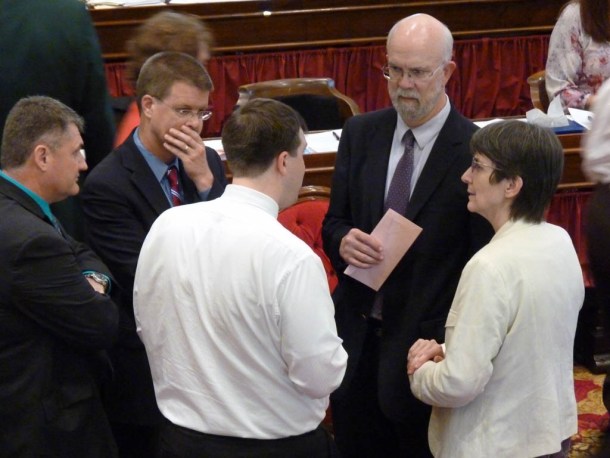
[H]ouse lawmakers voted Tuesday to eliminate a philosophical exemption that gives parents the right to opt out of immunizations required by schools.
There are 3,479 children in Vermont covered by philosophical exemptions, which represents 3.8 percent of all students in the state, according to the most recent Department of Health figures.
Debate, which was civil but lasted for several hours, revolved around parents’ right to choose what’s best for their children versus the impact of declining vaccination rates on public health and risks to immunocompromised children.
Vermont lags behind the rest of the U.S. and New England when it comes to vaccinations — with the exception of Maine in the case of some vaccines — according to the most recent figures from the Vermont Department of Health.
Those who wished to keep the philosophical exemption raised concerns about a small minority of people who have serious adverse responses to vaccinations, and the lack of scientific understanding for why this happens, as well as the economic conflicts of interest that pervade the federal regulatory process for approving vaccines.
Though immunization rates are still relatively high in the aggregate, Health Department data show there are some individual schools with rates as low as 60 percent. These are mostly schools with low enrollment, but medical experts who spoke in favor of eliminating the philosophical exemption said those schools would be at greater risk should an outbreak occur.
Vermont requires five vaccines for school entry: diphtheria, tetanus and pertussis; polio; hepatitis B; chickenpox; and measles, mumps and rubella (MMR).
Parental rights are important, but they “are not unlimited,” said Rep. Paul Poirier, I-Barre, a member of the House Health Care Committee. In the case of school entry vaccines, parental rights are “trumped” by broader societal interests, he said.
Poirier offered an amendment on behalf of his committee that removed the philosophical exemption, which the House adopted 85-57 on a decidedly nonpartisan vote.
 The House version of the bill would also make vaccination rates for each school available to parents at the start of the academic year and calls for additional reporting on the impact of removing the exemption. It does not remove the religious and medical exemptions to the vaccines required for school entry, although it does make minor changes to the process of maintaining a medical exemption.
The philosophical exemption is eliminated in July 2016 in the House-passed legislation to give parents time to adjust and make plans.
The Senate must concur with the changes for the bill to reach the governor’s desk. If they don’t accept the changes, it is likely to go to a conference committee.
Gov. Peter Shumlin indicated he would sign the bill in comments made last week following a forceful endorsement by the health commissioner for the removal of the exemption.
Two years ago, efforts to repeal the philosophical exemption stalled in the House. The issue resurfaced this winter following a measles outbreak that spread to 19 states and infected more than 150 people, raising concerns about declining immunization rates nationally and in Vermont.
This year the medical community called for the removal of the exemption, Poirier said. Medical groups helped to organize a recent Statehouse press conference, and made sure they were well represented at a public hearing Monday, which drew several hundred people to the Statehouse.
Poirier noted, “Almost unanimously the medical community is saying the same thing: ‘Let’s do away with the philosophical exemption.’”
A coalition of parents and some medical professionals who are opposed to removing the exemption maintained a strong presence throughout the process, and flew vaccine choice advocate Robert Kennedy Jr. to testify on their behalf.
Parents of children covered by philosophical exemptions have raised concerns that eliminating the exemption would force them to take their kids out of school or move out of Vermont.
Rep. Anne Donahue, R-Northfield, offered an amendment to eliminate both the philosophical and religious exemption, and create an “alternative health care practices” exemption, with steeper hurdles including a sworn affidavit and in-person consultation with a physician.
Her proposal would weed out parents who are not acting on a deeply held conviction, pointing to testimony from Health Department officials who said barriers to exemptions are effective in increasing immunization rates, Donahue said.
Several representatives called Donahue’s proposal a “compromise” and Donahue herself, who voted in 2012 to repeal the philosophical exemption, called her proposal Tuesday “a better way” to accomplish the same goals, while respecting parental rights. But critics of the proposal said it wouldn’t do enough to increase Vermont’s vaccination rates.
The proposal failed 71-73.
The Senate tacked its amendment repealing the exemption to a House bill, H.98, which makes technical corrections to the statutes governing communicable disease registries — including the vaccine registry.
Those underlying provisions were carried forward in the House version as well.

