


As the House bears down on a potential vote to remove the philosophical exemption for the immunizations required to enter school, new voices entered the polarizing debate Tuesday.
The Senate passed legislation repealing Vermont’s philosophical exemption after a measles outbreak that spread to 19 states and infected more than 150 people. The outbreak raised concerns over declining immunization rates nationally and in Vermont. Senators passed a similar bill in 2012, but the effort died in the House.
A group of mothers organized by the American Academy of Pediatrics Vermont Chapter called on House lawmakers to join their Senate colleagues, while Robert Kennedy Jr., an environmental lawyer and activist, urged them to keep the exemption in place.
The Senate-passed bill would not remove the religious and medical exemptions to the vaccines required for school entry. The required vaccines are diphtheria, tetanus and pertussis; polio; hepatitis B; chickenpox; and measles, mumps and rubella (MMR).
The House Health Care Committee is scheduled to take testimony on the issue through Thursday. House Speaker Shap Smith, D-Morristown, said he will bring the legislation up for a vote if the committee is able to make a recommendation before adjournment, which is expected to be May 16. It’s unlikely to get a vote before next week, Smith said.
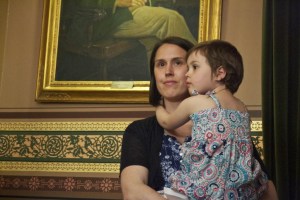
Mia Hockett, a physician and mother of two from Burlington, says her daughter’s immune system has been compromised as a result of childhood leukemia. Hockett and several other mothers and grandmothers said they were at the Statehouse to speak up for a “silent majority” of Vermonters who want the philosophical exemption eliminated.
“We’re moms; we’re the Vermont moms. We’re the ones who vote here; we’re the ones who represent the silent majority, the 73 percent of Vermonters who want to remove the [philosophical] exemption,” Hockett said. The 73 percent figure comes from a February poll commissioned by the pro-vaccine advocacy group Every Child By Two.
Hockett said her daughter Merin is now well enough to enter school, but the family’s excitement about Merin’s return to school was “marred” by the realization that her options would be limited due to Burlington’s low vaccination rates.
Vermont lags behind the rest of the U.S. and New England when it comes to vaccinations — with the exception of Maine in the case of some vaccines — according to the most recent figures from the Vermont Department of Health.
“I’m OK making some choices and some sacrifices … but I want to stand up for Merin because I think she has a right to go to school,” Hockett said, adding that there are other immuno-compromised children endangered by the state’s low vaccination rates, and ultimately those rates put the public at risk.
Though immunization rates are still relatively high in the aggregate, state data show there are some individual schools with rates as low as 60 percent. These are mostly schools with low enrollment, but medical experts have said those schools would be at greater risk were an outbreak to occur.
Hockett said she hopes if the philosophical exemption is removed, there will be parents who “have to step back, stop reading the blogs” and after talking to their doctor, find they are comfortable vaccinating their children.
There are 3,479 children in Vermont covered by philosophical exemptions, which represents 3.8 percent of all students in the state, according to the Department of Health figures.
Those same figures show the number of parents claiming a religious or philosophical exemption increased from 5.4 percent in 2012 to 6.1 percent last year, and the majority were philosophical. For the MMR vaccine, more than 90 percent of exemptions claimed by parents were philosophical.
Kennedy testified that he, too, strongly supports childhood immunizations — noting that all six of his children were vaccinated — but before parental choice is limited, steps must be taken to ensure vaccines are safe.
Kennedy says systemic corruption driven by the trillion dollar pharmaceutical industry has undermined the safety of vaccines in the United States.
Kennedy spoke before close to 100 people crowded into a hearing room. Many applauded after he spoke. He makes regular public appearances to speak about his activism, and said he’s visited two other states in recent weeks to speak out against the elimination of philosophical exemptions.
There are 19 other states that allow parents to opt out of required school vaccines through a “philosophical exemption.” A concerted effort is being made to walk back those laws, which is being “heavily orchestrated” by pharmaceutical companies, he said.
All the barriers that would protect a child in Vermont from a “rapacious industry” have been leveled by that corruption, Kennedy said. The CDC, which is tasked with approving and monitoring vaccines, is like a “sock puppet” for the vaccine makers and a “classic captive agency,” Kennedy said.
Congress has prevented lawsuits against vaccine manufacturers in state and federal courts, and the national press is “compromised” by its reliance on advertising revenues from the pharmaceutical industry, he said.
“The only thing left that protects that child from that company, the only barrier standing is the parent,” Kennedy said.
Kennedy said there are vaccines, including the hepatitis B and diphtheria, tetanus and pertussis, that contain trace amounts of mercury and can cause neurological disorders including autism. Kennedy recently apologized for comparing the neurological damage he attributes to vaccines to a “holocaust.”
The Vermont Coalition for Vaccine Choice opposes removing the philosophical exemption and paid for Kennedy’s flight to Vermont.
Medical experts that testified on the group’s behalf did not raise a connection between vaccines and autism in earlier testimony before the Senate, instead focusing on a lack of scientific understanding for why a small minority of people have “serious adverse” responses to vaccinations.
Thomas McLeod, the group’s policy director, said he believes the potential of a “link” between vaccines and autism merits more research, but that was not the purpose of asking Kennedy to testify. His presence was meant to highlight the level of corruption and lack of transparency that is “sufficient to raise safety concerns.”
Testimony on the philosophical exemption will continue at 9 a.m. Wednesday.

