

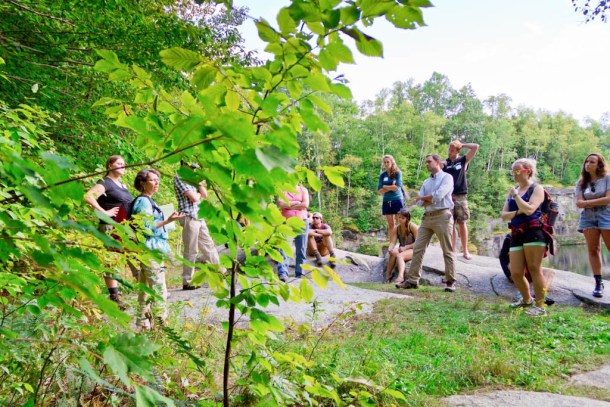
Starting with this fall’s freshman class, all University of Vermont undergraduates must satisfy a new requirement to complete their degrees — sustainability.
Sustainable approaches and practices will be built into the university’s curriculum across departments, as well as woven into co-curricular activities, so there will be several ways for students to fulfill the new requirement.
The UVM Board of Trustees recently approved adding sustainability as a new general education requirement for students starting in September, for the Class of 2019.
The university has a long history of integrating sustainability into coursework and student life, including student Eco-Reps, who work to educate their fellow classmates about sustainability.
The Eco-Reps work around the philosophy that simple lifestyle changes can improve human impact on the environment.
UVM has an Office of Sustainability, and has been working on the idea of making sustainability a general education requirement for several years, officials said.
The idea for the new requirement around sustainability originally came from the Student Government Association.
The UVM Office of Sustainability’s Web page states, “Sustainability is a big idea, like Love, or Justice, that looks different to different people and from different vantage points.”
“In the United States, the term ‘sustainability’ has recently become a label in product labeling that vies with ‘natural’ and ‘healthy’ in its potential to create ambiguity and greenwashing,” the UVM Office of Sustainability’s explanation of the term states.
Before the proposal was brought to the UVM Board of Trustees this spring, it was approved by the Faculty Senate.
Samuel F. Ghazey, a former senator in the Student Government Association and a junior who studies natural resource economics at UVM, said the new generation of college graduates needs to be literate in what sustainability means and how it can be integrated into every level of society.
Ghazey said the new sustainability requirement takes a “transdisciplinary approach,” and sustainability will be a thread that runs through departments and course offerings, as well as co-curricular opportunities.
“It will serve to educate undergrads on the complex nature of sustainability and will have them look at how the aspects of a ‘sustainable system’ all interrelate with each other,” Ghazey said.
Other general education requirements at UVM include diversity, information literacy and writing, said Laura Hill, a lecturer in the university’s plant biology department who served on the committee that led to the new requirement.
“There had been a lot of student backing for sustainability,” said Hill of the process.
Deane Wang, an associate professor of natural resources at UVM who also served on the committee, said there will be many pathways for students to fulfill the requirement.
“The requirement is that all UVM undergraduates, before they can graduate, need to know something about sustainability,” Wang said last week. “To demonstrate that they do, the university has devised a set of learning outcomes that can be achieved through participating in an approved activity: 1) taking a sustainability class, 2) enrolling in specific majors, minors, and concentrations that emphasize sustainability, or 3) through participating in a co-curricular activity that emphasizes sustainability. Any one of the three suffices to meet the requirement.”
Other colleges and universities are adding sustainability requirements for graduates, Hill said, but “I’d say UVM is definitely one of the first, at least in our region, to do this.”

