



[T]he Shumlin administration released a report on forest fragmentation Wednesday that highlighted Vermont’s shrinking woodlands.
Forests cover 75 percent of the state, a broad area compared to historical clearings that made way for agriculture in the 19th century. But now, Vermont’s forestland is declining. Since 2007, the state has lost about 75,000 acres of forest, or about 1.6 percent, according to the U.S. Forest Service.

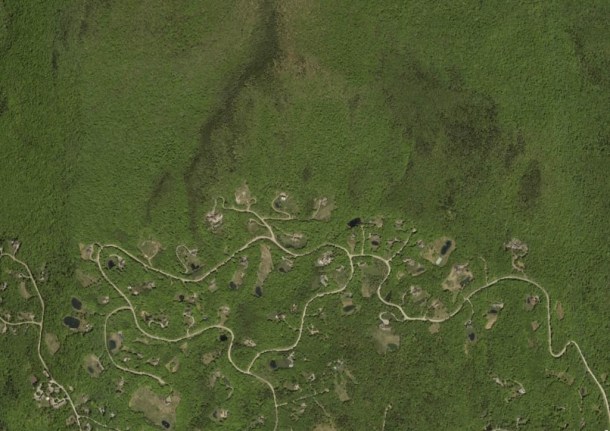
Housing development and rural sprawl is dividing Vermont’s forests into smaller blocks, state officials say. This fragmentation has consequences for the state’s economy and environment, according to Michael Snyder, commissioner of the Department of Forests, Parks and Recreation.
“That is no longer a forest. It cannot function as a forest,” he said pointing to a wooded subdivision in Essex during his presentation to lawmakers Thursday. “We need to decide whether we’re good with that.”
Growing residential development — and the roads, driveways and utilities that come with the homes — continue to carve Vermont’s forests into smaller blocks. Between 2003 and 2009, the amount of land in parcels of 50 acres or more decreased by 4 percent, or about 34,000 acres, according to a report by the Vermont Natural Resources Council.
“We’re losing our larger blocks of forestland,” said Jamey Fidel, forest and wildlife program director for the VNRC.
Eighty percent of Vermont’s forests are privately owned, the report states. Meanwhile, the number of landowners is increasing, the size of the parcels is decreasing and the age of owners is increasing. The cost to own land is a significant factor in whether forests are preserved by landowners, the report states.
The cost to own an acre of forest increased 73 percent between 2003 to 2009, according to the VNRC. Fidel said this puts pressure on landowners to sell their land for development.
“As the value of forestland goes up, so do the taxes associated with that land,” he said. “There is always going to be an increased pressure on the landowners to subdivide.”
Forest Benefits
Snyder said forests benefit the state’s economy and environment, especially larger blocks of forests.
The forest products industry generates $1.5 billion in revenue and employs 10,555 people, according to the North East State Foresters Association. Tourism and recreation also create spending and jobs. These jobs rely on large, healthy forests, according to the report.
Forests also provide valuable ecosystem services, Snyder said. Forests protect against floods, reduce sediment and pollution runoff and sequester about 8 million metric tons of carbon dioxide-equivalent greenhouse gases annually — about equal to the state’s total emissions.
According to the University of Vermont’s Gund Institute, every acre of forest provides about $318 in benefits.
“These are services that we are not paying for, but we would have to pay for otherwise,” Snyder said.
Large forests also provide habitat for wildlife ranging from songbirds like the hermit thrush, which is Vermont’s state bird, to black bear. Fragmentation causes changes to animal behavior and increases the likelihood of animal collisions with cars, the report states.
Policy proposals
The report makes several policy recommendations to improve forest integrity. Options range from education and outreach, incentives for landowners to keep their forestland and adding criteria to Act 250.
Snyder said forests should be considered in the Act 250 permit process. The report highlights several ways Act 250 could be changed to protect forest blocks.
“We consider values when we make land use decisions. But we do not consider the value of forest anywhere in this land value scheme,” he said. “We think it is time to do that.”
The report comes one year after lawmakers abandoned a proposal to change Act 250 to address forest fragmentation. Lawmakers instead passed a law, Act 118, requiring the Department of Forests, Parks and Recreation to study forest fragmentation.
Less than 5 percent of subdivisions trigger review through Act 250, according to the report.
The report also outlines several new incentives under Vermont’s current use program, which provides tax breaks to property owners who keep their land in forestry rather than develop it. The report says the program could offer additional tax breaks if the land provides ecological services, clean water value or flood resilience functions.
Fidel, of VNRC, said there are ways to continue development without harming forests. This includes making it more attractive to live in growth centers like downtowns and cities, and for people who choose to live in the forest, he said there are ways to avoid building in the core area of the forest.
“This isn’t about stopping development in forests,” Fidel said. “It’s about how can we be smarter about it.”
