

[S]tate and federal officials are investigating whether an Enosburg farmer sold out-of-state pigs to a Vermont purveyor.
From 2011 to 2015, Greg Finch sold Vermont-born, pasture-raised pigs from his farm in Enosburg to 5 Knives, the company that supplies Vermont Smoke and Cure.
On Feb. 10, however, USDA slaughterhouse inspectors noticed unfamiliar tattoos on a batch of Finch’s pigs, triggering a review of his paperwork, a voluntary market withdrawal by Vermont Smoke and Cure, a series of state and federal investigations into Finch’s farm, and a since-lifted quarantine on his pigs.
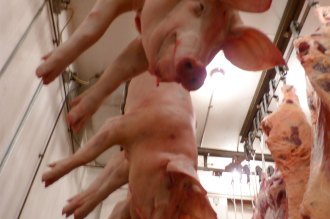
Greg Finch transported pigs every week from his farm to Vermont Livestock Slaughter and Processing in Ferrisburgh, where his animals were killed, chilled and cut. Black River Meats, Finch’s distributor, picked up the pork and transported it to Vermont Smoke and Cure in Hinesburg. Vermont Smoke and Cure would then transform the product into the specialty, born-in-Vermont pork products distributed to grocery shelves and restaurants in New England and New York.
The tattoos in question, which included the letters “NH,” led to a closer look by USDA officials at Finch’s paperwork. The tattoos were traced to a recent livestock auction in New Holland, Pennsylvania.
Finch did not respond to repeated interview requests from VTDigger.
Black River president Sean Buchanan and Vermont Smoke and Cure CEO Chris Bailey say they found a discrepancy in their protocols for Finch’s pigs and could no longer be certain of the claims made in 5 Knives labeling and marketing material. They executed a swift and voluntary market withdrawal, pulling all 5 Knives products from shelves and restaurants, they said.
Vermont Smoke and Cure has long sourced from outside of Vermont for most of their meat products, despite the state’s name being prominently displayed on their labeling. All Vermont Smoke and Cure products are processed, smoked and cured in the state, however, so the label complies with consumer protection rules regarding where a product undergoes its significant transformation. The 5 Knives subdivision, however, claimed Vermont born-and-raised status and was therefore subject to increased scrutiny.
Carl Cushing, the owner of Vermont Livestock Slaughter and Processing said the consumer was paying a premium price, Vermont Smoke and Cure was paying a premium price, and “there was an expectation that these pigs would be born and raised in Vermont.”
“You basically have a situation,” Cushing said, “where it looks like somebody profited on a particular product based on a misrepresentation.”
The original agreement for the 5 Knives line hinges on the requirement that Finch’s pigs be born in Vermont without the use of farrow crates and that they be raised on Vermont pasture when seasonally appropriate. They were to be fed non-GMO grain, and were to be free of antibiotics and hormones. Finch sold his pigs to Black River, who then sold them to Vermont Smoke and Cure, who in turn sold the final product to customers, retail partners and restaurants. Each transaction featured a cost of sale well above the USDA average for conventional pork.
Cushing, a former meat inspector for the state, says that Finch’s weekly drop-off of pigs to his slaughterhouse grew from three or four at the beginning of the program to about 25 at the time of the incident. His staff first noticed tattoos on Finch’s pigs a few months ago, and he says he questioned Finch about them immediately. Finch explained that the tattoos were for his own internal use to keep track of lineage and prevent inbreeding, and he later said they were connected to agricultural research done in partnership with Cornell and Tufts universities. Satisfied with this response, Cushing didn’t pursue the issue further or notify the USDA.
Dr. Kristen Haas, state veterinarian and director of food safety and consumer protection for the Vermont Agency of Agriculture, says any pigs brought into Vermont from out of state that don’t go directly to slaughter must undergo a veterinary exam, as well as receive an issuance of veterinary inspection and a state import permit.
Although Haas could not comment on the details of the state investigation, she explained that she issued the quarantine because the health status of the tattooed pigs was unknown at the time. After checking to make sure the animals had not been exposed to contagious diseases, the quarantine was lifted. “That doesn’t mean,” Haas added, “that our investigation and process is done. It does mean that we are now confident in the health status of those animals.”
Haas also explained that the investigations typically involve the USDA branch of Animal and Plant Health Inspection Services (APHIS) and can last between 60 days and 90 days. The investigations look to establish a timeline of the activities in question and determine how egregious any violations might have been, drawing a distinction between a one-time mistake and a pattern of bad behavior. Potential enforcement ranges from a letter of warning to a notice of violation and a monetary penalty to the farmer, which is subject to appeal.
While Haas and the Vermont Agency of Agriculture are examining the animal health and consumer protection side of the issue, the USDA Food Safety and Inspection Service (FSIS) is responsible for investigating potentially deceptive labeling issues on a federal level.
Representatives from the congressional affairs department of USDA could only confirm that an investigation was taking place, explaining that any claims of animal husbandry, geographic origin, or lack of growth hormones and antibiotics necessitate a written protocol at the slaughterhouse that lays out exactly where and how the animals were born and raised. When slaughterhouse inspectors suspect a violation of that protocol, the USDA FSIS launches an investigation into misbranding.
Although state and federal officials are examining whether or not Finch deceived consumers and violated regulations, questions regarding who can be considered a deceived consumer and who might be implicit in the deception remain. A closer look at the protocol discrepancy between Vermont Smoke and Cure and Black River Meats reveals that Finch and Black River agreed to loosen the stringent origin requirements of the initial 5 Knives agreement in July.
Documents provided to VTDigger indicate that Finch’s new protocol allowed for the future purchase of pigs from feeder operations out of state as long as the pigs spend either 90 days or half of their lives in Vermont before going to slaughter. The new protocol also mandates that pigs born outside of Vermont be identified to the customer and distributor. Neither Black River nor Finch notified Vermont Smoke and Cure or Vermont Livestock Slaughter and Processing of the change in protocol, however, meaning both Chris Bailey, of Vermont Smoke and Cure, and Carl Cushing were under the assumption that all of Finch’s pigs were born and raised in Vermont by the standards agreed to in the original protocol. Vermont Smoke and Cure continued to market and sell their 5 Knives products with the previous claims, including that the pigs were born and raised in Vermont.
Buchanan said he and others at Black River weren’t aware of the protocol discrepancy until the incident at the slaughterhouse. “It was an oversight,” Buchanan said in an email. “We never thought to touch base and make sure everything was realigned after we changed the protocol last summer.”
Chris Bailey said he couldn’t possibly know whether Black River or Finch intentionally withheld the revised protocol.
Bailey said the particular batch of pork in question would have violated either protocol because it had made it “from barn to slaughter” in just five days. He says he didn’t get the full picture from Black River or from Finch.
“Either way,” Bailey said, “our trust in the program is broken.”
The 5 Knives website is down with a message stating that they have stopped production after “being notified there was a possibility the pork [they] were selling may not match the 5 Knives label and mission.” Bailey says Vermont Smoke and Cure hopes to revisit the program in the future, but will likely have to broaden it to include pigs that meet the same husbandry standards but come from out of state as well as from Vermont.
“There just isn’t any other year-round core hog supplier in Vermont that can meet the volume,” Bailey said, though he said the state’s local pork industry is growing.
Buchanan expressed disappointment as well. “My feeling,” he said, “is that [Finch] was trying to make the volume, he cut some corners and he made a really, really, really careless mistake.” He says Black River will meet with Finch in a few weeks and review what exactly happened to determine whether or not their relationship is salvageable. “It’s not like we don’t have a friendly relationship,” Buchanan said. “It’s not like he hadn’t been a great producer. This is a guy that we’ve built a program around. We’re his livelihood and we have a responsibility to him, but at the same time he has a responsibility to us and to our customers.”
Nina Lesser-Goldsmith, of Healthy Living in Burlington, said her customers have been asking about 5 Knives ever since she pulled it from shelves in February. “It’s a very desirable product,” she said, noting that she thinks most of her customers care more about how the pigs were raised than where they were born. “All I’ve heard from our customers is that they want it back.”
For now, however, only the Vermont Foodbank has access to products from 5 Knives. Black River donated three pallets of pork products last week.
The state and federal agencies examining the incident will release public documents from the official investigation upon completion of the process.
Correction: Nina Lesser-Goldsmith’s name was misspelled in an earlier version of this story.
