

Editor’s note: Jon Margolis is VTDigger’s political columnist.
[W]ere it not so serious, the latest attempts by Vermont officialdom to shrink the impending budget deficit would border on the comical.
The Legislature and the Shumlin administration have not exactly been reduced to standing on a street corner shouting, “Anybody got a way to cut spending? Or increase revenue?”
Without, of course, calling that revenue increase a tax hike, which is what it is.
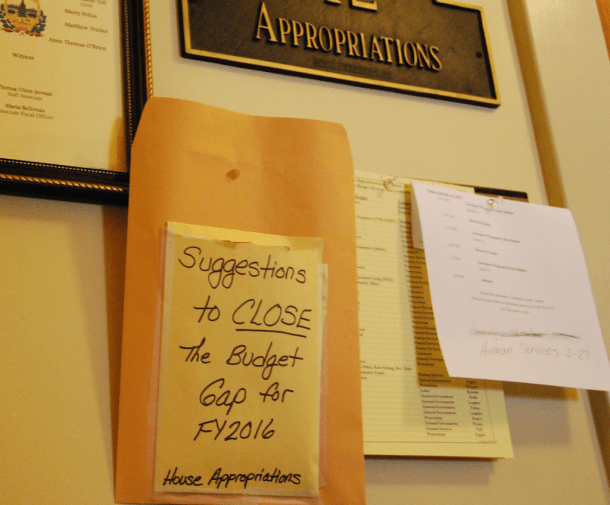
But it sometimes seems that way. There was the day late last month when the House Appropriations Committee heard suggestions ranging from buying less bottled water to having fewer members of the House of Representatives.
One of those proposals would save very little money. The other will not happen.
In fairness to both the lawmakers and administration officials, they are in a real pickle, and one reason they don’t quite know how to get out of it is that they are not sure how they got into it.
The budget gap is actually two gaps, $18.6 million for the rest of this fiscal year ending June 30, and maybe as much as another $90 million for fiscal year 2016, starting the next day.
From one perspective, there’s no mystery here at all. The state is on track to spend 5 percent more each year than it did the previous year, but its tax revenue is growing only about 3 percent a year.
But those tax revenues were supposed to grow faster. “Supposed to” here does not mean they had a moral responsibility to grow faster. It means that the experts – the economists and policy analysts for both the administration and the Legislature – after building their economic models and running the latest numbers through them, expected tax revenues to grow faster.
Were they the wrong models, or wrongly interpreted?
Maybe, and maybe officials allowed their hopes to turn into assumptions about one-time federal grants getting extended or another year of unexpectedly high inheritance tax receipts.
If so, they were not alone. Vermont is hardly the only state facing a budget crunch. So are many — if not most — of the other 49, and none of them can say they weren’t warned.
“State and local governments face long-term fiscal pressures,” concluded a report issued late last year by the U.S. Government Accountability Office. “Absent any policy changes, the sector will face an increasing gap between expenditures and receipts in future years.”
And so they are. In some cases the gap is not as bad as Vermont’s. In other cases it is worse. But one reason Vermont may have more of a problem than many states, experts say, is that it relies more heavily on the state income tax than most states.
Because it’s a progressive tax structure, with higher rates for wealthier earners (eight states tax all incomes at a flat rate; nine have no income tax at all) income taxes have the advantage (at least as most Vermonters probably see it) of being equitable. They have the disadvantage, noted Steve Klein, the Legislature’s chief financial officer, of being “volatile,” meaning when economic growth is slow, income tax revenues lag.
Kavet and others suggested that ever-increasing economic inequality could be a factor in the disappointing income tax revenue count. As is true in almost all states, wealthy Vermont households pay a smaller percentage of their income in state taxes than do lower- and middle-income households.
But this doesn’t entirely solve the mystery because Vermont’s economic growth has been about average in comparison with the other states, and, if anything, its economy is picking up even as the budget gap seems to get worse.
“Growth in consumption taxes looks good,” said Tom Kavet, the Legislature’s consulting economist. “The economy is dynamic. New stuff is happening.”
Kavet and others suggested that ever-increasing economic inequality could be a factor in the disappointing income tax revenue count. As is true in almost all states, wealthy Vermont households pay a smaller percentage of their income in state taxes than do lower- and middle-income households.
A January study by the Institute on Taxation & Economic Policy found that the very wealthiest Vermont households (those earning $391,000 or more), pay 7.7 percent of their income in state taxes (total state taxes, not just income taxes), while those in the middle (earning between $38,000 and $58,000) pay 10.5 percent.
So it’s simple arithmetic. If more of the income flows to those who pay a smaller percentage of their income in taxes, the total tax revenue will be smaller than it would be if they paid a higher percentage, or even the same percentage as other taxpayers.
No one claims that this accounts for all of Vermont’s budget gap. But it could explain part of it.
It isn’t that rich people don’t pay a lot of taxes. Victor Gauto, the chief of research and operations at the Tax Department, said the richest 10 percent of Vermont households pays 59 percent of all income tax revenue. That would appear to lend some credence to the claim that any increase in taxes for the wealthiest would inspire many of them to move away, thereby decreasing the total amount of tax revenue collected.
Gauto said the data do not really support that contention, as the data generally do not support it elsewhere in the country. Yes, wealthy people move out of the state for all sorts of reasons (the state does not ask them why). But at the same time, Gauto said, “We also have new high-income households moving into the state,” despite the relatively high marginal income tax rate.
“We can’t narrow down this movement to tax reasons,” he said. “More likely it’s influenced by other factors. Much of it is probably job-related.”
The budget gap might decline slightly in the next few months. Kavet said that to some extent the budget shortfall was “a first half of the fiscal year issue.” He said he would not be surprised if income tax receipts in February (not yet reported), March, and especially April ended up exceeding expectations.
Still, Gov. Peter Shumlin and the lawmakers are probably going to be forced into some combination of distasteful budget cuts and tax increases to close the gap. Shumlin has said he does not want to close it by imposing new taxes, even on upper-income households.
“Raising revenue this year to meet the budget gap does not solve that problem,” he said.
But he has proposed a tax increase on upper-income households by urging the Legislature to end Vermont’s practice of allowing taxpayers who itemize income to deduct one year’s state income tax payments from the next year’s taxable income. Vermont is one of the few states that allows this deduction, and it largely benefits the more affluent.
Even if the Legislature agrees, though, this move will cut the shortfall by less than $15 million, not enough to close the gap, no matter what caused it.

