

[P]olice could petition to seize the assets of people involved in animal fighting under a bill moving through the Vermont Senate.
S.102 would expand animal cruelty laws to include training or using an animal for fighting, plus allow police departments to seize assets from convicted persons and sell the property to pay for investigating and prosecuting the case.
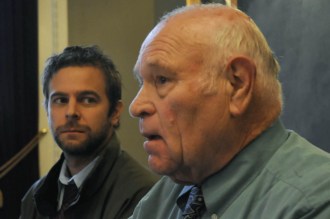
Sponsored by Sen. Dick Sears, D-Bennington, and Sen. Tim Ashe, D/P-Chittenden, the bill would amend an existing law that allows the state to petition the court to seize someone’s property in certain drug cases.
The bill establishes a judicial procedure for taking personal property and real estate and selling the property after 90 days. The law would also allow administrative forfeiture for property worth less than $50,000, meaning police would not need judicial approval to take the property, but the owner could contest the action.
Sixty percent of the proceeds would go to the investigating law enforcement agency; 20 percent would go to the prosecuting attorney’s office; and 20 percent would go to the state for “alternative justice programs.”
Sears, chair of the committee, said at a hearing Tuesday that he is considering adding an amendment to the bill that would create a task force to research animal cruelty cases and recommend best practices to lawmakers and law enforcement.
Sears asked his family’s veterinarian, Dr. Bo Bergman of Bennington, to testify by phone about his experience treating dogs that he suspects were injured while fighting.
Bergman testified that as part of a cruelty to animals charge against Dereck Jensen, 38, of Bennington that involved 20 pit bulls, he treated many of them for “clear fighting wounds,” and between six and 10 were euthanized.
“There was a number of gruesome things, you know, missing toes, missing limbs,” Bergman said. “Certainly, I have a strong concern that this case is representative of the possibility of dog fighting in Vermont.”
Bennington Police Chief Paul Doucette said the case has cost $7,000 for investigations, veterinary treatment and euthanasia.
Doucette said he supports the bill “100 percent” and that the Legislature should “take a serious look” at the bill as a way to help small towns pay to investigate animal cruelty cases.
“This isn’t just about public safety, you know,” Doucette said. “I think we need to consider our four-legged friends. A huge expense has evolved in these types of situations.
“This is a big business,” Doucette said of animal fighting.
Vermont State Police Sgt. Tyler Burgess testified on behalf of Public Safety Commissioner Keith Flynn. Burgess is in favor of creating a task force and using the threat of asset forfeiture to discourage animal fighting in the state.
“This is not a law enforcement issue,” Burgess said. “This is a community issue.”
Joanne Bourbeau, director of the Northeast region of the Humane Society of the United States, also testified in favor of the bill. Bourbeau said that animal fighting is illegal in all states, 15 of them have laws against the possession and transport of paraphernalia for animal fighting, and fewer than 10 have laws allowing asset forfeiture for convicted fight organizers.
“I, in my 20 years in Vermont, have been aware of fighting,” Bourbeau said. “Recently in Brattleboro, someone was approached just walking a pit bull asking about fighting the dog.”
Bourbeau said in an interview that she supports the bill because it would make local law enforcement more likely to investigate cases of animal cruelty.
“It all comes down to the hesitancy of law enforcement agencies to even get involved because of the high cost of investigations,” Bourbeau said.
Allen Gilbert, executive director of the ACLU of Vermont, said incentivizing arrests is bad public policy. Gilbert said states have historically used asset forfeiture in drug investigations, leading police to view drug arrests as a “cash cow.”
In Vermont, Gilbert said the state has sent proceeds from asset forfeiture to the state treasurer since 1985 as a way to discourage making arrests to take and sell property. As written, Gilbert said, sections 3 through 7 of S.102 would revive that trend.
“What’s happened is the police have seen an opening to try to have a law that’s been in place for 30 years changed,” Gilbert said. “Maybe [asset forfeiture] was a good idea at one point. It was a way to cut into the rampant profit of rampant drug trafficking.”
Gilbert said money from asset forfeiture does not have enough oversight.
“Instead, the money flows directly into the department, and they can choose how they can spend it,” Gilbert said.
Sears said he used a law in Minnesota as an example while writing the bill, and he will set up a hearing next week with more witnesses.
CORRECTION, Feb. 26, 2015, 9:20 a.m.: An earlier version of this story had an incorrect figure for states that have laws against animal fighting. All 50 states ban animal fighting and 15 have laws against the possession and transport of paraphernalia for animal fighting, according to Joanne Bourbeau.

