

Tom Slayton of Montpelier is editor emeritus of Vermont Life magazine. In This State is a syndicated weekly column about Vermont’s innovators, people, ideas and places.
[E]xpert birder Larry Clarfeld was walking along his usual path through the Burlington Intervale about three weeks ago when he spotted a small bird that looked out of place.
“This little bird popped out, and at first glance, it looked like a vireo,” Clarfeld said.
That would be unusual because it was November and snowy. Most vireos would have gone south for the winter long before then. So Clarfeld followed the little bird until he could get a good look.
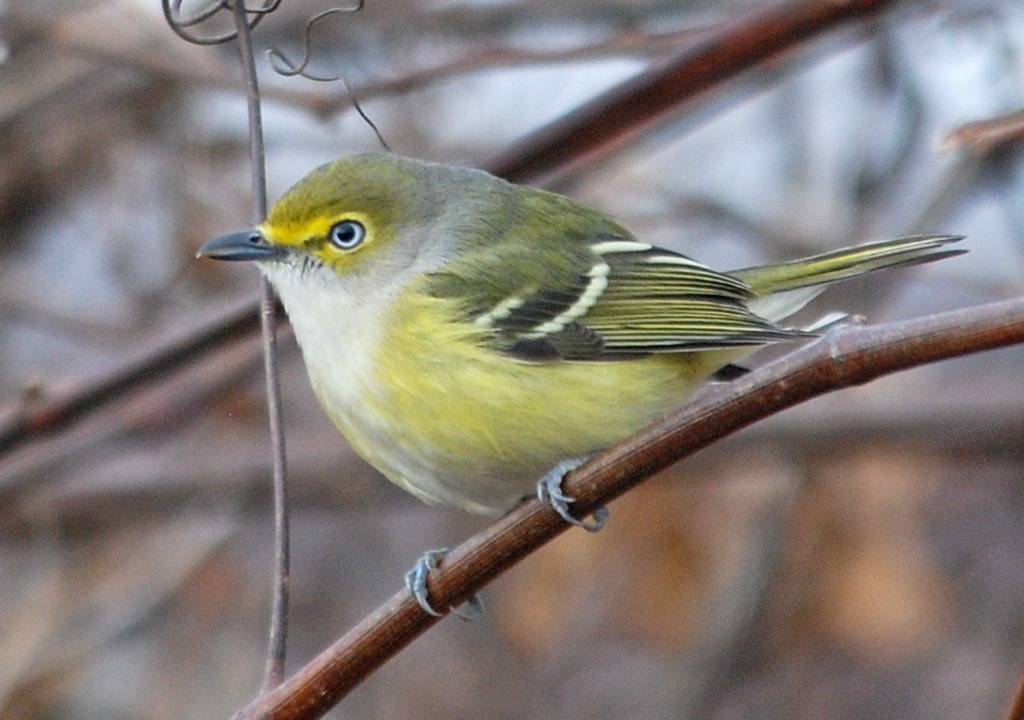
As it foraged in a row of wild raspberry canes, Clarfeld got his binoculars on the little interloper. What he saw stopped him in his tracks: it was a white-eyed vireo, a bird that should have been nowhere near Vermont.
Clarfeld, who is a naturalist and teacher by trade, ran through a mental checklist of field marks, making certain of his identification. He was aware that this was a rare find.
“It had yellow on its face and on its flanks – yellow in all the right places,” he noted.
But it wasn’t until later in the day, when he entered the sighting on Vermont eBird, a website database, that he realized just how unusual his sighting was. Most white-eyed vireos are in the Deep South by November. None had ever been seen in Vermont this late in the year.
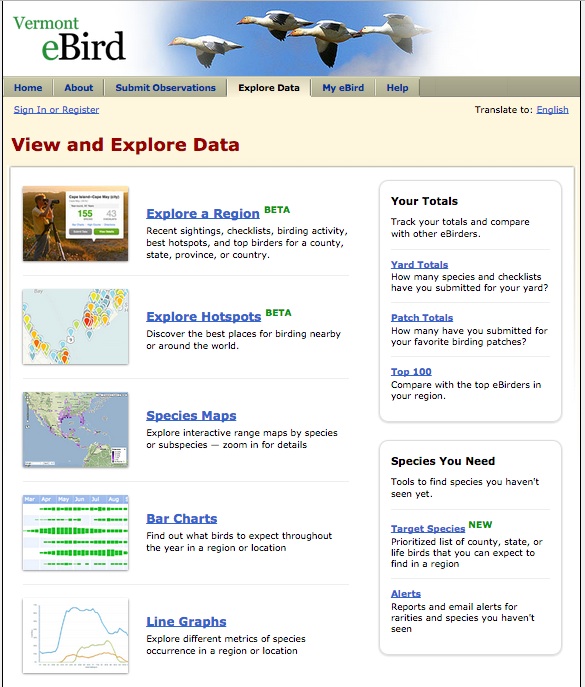
“I was able to pull up all the sightings of this species and filter them. There were only two previous Vermont sightings this late in the year, and they were in October.”
By recording and researching his find on Vermont eBird, Clarfeld had made the leap from observer and appreciator of nature to citizen scientist.
“It’s an incredible tool,” Clarfeld said. “I’ve talked to people who have been observing birds for years, and they’re all excited about it.”
Vermont eBird, the local portal to a website database overseen by the Vermont Center for Ecostudies (VCE) in Norwich, enables birders across Vermont to enter their sightings every day of the year. The center studies a wide variety of animal life in Vermont, ranging from insects to rusty blackbirds and common loons.
And citizen scientists like Larry Clarfeld are an important part of it all.
The center’s website research on birds has turned up several important facts and trends. For example, it has helped show (in conjunction with VCE’s Forest Bird Monitoring Project) that Canada warblers and rusty blackbirds are declining rapidly in Vermont.
In its first 10 years, Vermont eBird has documented more than 380 bird species and tallied nearly 123,000 checklists of birds across Vermont. Thus, it has conducted probably the largest single measure of the state’s biodiversity.
Professional scientists at VCE tease and massage the website’s data to discover what’s happening with bird populations in the Green Mountains and elsewhere. The database is a powerful tool for their research.
The key to its effectiveness is those roaming amateur citizen scientists known as birdwatchers. More than 500 Vermont birdwatchers the length and breadth of the state submit their sightings, keep personal online lists, enter birding contests organized by VCE, and thereby provide much of the data the website receives and manages.
It’s important to note that while it started here, eBird is not simply a Vermont tool. It is now part of a global database, to which Vermont is one web portal. It was conceived of in 2001 by the Cornell University Ornithology Lab. The first portal opened in Vermont in 2003. The website database now has portals in several states and foreign countries. Since its beginning, the Vermont Center for Ecostudies and Vermont birders have played a key role in shaping and developing it.

Conservation biologist Kent McFarland is Mr. Vermont eBird. He founded and oversees the Vermont eBird portal.
“It’s unbelievable, what we can do now,” he said, noting that because birds are such bellwethers of the natural world, ornithological information obtained through the website will help scientists understand the entire ecosystem.
“We can start to understand things in a much deeper way,” he said. “Every sighting is a little piece of the puzzle.”
Vermont eBird makes it easy for any birder to record his or her sightings – time, place and species. Birders can compare their successes with other birders, participate in county-against-county contests, record their life list or other information at the website. And they can explore the data that’s already been recorded.
The information they contribute helps inform ornithological science in Vermont, across the U.S., and abroad. McFarland notes that some 80 scientific papers have been published in the last two years, based on eBird data.
He and the other 10 scientists employed by the Vermont Center for Ecostudies do much more than simply massage electronic data.
The staff is all field biologists and consequently spends much of its time outdoors — chasing rare butterflies on Mount Washington, counting dragonflies in lakes and marshes, researching the life in the thousands of Vernal pools around Vermont, and more. The organization has an annual budget of $1.1 million, which it must raise through donations, grants and contract work with state and other conservation agencies.
Their primary focus is summed up in their motto: “Uniting People and Science for Conservation.” Their aim is to bring citizen scientists into the research equation.
For more than 20 summers, McFarland and Chris Rimmer, the VCE executive director, have climbed Mount Mansfield and traveled to the Dominican Republic to study one of Vermont’s rarest and most elusive birds, Bicknell’s thrush. VCE staffer Judith Scarl oversees the springtime “rusty blackbird blitz” in which teams of birders seek out the rapidly declining blackbirds and identify their most important breeding and migratory sites. Loon biologist Eric Hanson has watched, as loons have increased from a scant seven pairs 30 years ago to 84 nesting pairs in 2014. Staffer Steve Faccio goes out with volunteers every spring to monitor the life in hundreds of vernal pools.
And as part of the VCE Forest Bird Monitoring Program, teams of unpaid volunteers organized by VCE have walked established routes through forests across the state to observe, count and enter their sightings on Vermont eBird.
What all the various projects add up to is a greater understanding of the natural world in Vermont. Citizen scientists — birdwatchers and other volunteers – are an integral part of it all.
And they are already important contributors to what is undoubtedly VCE’s most ambitious project: The Vermont Atlas of Life. Based on the Vermont eBird model, the Vermont Atlas of Life will become a web-based library of knowledge on the biodiversity of the entire state – birds, mammals, insects, plants, snakes, turtles and more.
It’s a huge project, but one that VCE Executive Director Rimmer believes will provide knowledge vital to Vermont’s continued ecological health. It’s important, he says, to bring birdwatchers and other amateur scientists into the mix.
“We have a responsibility to care for these creatures and their habitats,” Rimmer said. “And accurate factual knowledge is one of the best tools we have for doing that.”
