

Change is coming to Vermont’s public education system — whether by design or as a consequence of inaction.
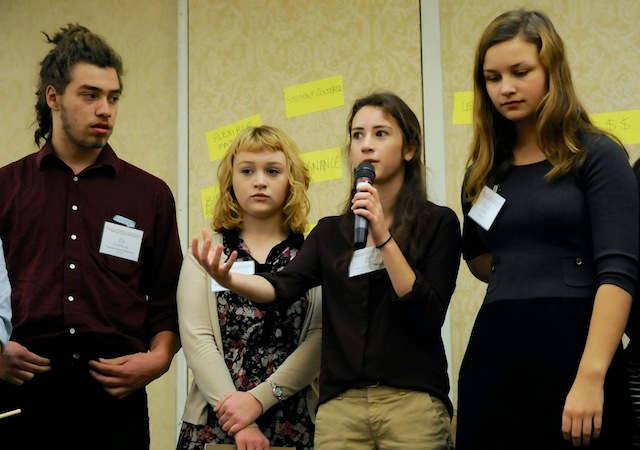
That was the consensus of 200 participants at the close of a two-day summit on education finance and equity. They settled on little else, but most appeared to walk out of the DoubleTree hotel in South Burlington with a deepened understanding of the challenges facing Vermont’s public education system.
The Green Mountain Imperative, an invitation-only symposium hosted by the Vermont Business Roundtable with eight partner organizations, sought common ground among students, parents, teachers, school boards, administrators, nonprofits, businesses and state agencies.
Day 1 generated big ideas for improving Vermont’s public education system, closing the achievement gap between students from rich and poor families, and making the whole system easier to pay for.
Day 2 entailed whittling those ideas down to a handful of actionable goals. The participants didn’t quite get there. But they did hash out a handful of goals, with varying levels of buy-in.

The development of a sustainable financing system for education was a major focus, as was a more streamlined governance structure.
Lawmakers will tackle both issues in the upcoming biennium in the aftermath of contentious election season. A 9-cent hike in the statewide property tax rate drove many disgruntled voters to the polls earlier this month. As a result, Republicans nearly won the governor’s race and the party scored gains in both the House and Senate. Proposals for reforming the education funding formula have been batted around in the House Ways and Means Committee for four years, and the House in 2014 passed a district consolidation bill that was ultimately shot down by the Senate.
At the conference, participants said they wanted to see better accountability for school performance and a shift toward more student-driven learning. Many also wanted more of an emphasis on early childhood education and a realignment of resources to support a continuum of education programs from birth to work. Participants also wanted to see better coordination of education and human services programs for children who are in poverty and who are more likely to underperform academically.
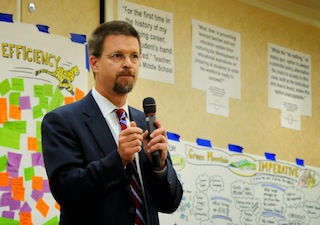
Rep. Shap Smith, D-Morrisville, a co-convener of the summit, was joined by several representatives. No senators attended the event, though VBR president Lisa Ventriss said 10 were invited.
Smith said people want a framework for changing the education system and latitude at the local level. “Different places are going to have different needs and require different resources to get to similar goals,” he said.
Gov. Peter Shumlin has repeatedly said he does not think mandatory consolidation can be successful. Rebecca Holcombe, the secretary of the Agency of Education and a member of the governor’s cabinet, has embarked on a fall road show with the Vermont School Boards Association to encourage struggling districts to find efficiencies.
Holcombe said the state has very low student-to-teacher ratio and one of the highest per-pupil spending levels in the nation, and that investment isn’t paying off in terms of achievement. The challenge to reconciling both quality and cost is Vermont’s Rube Goldberg-like governance system, small local communities, and scarce resources, she said.
The challenge isn’t just a matter of scale, however. Schools are providing more social services for children. As Smith put it: “The education system is becoming an arm of the Agency of Human Services.”
Addressing that problem touches another issue: barriers. Smith says the walls between case workers and educators serving the same families and between school boards within districts in Vermont’s complex governance structure must come down.
“We have to figure out a way to stop pointing fingers and point in the direction we want to go,” Smith said.
Tom Pelham, a former state representative who also headed the finance and tax departments in the Dean and Douglas administrations, said changes to the system are inevitable, regardless of what was or wasn’t decided at the summit.
“Change is going to happen because the force is outside this room,” Pelham said.
Rep. David Sharpe, D-Bristol, ranking member of the House Ways and Means Committee, says public pressure is a driver of legislative action. Better communication with the administration and the Senate will be necessary to bring any proposal “across the finish line.”
The education financing discussion was familiar ground for many at the summit.
These conversations have happened many times before, said Mary Powell, president and CEO of Green Mountain Power. It’s going to take “a lot of courage and a lot of leadership” to finally translate dialogue into action, she said.

