


Editor’s note: Tom Slayton is a Montpelier freelance writer. He is editor emeritus of Vermont Life magazine. In This State is a syndicated weekly column about Vermont’s innovators, people, ideas and places.
A dripping wet Jon Trembley emerged from Journey’s End swimming hole in Johnson and declared, smiling: “We like to go to places like this and entertain ourselves by jumping off cliffs!”
Trembley, a Johnson State College freshman, was not alone. A recent Sunday afternoon was hot and sunny, and it seemed like half of the school’s student body – including the women’s soccer team — was there to swim, jump off the rocks, and revel in the cool, sylvan beauty of the spot.
Fortunately, Journey’s End has been permanently conserved. But elsewhere, swimming holes are becoming scarcer and scarcer.
Although they have long been a treasured part of every Vermonters’ summer, as Vermont becomes less rural and more suburban, swimming holes are closed. More riverbanks get posted, more land gets developed, and more old swimming holes become newly private property — and inaccessible.
The Vermont River Conservancy (VRC), a small organization that specializes in conserving rivers and the land alongside them, has taken note of those losses.
“We’ve noticed that many of these really spectacular places that were used by local people were being purchased or posted,” says Stephan Syz, founding board member and guiding light of the River Conservancy.
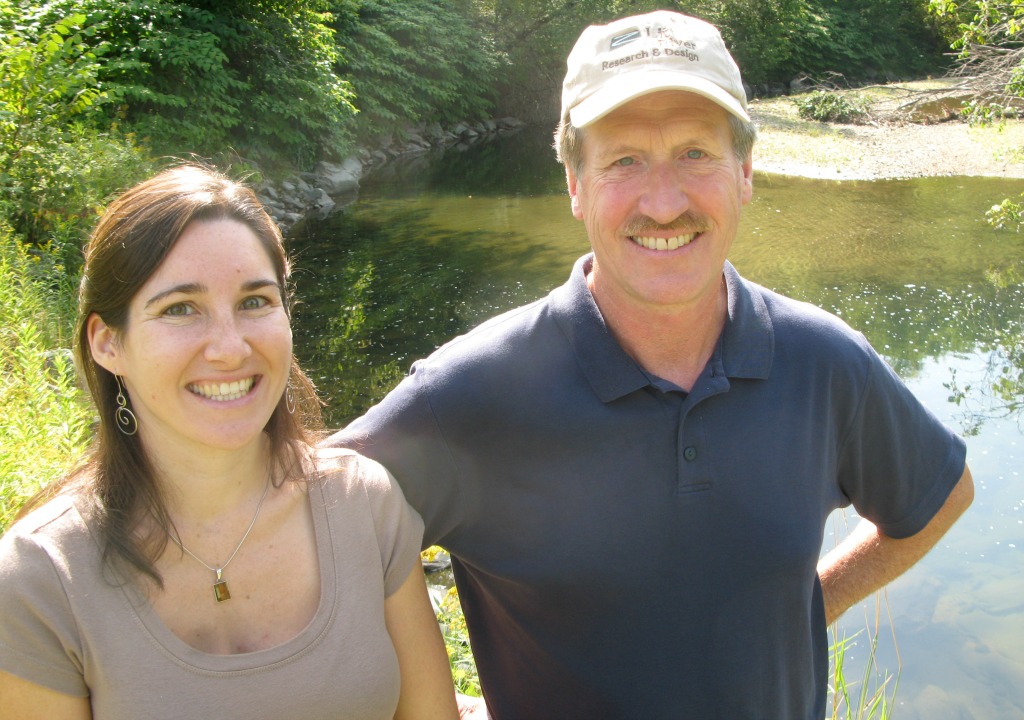
Assistant Director Lydia Menendez adds: “We receive calls frequently stating that a swimming hole that people used to visit has been closed.”
Fortunately, the conservancy has not only noticed the trend but it has a plan, and a bold one, to solve the problem: to conserve for public use a swimming hole in every town in Vermont.
“It could take us 10 years,” says Executive Director Steven Libby, “but every town should have its own swimming hole – it should just be part of that town’s public amenities.”
The campaign is already underway, and the popular Journey’s End Swimming Hole in Johnson recently became one of VRC’s major successes.
It’s a classic example of a place that has been used by residents of Lamoille County and nearby Johnson State College for many years. At the bottom of a deep, forested ravine, Foote Brook, a tributary of the Lamoille River, foams over a triple waterfall and tumbles into a deep rock-lined pool. Its clear, green-tinted water then courses through a channel in the rock ledge and empties out into another, shallower pool with a gravel beach. On a hot day, it’s pure heaven.
Libby notes that that section of the brook is prime trout habitat, and has long been a favorite spot for anglers as well. Cold, fast-moving water retains more oxygen than warm, sluggish water, and the cold waters of Foote Brook provide lots of oxygen-rich water that trout like. In fact, when the weather is warm, trout come up the brook from the Lamoille River far below, in search of the welcoming cold water.
“You can sometimes see large trout swimming around in that big pool below the falls,” Libby noted. “Humans aren’t the only creatures that like cold water.”
However, in 2010, the land surrounding Journey’s End went on the market as a house lot, a fact that raised the possibility of it being posted and closed by a new owner.
“We got the call: ‘This land’s on the market. We could lose Journey’s End!,’ ” Libby said.
The River Conservancy will celebrate saving Journey’s End on Sept. 7, at the swimming hole. The Johnson Conservation Commission will lead nature walks on the property at 12:15 and 1:45 p.m., and there will be a dedication ceremony at 1 p.m.
The River Conservancy promptly launched a special campaign to save the popular spot. As is typical for the organization, they got contributions from an array of sources, ranging from single individuals to large foundations and state agencies. In all, they raised some $250,000 and purchased 25 acres of land, including the swimming hole. Then they conveyed the property – with a permanent conservation easement – to the town of Johnson, which is now the long-term owner of the spot.
Thus, fishermen, swimmers, bird watchers and hikers will have Journey’s End and the 25 acres surrounding it as a public amenity forever.
The River Conservancy will celebrate saving Journey’s End on Sept. 7, at the swimming hole. The Johnson Conservation Commission will lead nature walks on the property at 12:15 and 1:45 p.m., and there will be a dedication ceremony at 1 p.m.
Among the other swimming holes that VRC has conserved include Twenty-Foot Hole in Reading, Buttermilk Falls near Ludlow, Lower Clarendon Gorge on the Mill River in Clarendon, and a favorite spot near West Berlin on the Dog River. The organization is currently working on other projects, including one with the town of Bolton to conserve the famous Bolton Potholes. But the campaign is really just starting.
And it has some special challenges to overcome. Unlike other types of river-conservation projects that VRC handles, swimming holes often have nuisance and liability issues.
“Conserving a campsite with a few visitors a year is different than conserving a swimming hole where 50 people might show up on a sunny Saturday,” said Menendez.
About 15 percent of Vermont’s 246 towns already had conserved public swimming holes, according to unofficial VRC estimates. Those the organization has conserved so far to date bring that to more than 20 percent. However, a thoroughgoing town-by-town survey of swimming holes has not been done, and that’s something that Libby feels that VRC should undertake.
“This is a totally massive project,” he said. “But it’s important. There’s a social equity issue about access to Vermont’s rivers. Everybody should be able to get to these places.”
In fact, one reason VRC was created back in 1995 was because a popular swimming hole on the Mad River in Moretown was posted by the landowners after irresponsible swimmers broke beer bottles on the rocks around the water. (That swimming hole remains closed to public use.) Such actions are a reason that the current VRC campaign includes finding a responsible public owner of each site, whether state, town, VRC or another conservation organization, and establishing a long-term management plan.

Since its beginning, the River Conservancy has conserved a wide variety of river properties. Popular fishing areas, paddler and boat access points, paddle trail campsites along the Connecticut River Paddlers’ Trail, wildlife preservation spots and places where conserving riverside land promotes flood resiliency are among the various conservation projects done by the Vermont River Conservancy.
The organization is small, but effective. (Its three employees all work part time, for a total of about 1.5 full-time equivalents. Its total annual budget is $722,000.) Yet in its 20-year existence, in addition to the swimming holes it has conserved, VRC has completed some 60 projects totaling 1,582 acres of land conserved, 32 miles of river shore protected, 28 river corridor easement projects, and 15 campsite and river access projects.
It’s important work, Libby believes, because of the importance of rivers to all Vermonters.
“We in Vermont have these amazing places that can be part of our lives,” he said. “In conserving these places, we are conserving traditional Vermont community values.”
