

The Vermont Agency of Transportation will have to put $100 million worth of bridge, road and rail projects on hold if Congress does not shore up the federal highway trust fund by Aug. 1.
In all, 38 projects could be affected. The agency was counting on $195 million from the trust fund this year.
Unless Congress transfers $9.7 billion from the General Fund to the federal highway trust fund by the end of the month, all states will be forced to cut projects. The trust fund is running out of money because gas tax revenues have declined; Americans are driving less and using more efficient cars. The national gas tax is 18.4 cents per gallon and has not been increased since 1993.
Republicans in the U.S. House and Senate are ideologically opposed to raising the gas tax — or any other tax — to shore up the fund.
The partisan brinksmanship over the solvency of the trust fund has gone further this time than in years past. Republicans in the Senate want to cut transportation spending instead of raising the gas tax.
The trouble is, the money has already been obligated to the states.
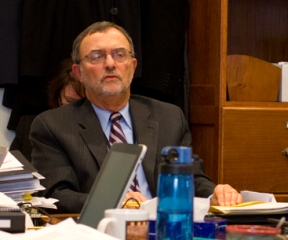
Brian Searles, the secretary of the Agency of Transportation, says the federal government approved 80 to 100 projects for Vermont in this budget cycle. The state has moved ahead with construction on most of those projects, but now that the federal reimbursement rate could be reduced from 80 percent to as little as 30 percent, Searles said the agency had no choice but to put 38 projects on the back burner.
“This year we’re more worried because we’re literally within a couple of weeks of important dates in the legislative process,” Searles said. “This bill has to be passed in House and the Senate and then it has to get to the president for his signature (by Aug. 1).”
Most of the state’s construction program is already under contract, Searles said, “and we’ve got to pay those bills.” The state treasurer has set aside up to $15 million for current projects.
Searles said the agency will not seek bids for projects that were teed up for construction later this year. “We don’t want to take on additional projects if Congress hasn’t acted,” he said.
Twenty of the 38 projects are bridges; the rail funding is for crossing improvements. The agency has not yet decided which projects will have to wait, he said, but the agency would most likely stall the largest projects that consume more money “so we can get largest amount of payback.”
A project that would likely be on the chopping block is one of the largest bridge projects in the history of Vermont — a $60 million bridge over the West River in the Brattleboro area, he said.
The agency has 800 to 1,000 projects under phases of development at any given time. The state’s capital program for rail, roads and bridges is $400 million to $450 million out of a total transportation budget of $685 million this year.
“It’s the most aggressive capital program we’ve ever had,” Searles said. The agency was operating under the assumption the state would have the funds to carry out the federal program.
The state is still replacing temporary bridges that were installed after Tropical Storm Irene damaged 500 miles of roadway in Vermont.
It can take years for projects to obtain federal approval and reach the construction phase. At that point, delays in construction are costly.
“This is not the way we should be doing business,” Searles said. “Hopefully they’ll resolve this because it’s a lot of work at the state level, in every state, just to make sure we are managing the work load, paying the bills and not blowing budgets.”
Searles is dismayed by congressional infighting over the trust fund, and he says the bickering is a prelude of things to come. The transportation spending legislation known as MAP-21 expires on Sept. 30 and must be reauthorized. He said it’s likely Congress will temporarily extend MAP-21 for a few months instead of passing a new capital spending plan for five to six years. MAP-21 took Congress three years to pass; it went into effect in 2012.
“I remember a time when transportation was nonpartisan,” he said. “You made an investment to build this infrastructure and you needed to maintain it. Most of this is not adding capital construction, we’re talking about timely maintenance and rehabilitation to existing infrastructure.”
Sen. Bernie Sanders, I-Vt., who serves on the Environment and Public Works Committee, supports a six-year reauthorization bill.
The immediate crisis — the trust fund gap — could spur the cancellation of 112,000 construction projects and 700,000 job losses, according to a statement from Sanders’ office.
Sanders blames Republicans for the job losses and says the nation’s infrastructure resemble that of a Third World country if Congress refuses to maintain roads and bridges.
“For most of our history, the United States led the world in transportation innovation, from a network of canals, to the transcontinental railroad to the interstate highway system,” Sanders said. “These innovations gave our economy a competitive advantage and our workers a decent standard of living. These investments made us the economic leader of the world.
“Unfortunately, however, right-wing Republicans have a different vision,” he said. “Their anti-government, anti-tax ideology is so extreme that they are prepared to allow America to descend into a Third World infrastructure and, in the process, sabotage our economy and job growth.”
On Thursday, the House Ways and Means Committee will consider an eight-month extension of MAP-21. Senate Finance that day will resume markup of a 3-month extension and consideration of an $8 billion highway trust fund bailout.
House Republicans wanted to gut funding for Saturday postal deliver service in exchange for bolstering the trust fund. Rep. Peter Welch, D-Vt., led an effort to kill that bill.
Sen. Chuck Schumer, D-N.Y., told Bloomberg News that a compromise on the trust fund is “the very highest priority this month.”
