


Jay Peak Resort’s multimillion dollar side projects in Newport and Burke are delayed due to a slowdown in investor recruitment. Federal backlogs and increased scrutiny of all projects financed through the EB-5 Immigrant Investor Program have jammed up the ventures, which are part of the resort owners’ ambitious Northeast Kingdom Economic Development Initiative.
Jay Peak president and partial owner Bill Stenger and majority owner Ariel Quiros say they’re confident construction will begin this summer at AnC Bio, their planned biotechnology research park in Newport, and at Q Burke Mountain, Jay Peak’s newly acquired sister ski area in Burke.
Before they access the money they’ve already raised, the developers are waiting for the EB-5 projects’ early investors to receive visa approvals from U.S. Citizenship and Immigration Services, which administers the EB-5 program.
In the meantime, other potential investors whose capital is needed to complete the financing plans are wary of placing their money in a project until they see that job creation and business plans have gotten a green light. A few investors who placed their money behind the AnC project have asked for a refund. Data is not available on the nationwide incidence of EB-5 refunds.
“We have refunded a handful of investor funds due to the delay, but those spots have been taken up quickly by others,” Stenger said by email from Shanghai on April 15. He was in Asia for investor recruitment events, two of which were attended by Sen. Patrick Leahy, D-Vt., and Rep. Peter Welch, D-Vt., as part of a trip to Asia for a broader diplomatic mission.
The delays and depth of inspection the AnC Bio and Q Burke projects have faced are not uncommon in the EB-5 program.
EB-5 is a federal immigration program named after the type of employment-based visa it affords. Would-be immigrants and their immediate family members can get a conditional visa in exchange for investing $500,000 to $1 million in a U.S. business. (In Vermont, which has a rural program, the maximum amount is $500,000.) If at least 10 jobs’ worth of economic activity can be attributed to that investment within two years, the visas are upgraded to green cards.

Brent Raymond, the Vermont EB-5 Regional Center director, said in an email that the visa review process has slowed dramatically in the last year. “The initial petition is of significant importance since it is when USCIS evaluates the new enterprise’s business plan,” Raymond wrote. Regional centers are hubs for EB-5 funded projects, and Vermont’s is the only regional center in the country wholly owned and operated by a government entity — in this case, the state’s Agency of Commerce and Community Development.
Wait times for visa applications associated with Vermont projects have doubled. The same problem is widely lamented in the quickly growing EB-5 community nationwide.
“The Vermont EB-5 Regional Center, [EB-5 industry trade group] IIUSA and regional centers around the country are very concerned by these delays,” Raymond said. “The delays being experienced could negatively impact business plans. The delayed processing times have already impacted the regional center’s ability to successfully recruit companies. I’m hopeful the USCIS will focus on remedying the issue.”
Four projects in Vermont are waiting for their investors’ initial visa approval, Raymond said. One project has been waiting for about 17 months.
In addition to the longer wait time, Raymond and other EB-5 stakeholders around the country say they’ve seen a pronounced increased in the number of investors who are asking for additional evidence to support the likelihood that their money will lead to U.S. job growth.
USCIS has hired economists to vet EB-5 business plans, and they apparently are going through job creation projections with a finer toothed comb than the traditional immigration officials who previously reviewed EB-5 petitions.
Some AnC Bio investors have received requests for evidence, Stenger confirmed. He said none have been issued for Q Burke.

“Before launching headlong into projects we certainly want assurance of project approval,” Stenger said. “Yes, the [USCIS] backlog has given us pause to be cautious but approval will indeed come.”
REVISED TIMELINES
Jay Peak used EB-5 financing for most of its recent buildout, including the Tram Haus Lodge, indoor water park and the new Stateside Hotel and Baselodge.
Q Burke Mountain and AnC Bio represent Jay Peak’s first projects outside its own resort. The two projects are part of the three-part, roughly $425 million suite of developments to be funded with immigrant investments. Together with a project in downtown Newport and expansions at the Newport State Airport, the project is known collectively as the Northeast Kingdom Economic Development Initiative.

Despite the setbacks from still-pending approvals at AnC and Q Burke, Stenger and Quiros remain confident in their team’s plans.
“We hope to start doing work up at Burke this year, and we will,” Quiros said. “And we will start doing work also at AnC Bio this year. I don’t know exactly when but we will, we will.”
Stenger said he expects project approval for AnC Bio and Q Burke within the next two months, and they’ll break ground in both places as soon as it comes.
“We will be in meaningful construction in each community, Jay Peak, Newport and Burke by the mid to late summer,” Stenger said.
Pending project approval, he plans to break ground at AnC Bio in June, when construction also would start on the first-phase hotel at Q Burke. Plans for aquatic and tennis centers at Q Burke are still down the road, along with expanded mountain biking operations.
Jay Peak’s Stateside hotel has also been pushed back, but for different reasons. The hotel opened in December, and initial visa applications from investors already are approved. Stenger said Jay Peak made a business decision to work on its marketing plan while they wait for additional stormwater and other environmental permits.
He expects work on Stateside’s additional suites and recreational center to commence by September.
Another potential EB-5 project — the mixed-use Renaissance Block and waterfront hotel in downtown Newport — is being planned. Stenger said acquisition of a downtown block is complete, a deposit has been made on a retail store across the street, and the waterfront property will be under contract in June.
The group’s privately funded initiative at the Newport State Airport in Coventry also is proceeding, with an Act 250 environmental permit application being drafted and public hearings underway.

Plans to bring German window manufacturer Menck to Newport fell through in 2013. The developers realized a change in factory specifications and realistic sales projections would not ensure success in reaching the required job creation numbers in time for investors to get their green cards.
The facility, which was to be built on the same campus where AnC Bio is being planned, was called off before Stenger and Quiros started recruiting investors and before the project became affiliated with the Vermont EB-5 Regional Center.
THE BIG PICTURE
USCIS is working to speed up visa adjudications, but the agency’s slowdown is not just a bureaucratic logjam. Many of the new processes that have slowed down reviews are in response to a string of controversies within the program.
EB-5 has been plagued by accusations of fraud and lax oversight in the past. It was temporarily shut down in the 1990s. Recent events have revived close examination of the program.
A convention center in Chicago was exposed as a fraud in 2013.
A couple in Texas has been charged by the Securities and Exchange Commission for running a Ponzi scheme under the guise of an EB-5 project.
A botched beef processing plant in South Dakota has spawned legislative investigations into the company’s bankruptcy, lost investments, double-billings and missing records. One state official involved in the EB-5 program died by alleged suicide in 2013.
And a Homeland Security Inspector General investigation into then-USCIS director Alejandro Mayorkas was disclosed in 2013. The revelation sparked a political controversy that ensnared not only Mayorkas — also presidential nominee for second-in-command at the Department of Homeland Security — but also Terry McAuliffe, then-candidate in the Virginia gubernatorial race, and Anthony Rodham, the brother of former Secretary of State and potential 2016 presidential candidate Hillary Rodham Clinton.
To help tighten up the program and its public image, USCIS hired economists to vet the business plans. But new staff take time to get up to speed on the intricacies of the program’s complex regulatory structure.
At the same time, the office that handles EB-5 applications is in the process of moving from California to Washington, D.C., which has thrown a wrench in operations, many EB-5 stakeholders say.
This confluence of operational changes and increased scrutiny, combined with a spike in EB-5 project applications, have slowed down reviews.
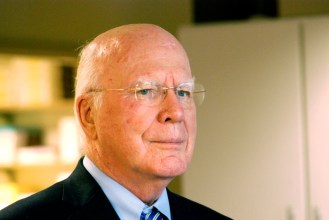
Sen. Patrick Leahy is a champion of the EB-5 program. His spokesman said once the move is complete, “the processing time is expected eventually to be significantly reduced.”
In the meantime, his office acknowledged, the delays are making investors nervous.
“Sen. Leahy has been in constant contact with [Department of Homeland Security] Secretary Johnson, CIS, and CIS nominee Leon Rodriguez on this issue,” the spokesman said.
An even longer-term challenge for Leahy and the EB-5 community may be getting the EB-5 regional center pilot program solidified by Congress. It’s set to expire Sept. 30, 2015, but Leahy is trying to make it permanent. The traditional EB-5 visa, whereby immigrants start their own businesses to directly create 10 jobs on their own payroll, already is permanent.
Leahy’s ideas for the regional center, along with more tweaks to the EB-5 program, are contained in an amendment to pending immigration reform.
One change, in particular, is in demand by the growing number of EB-5 developers. It would not count investors’ family members when adding up visas against the annual cap of 10,000.
The visa limit is expected to be reached for the first time ever in 2014 — intensifying competition among projects vying for investors. Taking family members out of the calculation will significantly increase the number of eligible investors.
But the bill Leahy’s amendments are attached to — comprehensive immigration reform — faces an uncertain fate.
“House leaders continue to send mixed signals about whether they will allow votes on the bill or on any comprehensive immigration reform bill,” Leahy’s office said. “If the House continues to stand in the way, that obviously would needlessly slow the program’s growth and reduce the potential investments and jobs created.”
