

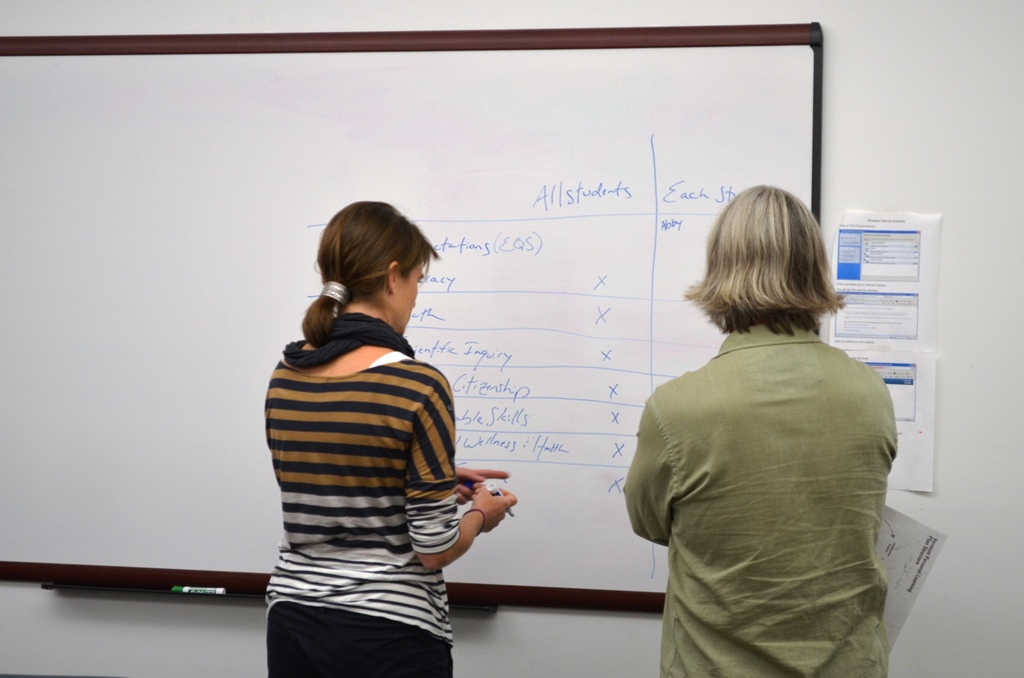
A new law, proffered by Gov. Peter Shumlin and passed by the Legislature last spring, requires every student in grades 7-12 to have a “personal learning plan.” A 26-member group of educators met for the third time Tuesday to figure out how to help schools make that happen.
The point of the plans is to help students work with teachers to tailor their education to their career goals.
The group has until January to figure out “best practices” for putting the plans in place. Tuesday, they received input from students who, without a mandate, had decided to develop de facto “personal learning plans.”
One of those students, Abigail Trombley, a 16-year-old at Champlain Valley Union High School in Hinesburg, told the group that traditional school “wasn’t working for me.” With guidance from CVU and her family, she drafted a plan that’s included job shadowing an orthopedic surgeon, taking human biology at the University of Vermont, working at the stables where she competitively rides and taking normal high school classes.
“You can take AP (Advanced Placement) courses and more challenging courses, but the bottom line is what changes the experience is the teachers you get to work with and the other kids in the classroom and I found I could get a difference experience at a difference place and it’s made a huge difference for me,” she said.
Trombley said she believes it’s a good idea to implement personal learning plans across the board. “The only reason more people don’t do it is because people don’t know it’s an option.”
Trombley, technically a junior, is graduating early and taking a gap year to ride horses before going to college.
The portability of the plans is a central concern for the group.
Superintendents, principals and the other group members were especially interested in exploring what happens when students such as Trombley transfer schools, and how to capture those different activities on a transcript.
At the same time, they’re mindful of not wanting to saddle schools with too many specific guidelines.
“We know we all want local control, but if this doesn’t have some common structure, we’ve got the transportable issue,” said Ellen Berrings, a teacher at Harwood Union High School.
Without a template, examples and other resources, Jennifer Botzojorns, assistant superintendent of the Chittenden East Supervisory Union, predicted that “high spending wealthy districts with curriculum coordinators” would have no problem implementing the plans, whereas less wealthy schools would be “left scrambling.”
The group also discussed the actual elements of the plans, how often they should be re-evaluated and how schools could measure whether students are actually adhering to them.
They have all-day meetings scheduled for Nov. 12 and Dec. 17.
Debi Price, education project manager for the Agency of Education, said she’s pleased with the progress the group has made. They’ve developed a set of documents, still in draft form, which lay out “steps to implementation.” Price emphasized these materials don’t include mandates and are only meant to provide guidance to schools.
The group’s “homework” for the next month is to run those documents by their school colleagues and collect feedback.
