

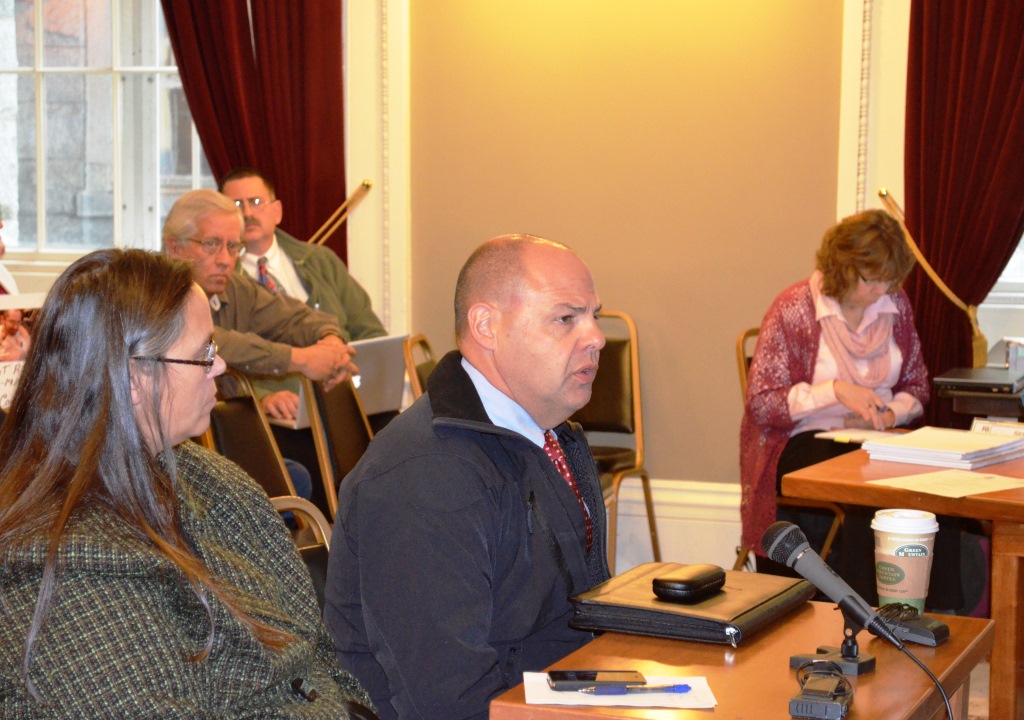
Right after Corrections Commissioner Andy Pallito finished his presentation to the Corrections Oversight Committee on Monday, chairwoman Rep. Alice Emmons, D-Springfield, turned to her fellow members, scanning their faces for questions.
“I guess it’s just the constant question,” said Rep. Martha Heath, D-Westford. “Is there any hope in the detainee situation?”
Detainee numbers — which normally fluctuate on a seasonal basis — have remained high. On Monday there were 438 people behind bars awaiting court action — well over the department’s target of 300, which also happens to be the number to which its budget allocation was pegged.
Drug sweeps and a corresponding uptick in felony charges are likely drivers, according to that state’s Chief Administrative Judge Amy Davenport.
“Until we can figure out how to deal with the drug problem I don’t see how we can make a real change in this,” Davenport told lawmakers.
While the DOC has to make room in its correctional facilities to house the detainees, the uptick in felony charges also affects the Defender General’s Office, which represents the majority of those detainees.
Defender General Matt Valerio said his office handles 20,000 cases a year and represents about 85 percent of the people in the criminal justice system. Felony charges increased 6.5 percent in fiscal year 2013, and that, he said, caused “a significant increase in our caseload.”
Valerio suggested lawmakers turn their focus to a different group of people behind bars — the roughly 220 inmates who are still there because they can’t find suitable, department-approved housing.
Valerio did offer lawmakers a theory about why the number hasn’t abated — a dearth of what courts would consider “responsible adults.”
“Certain conditions of release have a level of popularity,” Valerio said. For younger detainees, judges sometimes won’t authorize their release unless they can show that there will be a “responsible adult” keeping tabs on them.
“This is one of those conditions of pretrial release that has apparently become popular,” Valerio said, noting that it is “one of the biggest hang-ups” to decreasing the detainee population.
Recently, when the detention population was especially high — 475 — Valerio had his offices look at why each detainee was being held. According to Valerio, 92 of those detainees were eligible for release except for a single sticking point — no “responsible adult” had volunteered to watch over them.
The corrections oversight committee also got a primer on how bail is set, revisiting the state statutes to see if they needed tinkering with.
Bram Kranichfeld, executive director of the State’s Attorneys and Sheriffs’ Department Association, cautioned lawmakers against tampering with these laws. “There are very good policy reasons for the bail policies as they exist,” Kranichfeld told them.
Davenport distributed a spreadsheet with profiles of 80 detainees that outlined why they were either being held without bail or being held at a bail too high for them to pay. Forty were identified as having “serious” drug charges, 12 were from out of state, and 19 had violated probation. The steepest bail amount was $500,000 for a New York resident with six pending criminal charges, including heroin trafficking.
The committee also spent time looking at the perennial problem on the other end of the correctional system that Valerio raised — finding housing for inmates eligible for release.
Roughly 10 percent of the prison population has fulfilled their minimum sentence but hasn’t been released because they haven’t found housing that meets DOC standards.
“To me that’s the end you can make progress on,” Valerio said
Pallito’s assessment was less upbeat. “It’s a knife-edge for us,” he said. “The overwhelming percentage of the population that currently has lack of housing has a sex offense.”
In recent years, the Legislature added funding to the corrections budget to support additional transitional housing beds, but Pallito said, at this point he’s not sure more beds would fix the problem. For the remaining 220 inmates, a large part of the problem is finding facilities and communities that will accept the offenders, he said.
Lawmakers revisited a third hurdle keeping the state from reducing the number of jailed residents — under-utilization of electronic monitoring devices that could keep offenders out of prison. Two types of devices — a Global Positioning System (GPS) device embedded in an ankle bracelet and an alcohol-monitoring bracelet — are used for offenders on furlough or probation and a few pretrial detainees.
Davenport cited anecdotes about people ripping off the bracelets as one of the reasons judges are reluctant to rely on the technology.
Valerio said judges have yet to adapt their policies to significant technological improvements that have been made to the devices in recent years.
