


NEWPORT — The Federal Reserve Bank of Boston convened at the edge of Lake Memphremagog in Newport on Monday morning. Banking, housing and community development specialists from northern New England descended on the Canadian border town to discuss one of the biggest economic development proposals in the region: An ambitious, interconnected set of projects worth $465 million and paid for by immigrant investors.
With a crystalline late summer view of sailboats, water and blue sky on a cool morning, about 90 people from northern New England and Massachusetts listened to a panel discussion about immigrant-funded development in Vermont. The occasion, an annual regional meeting of the bank’s Community Development Advisory Council, was held at the downtown Gateway Center.
Richard Walker, council chair and senior vice president and community affairs officer, said the federal EB-5 Immigrant Investor program “seems like a tool Vermont is using exceedingly well.”
EB-5 allows would-be immigrants to earn a green card by investing in an American business. The ante is $500,000 in most of Vermont ($1 million in less rural regions or areas with low unemployment), so long as each installment of capital generates 10 jobs. Nationwide, more than 300 regional centers administer the federal EB-5 Immigrant Investor program. Vermont’s operation is the country’s only regional center that is wholly owned and operated by the state.
Walker and several colleagues from his office headed north Sunday morning to learn more about EB-5 and determine whether immigrant investment projects could help other states in the region.
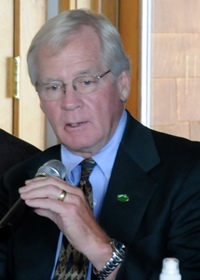
The group’s tour of Jay Peak Resort and downtown Newport, followed by Monday’s panel presentation, appears to have been persuasive.
Jay Peak Resort co-owner Bill Stenger announced matter-of-factly to the audience that he’ll use EB-5 to bring roughly $500 million in capital to the Northeast Kingdom in the next four years, starting with $20 million he expects to land in the next two months for a biomedical research park planned for a hill overlooking Newport.
Stenger and his business partner, Ariel Quiros, have already begun a two-phase, $160 million expansion at Jay Peak’s new “sister” resort, Burke Mountain. Additional plans to bring a German window manufacturer to Newport, plus turn a city block and waterfront shopping plaza into a mixed-use development and marina, hotel, conference center are still awaiting EB-5 approval. In all, the partners hope to create about 9,300 direct and indirect jobs in the Northeast Kingdom, the poorest and most rural area in the state.
All of this is on top of the hundreds of millions of investment dollars Stenger and Quiros already have injected into growth projects at Jay Peak. With the addition of an ice center, golf course and heated water park, the alpine ski resort has been transformed into a year-round indoor/outdoor funhouse in less than six years.
Walker wanted to know whether the developments have spurred the job creation and ancillary development the program is designed to generate.
“It seems that is the case,” he said.
Each investor in Jay Peak’s first phase of EB-5 projects has received a green card, Stenger said. An investor’s immigration status initially is granted for two years on a conditional basis and made permanent only if the U.S. Citizenship and Immigration Services is satisfied that the required 10 jobs have been created according to plan.
Stenger said he will begin repaying investors in January. Return on investment for EB-5 projects is not mandated by law: All investments are “at-risk,” with no guaranteed rate of return and no promise that a green card will materialize. Payback, however, is critical to the on-the-ground success of the Northeast Kingdom Economic Development Initiative, Stenger said.
“What’s the best form of new business?” he asked the crowd rhetorically. “A satisfied customer.” Stenger said he wants to keep his investors happy, because future projects rest squarely on his reputation in the investment world.
Stenger credits the success of his EB-5 projects to his ongoing partnership with state government, as well as the quality of the projects and the market-driven business outcomes they are designed to deliver.
“We deliver. And the state delivers,” he said Monday morning.
Vermont’s EB-5 Regional Center director Brent Raymond said in a separate interview that there are limits to what his office can deliver. He laughed when asked about potential conflicts of interest with state permitting, for example, given the regional center’s own stake in the projects.
“I wish I could tell ANR (the Agency of Natural Resources) what to do,” Raymond said.
Despite his confidence in the independence of the various state agencies on which EB-5 projects hinge, Raymond appears to understand the potential or perceived conflict of interest the state-run regional center. Since taking over the office, which he runs in addition to the state’s office of international trade, Raymond said all EB-5 projects have been required to have Act 250 permits in hand before they can be approved by the regional office.
Raymond took several questions at Monday’s panel regarding the structure, governance and staffing of the office — all of which he answered fully. He’s reluctant to say too much, however.
Just as developers’ EB-5 project business plans are proprietary, Raymond says the inner workings of the regional center are the state’s own trade secret.
Correction: This article was updated on Oct. 9, 2013, to note that more than 300 regional centers nationwide are approved to administer the federal EB-5 Immigrant Investor Program.

