

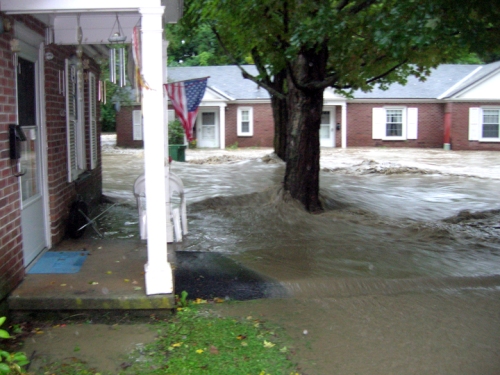
The Melrose Terrace public housing development was full long before FEMA maps placed it squarely in a special flood hazard area. Its 80 or more elderly and disabled residents were accustomed to evacuations long before and long after President Bill Clinton issued a presidential order that no critical population shall be housed in a flood zone using federal money.
Yet few other options exist in Brattleboro’s tight housing market for an agency with limited funding options, said Brattleboro Housing Authority executive director Christine Hart. Reluctantly, months after extensive flooding from Tropical Storm Irene in 2011 rendered much of Melrose unlivable, apartments were repaired and the housing authority moved tenants back in.
But that time, Hart said, the housing authority’s board committed to finding another way. They would build a new development for Melrose tenants in a new location.
“We promised we had to get these people to higher ground,” Hart said.
And now, they just might get a shot at the money they need to do it.
Since 1937, housing agencies like Hart’s traditionally have relied on the U.S. Department of Housing and Urban Development for the vast majority of their public housing funding. But a new test program would lead them to the world of private equity.
No more would housing authorities have to wait for enough money from HUD to pay for capital improvements to an aging housing stock — funding the agency has long deferred due to budget woes of its own. A new federal program would give local housing authorities permission to raise their own money.
For-profit developers of affordable rental housing and nonprofit housing organizations, such as those funded through the Vermont Housing and Conservation Board, have done this for 25 years, thanks to state and federal tax credits for low-income housing.
Those mechanisms, plus the option to take on debt through mortgages, are now available to select public housing authorities through the Rental Assistance Demonstration (RAD) program.
RAD is voluntary for now — in fact, it’s only accessible to a limited number of public housing authorities through a competitive application to HUD. Brattleboro Housing Authority is assembling a development team to put together its application to the new program. It would be the first in Vermont to apply.
But housing directors across the state are watching skeptically.
As described by Sarah Carpenter, executive director of the Vermont Housing Finance Agency, many see the RAD program as part of a trend of HUD “walking away from their obligation to provide funding to those projects.”
HUD says the agency is helping public housing authorities become more nimble.
“Obviously funding has been cut, and it isn’t meeting the needs of our housing authorities,” said HUD public affairs officer Rhonda Siciliano. “We realize that, so this was designed as a potential tool to help our housing authorities find ways to meet their (capital) needs.”
HUD’s dilemma aside, many housing experts in Vermont are concerned about increased competition RAD may bring to the private equity market and the limited tax credits it channels.
Competition
Low-income housing tax credits traditionally are the province of affordable rental housing developers, be they nonprofit or for-profit businesses: The VHFA awards state and federal tax credits to developers, who in turn sell them to private investors.
Whereas a five-year state tax credit of $100,000 a year may total $500,000 of tax savings, the developer may sell it for $425,000 to an investor looking to shelter some profit from a private business. The developer gets the capital, the investor nets $75,000 by paying less in taxes than it paid for the tax credits, and the state forgoes some revenue in exchange for a private investment in the public good.
But adding public housing agencies to the VHFA’s queue for tax credits is not what the tax credit systems were designed for, said Maura Collins, policy and planning manager for VHFA.
About 1,800 public housing units exist in Vermont, Collins said. “Theoretically and historically, those should have been operating on their own and getting enough funding to be good, safe, affordable, decent housing for the residents,” she said. “The system wasn’t really set up to have (public housing authorities) accessing the … tax credit resources that were designed for other projects or for new projects.”
RAD is only voluntary at this point, and opinions vary among public housing directors as to whether HUD plans to eventually require participation, thereby divesting itself more thoroughly of responsibility for improvements to the aging housing stock. HUD officials who could comment in depth about the RAD program could not be reached in time for this publication.
But RAD is more than a merely theoretical threat to affordable housing financing in Vermont, Collins said. She hesitated to call it a crisis, but she underscored the urgency of somehow addressing public housing’s maintenance and repair.
“Housing developments … have capital needs today and a lot of these have been deferred for years because there’s not enough funding,” she said. “At some point there’s going to have to be a big capital infusion,” she said, not to mention new building to accommodate Vermont’s growth.
Hope
While Hart understands the complications the RAD program carries, she nonetheless holds high hopes for what the new financing options can do for Brattleboro.
If her housing authority’s plans for Melrose are accepted into the RAD program, she’ll at least have a chance to compete for funding, instead of simply watching congressional funding for public housing dwindle, as she has for years.
“I think that HUD has a real dilemma in that it knows it has serious capital backlog and it’s not getting the public dollars it needs for housing authorities to bring those properties up to where they should be,” Hart said.
Hart also underscored that HUD officials, while their agency has been given less and less money to work with, have been more than accommodating in her quest to give her tenants more secure housing.
She hopes Brattleboro can serve as a test site through which HUD can work out a program to help housing authorities rebuild after a natural disaster. Plenty of other housing authorities inevitably will be in the same position as Melrose Terrace, she said.
Optimism may be her only choice: With the development in a flood zone — indeed, part of it was built in the path of the brook — Hart knows Melrose may not remain structurally sound through another major storm.

