

Legislative leaders announced Friday that they do not have a budget and tax agreement with the Shumlin administration.
That means there will be no Saturday adjournment. House Speaker Shap Smith and Senate President Pro Tem John Campbell made the announcement at about 5:30 Friday evening after a long, closed-door discussion with tax and budget writers from Senate and House committees.
The House and Senate will reconvene on Monday and Tuesday; President Pro Tem John Campbell was unable to persuade his members to come back on Saturday. The Legislature has been in session for 17 weeks, and is budgeted for 18 weeks.
Very little progress has been made on budget and tax agreements over the last 24 hours. On Friday, Sen. Tim Ashe and Rep. Janet Ancel, the respective chairs of the Senate and House tax writing committees, floated a proposal to move the state income tax system to a modified adjusted gross income model with a cap of 2.5 times the standard deduction in fiscal year 2014 and a 3 percent minimum tax for filers who earn more than $125,000 in fiscal year 2015. Based on Joint Fiscal Office data from 2010, the plan is net neutral, meaning it does not increase taxes in the aggregate. Tax rates would drop as a result of the change. Individuals would see tax increases or decreases, depending on their income levels. More than 200,000 middle class taxpayers who earn less than $200,000 would be the biggest beneficiaries according to the 2010 models; roughly 14,000 Vermonters would pay slightly more in taxes as a percentage of their income. One hundred filers who earn more than $1 million per year would see an aggregate $2.4 million increase in taxes; 195 filers in that same top earning category would see an aggregate tax decrease of $1.2 million.
Ashe and Ancel have said their proposal makes the income tax system more equitable. Their plan is based on three years of testimony and research in the House Ways and Means Committee. The Vermont Blue Ribbon Tax Structure Commission originally proposed a shift from taxable income to adjusted gross income in 2011.
Gov. Peter Shumlin says the proposal is a tax increase and violates the spirit of the agreement he struck with Democratic leaders on Tuesday in which Smith, Campbell and the governor decided not to increase taxes but to reduce the budget by $10 million. The Senate had proposed to raise $10 million in additional tax revenues; the House proposal was $27 million.
While legislative leaders say the shift from a taxable income base to adjusted gross is net neutral, Shumlin says the plan would raise $10 million in taxes, based on 2007 tax models that he says better reflect current income levels.
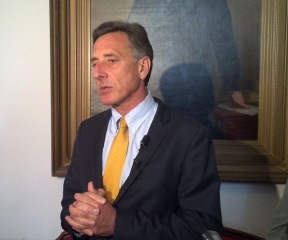
“Let me be clear,” Shumlin said Friday evening, “as I’ve said, this is the wrong time to raise income taxes on Vermonters. I’ve only heard about proposals, I haven’t seen them, But the last thing we should be doing is raising income taxes, changing the income tax system on the fly and the last minute when we don’t need the money.
“We should not raise income taxes, we will not raise income taxes, we must not raise income taxes.”
Questioned about why he could not support a plan that would lower income taxes on the vast majority of Vermonters, Shumlin said: “Here’s our challenge, when you slap together a proposal on the fly, no one knows exactly what it does.”
Smith told reporters the Legislature doesn’t have to have an agreement with the governor on the tax bill, and “We actually don’t necessarily have to have a tax bill.” In anticipation of this new development on Friday, senators tacked amendments onto the technical tax bill.
The Senate miscellaneous tax bill used employer assessments for Catamount Health and a new 1 percent premium tax to fund the state’s new health care exchange. The Shumlin administration must have a legislatively approved funding mechanism for the exchange by the end of the session to satisfy federal requirements. It would be difficult for the governor to veto a bill that includes funding for the exchange, several officials said.
In addition to the disagreement over changes to the tax code, the Shumlin administration and lawmakers have failed to come to an agreement on the details of the budget cuts, none of which appear to have been worked out in advance.
Lawmakers spent four months perfecting budget and tax proposals for the end of the session. Many of those details have been re-evaluated over the last three days, but the big items remain outstanding: Language regarding a five-year cap on the welfare-to-work program, funding for temporary housing, and management of budgetary increases in the disability services program. Decisions about how much would be invested in child-care subsidies and Red Cross emergency preparedness for a Vermont Yankee accident are still up in the air.
On Friday, lawmakers on the budget and tax committees were ushered from one private meeting with the governor, the speaker or the pro tem. Scheduled budget conference committee meetings were token affairs and the tax conferees abandoned public meetings altogether. Key lawmakers are expected to hammer out more details of the agreement over the weekend.
Editor’s note: This story was updated at 7:45 a.m. and 8:15 a.m. May 11.
