

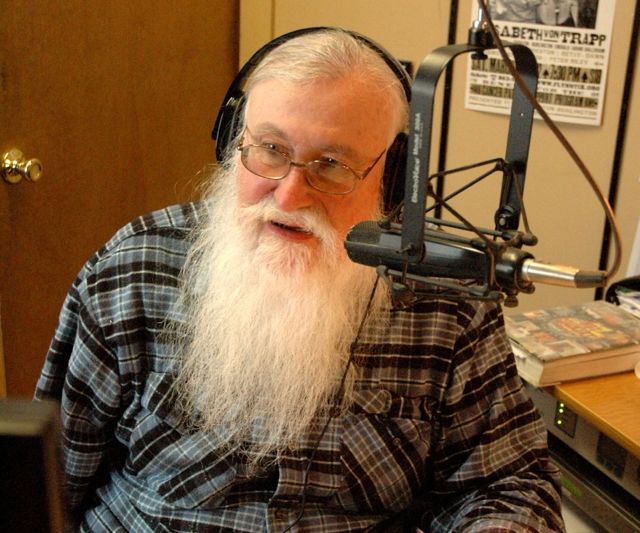
 Joel Najman thought his career was destined to be in psychology.
In an odd, tangential way, he was right, though instead of an office with a couch, he’s spent his time in cramped rooms surrounded by an untidy jumble of wires, sound mixing boards, tape decks, turntables, computer monitors and electronic devices. Which is to say, one of the innumerable broadcast studios where he has worked for nearly five decades as a disc jockey.
To call him just a well-known Vermont DJ, though, is like calling Elvis just a singer.
Najman’s upcoming 50-year anniversary in broadcasting will sum up a career where the spinning vinyl platters and CDs (and now, mouse-clicked digital song files) are mere background music. And here’s where the psychology comes in. In his lifetime, Najman has accumulated an apparently limitless stack of yarns and illuminating stories that delve into the history, sociology, deep secrets and yes, very psyche of the music of the ’50s, ’60s and ’70s – doo-wop, rock ‘n roll, pop ballads, folk music, country and other genres, all of which seemingly flow like blood through his veins.
In short, he’s a walking, talking, breathing Wikipedia, ever editing and adding to his knowledge, a marvel of musical archaeology and singer biography. As many Vermonters know, he puts this on display every Saturday night on Vermont Public Radio, where he hosts “My Place.”
The show is a narrated hour-long stroll through musical history that can be quirky, revelatory, erudite, heart-warming and heart-rending, and thought-provoking – often all at once.
His signature broadcast was pretty much accidental. He filled in for DJ David Field at VPR at one point and found a permanent place on the station.
“I kind of backed into it,” he says. “I came in and subbed for him when he was sick, and sadly he was very sick.” Field had cancer, Najman said, “and when he passed away, I just continued to do the show. There was never any formal anything for many years.”
He’s now been doing “My Place” for 30 years, and hasn’t missed a single show in all that time. So far, he’s produced more than 1,500 broadcasts.
His career in broadcasting is accidental. He was born in Indiana, but his parents moved to the Bronx when he was a child. In New York, he became captivated by the doo-wop music exploding in the city in the late 1950s, and so began a lifelong love of radio listening. Accepted at Middlebury College, he decided to try doing a radio show at the college station, WRMC, which was so small it was broadcast through phone lines, he recalls. The year was 1963.

When his roommate got a job at WFAD, a commercial station in town, he went out and got a gig across the lake at WIPS in Fort Ticonderoga. “We were broadcasting against each other,” he says with a laugh.
“I had to take a ferry boat to get to work,” he remembers. The pay? “Whatever the minimum wage was, we got it.”
Broadcasting was a barely money-making sideline, he still thought. After graduating, he went on to all but earn his Ph.D. at the University of Vermont in experimental psychology. But feeling “burned out,” he never defended his thesis. His sideline as a DJ became his career.
“The radio just totally absorbed me, and I’ve been there ever since,” he explains. “It was never really a conscious decision.”
In the words of the immortal Bill Haley & the Comets, it’s been “Rock Around the Clock” for Najman ever since. At the age of 69, he’s still going strong, though he’s cut his hours back to roughly 15 or so a week. Last week, he was filling in at WLVB in Morrisville, the country music station owned by the Radio Vermont Group, whose flagship station is WDEV in Waterbury, where he still has two weekend shows.
Dressed in a blue flannel shirt, slacks and wearing Sorel boots, he’s a shaggy bear of a man, sporting a long white beard that would make Kris Kringle jealous, and a WDEV ball cap that hides a vigorous growth of gray hair tied in a long loose ponytail. From his seat in front of the broadcast console, he easily hits smooth, smart segues, flawlessly reads weather and station IDs with his sonorous voice, and mixes in musical tidbits. He is a master at the craft.
When a CD starts skipping, he spins away from a conversation, whips on earphones, and makes a humorous apology into the mike, quickly punching up another song. Pulling the CD, he inspects it and wipes it with his shirttail to fix the blemish.
“That’s why I wear flannel — I’m not kidding,” he says.
His evolution to rock ‘n’ roll historian, genealogist and archeologist of artists’ lives and tunes stems from his fascination with “the backstory.”
“I did not want to be an oldies DJ,” he explains. “I always enjoyed the backstory and the history.”
Does he ever. As a psychology major, he’ll readily admit this has become somewhat of an obsession, laughing at his tendency to go off on rock ‘n’ roll tangents, weaving stories out of the remarkable threads and colorful bits and pieces of lore that reside in his brain. After relating a few of these tales, he says: “Sorry to tattoo you.”
Then he adds by way of explanation, “The story behind the songs are always amazing to me.”
On “My Place,” Najman unearths remarkable musical history and finds connections no one knew existed, or comes up with thematic programs that are fresh and original. He scribbles yellow notepads full of history for his show, which is unscripted but mentally planned out and purposely conversational in tone.
“I never think I’m broadcasting,” he explains. “I feel very comfortable, talking (as if) essentially to one person.”
He used to do it live, but now pre-records the shows at VPR on a “nighthawk” shift from 1 to 4 a.m., editing it down to an hour. The free-form hour only has one caveat, which is to have a clear ending, “to try and resolve each program,” he says.
In his search for the backstory he has travelled all over and made innumerable stabs in the dark to track down stories, rumors, liner notes and books. The Internet has made all this a lot easier today, he says. In the old days, he joked he earned about 20 cents an hour what with all the research he invested in the show. It’s only in the last decade that “My Place” has been archived in an effort to preserve his unique insights and stories.
Thirty years into the gig, he’s never short of themes and program ideas. He’s excavated the backstory and past renditions of the Kingston Trio’s famed “Hang Down Your Head, Tom Dooley,” and the “The Lion Sleeps Tonight.” He’s done shows on all the songs that had the word “radio,” programs on pop songs done by different generations of the same family, focused on one artist (from Etta James to Elvis and Patti Page), Jewish songwriters and girl group vocalists. When a famed artist dies, he’ll often do a retrospective.
“A couple of people have labeled me the musical mortician. I cringe at that,” he says.
Even as he worked at WLVB last week, hearing a country music song popped an idea in his head to do a program on all the songs that have the word “prayer” in them. He quickly tallied seven songs.
“All these programs are germinating behind the scenes,” he says.
Is he surprised that he’s tallied almost 50 years at the sound table and mike, and at his craft. The answer is yes.
“The chronology is sometimes a big blur to me,” he says. But he still loves doing “My Place” and the research that goes into it: “I so enjoy having an output and a vehicle. I get so fascinated by this material.”

