

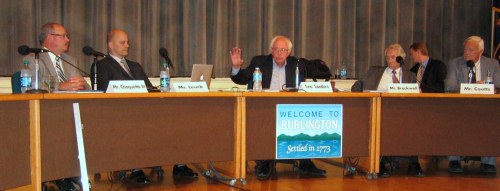
Sen. Bernie Sanders thinks he knows why gasoline prices are consistently higher in northwestern Vermont than in other parts of the state and country. At a U.S. Senate hearing Sanders brought to Burlington on Monday, however, the witnesses stopped short of confirming his suspicion that the main reason is concentration of ownership and a lack of price competition.
Joseph Choquette III, public affairs adviser for the Vermont Petroleum Association, fielded most of the questions during a one-hour hearing of the Senate Energy and Natural Resources Committee in Burlington City Hall. Describing the region as a “low volume market,” Choquette insisted that it is impossible to “prove or disprove” Sanders’ argument.
Other witnesses provided technical explanations of how the market operates and some impacts on consumers. But no one could explain the fact that average gasoline prices in the Champlain Valley have been consistently higher than the national average.

Over the past three years Burlington area prices have exceeded the national average 86 percent of the time, sometimes by as much as 29 cents per gallon. Burlington prices exceeded the statewide average 72 percent of time. Prices in St. Albans exceeded both the U.S. and Vermont average 90 percent of the time.
At the hearing Ben Brockwell, director of data for the Oil Price Information Service (OPIS), recounted his efforts to identify any variables that could explain the difference. His research ultimately ruled out the use of reformulated gasoline (area stations use conventional gas), tax impacts, and transportation costs.
“I have been unable to find a reasonable explanation to justify or explain why Burlington, Vermont, retail gasoline prices are higher than neighboring areas,” Brockwell concluded. However, he acknowledged that Sanders’ suggestion of stifled competition due to control of the market by four companies is a factor “that might deserve closer inspection.”
Four gasoline distributors – S.B.Collins, Champlain Oil, R.L. Vallee, and Wesco – own nearly two-thirds of the region’s 185 filling stations, Sanders noted. They have a right to make a profit, he said, but “they should not be ripping people off in these tough economic times.”
Sanders also pointed out that since launching his investigation, and despite recently rising national wholesale prices, Burlington’s gas prices dropped below the national average for the first time in months. In July, average prices in the Burlington area went down by about 9 cents a gallon, even though wholesale prices rose by 18 cents. Burlington gas prices are currently about the same as the national average.
“This indicates to me that when local distributors want to be competitive they have the capability of doing so,” he concluded. While Sanders praised the emergence of a “more competitive spirit,” he implied that the reason may be his inquiry.
Another focus of the hearing was the long-frustrated effort by Costco to build a gas station at its Colchester location. Sitting next to Choquette, Costco Vice President Rob Leuck said that competing gas stations have successfully blocked approval of a Costco gas station for more than four years.
Costco operates gas stations “wherever it is practical” and considers it a core service. Although the company’s basic pledge is “we will not be undersold,” Leuck stressed that its gasoline exceeds EPA standards. It sometimes sells below cost, he added, but only on a temporary basis in response to competition.
Having a Costco filling station in Colchester would “serve the entire community by lowering the opening price point and reducing the average price paid for gasoline at all nearby outlets,” Leuck argued. The company claims to have brought down prices in other markets.
Sanders was careful to say that the hearing had nothing to do with Costco’s current permit application. “It would be totally improper,” he said, for anyone to intervene in a Vermont “quasi-judicial process.” He nevertheless stressed that local gasoline distributors are among Costco’s major opponents, and read sections of a letter from the company.
The letter alleges that Costco has obtained “several approvals for our proposed gas station in Colchester, but each approval has been appealed by, among others, gas station owners in northern Vermont. We can discern no legitimate reason for these appeals, and believe that there are really an attempt to use the land use process to stifle competition for gas sales.”
According to charts displayed during the hearing, gasoline profit margins for the Burlington area have almost always been higher than the national average. Sanders called the issue complicated and “extremely opaque.”
To a large extent gasoline prices are determined by the price of crude oil. Although the Oil Producing Exporting Countries (OPEC) have considerable power, five giant oil companies – Exxon, Mobil, BP, Shell, Chevron and Conoco Phillips – have made more than a trillion dollars in profits in the last decade, Sanders noted.
Another factor mentioned by Sanders is Wall Street speculators who buy and sell huge amounts of oil on the futures market. Brockwell buttressed this line of argument with the personal opinion that “Wall Street refiners” have been a “primary force determining the price of gasoline at the pump” for the past 10 years.
Sanders reported that Wall Street speculators control over 80 percent of the oil futures market. The largest may be Goldman Sachs, which admitted earlier this year that “excessive oil speculation is costing Americans about 56 cents a gallon at the pump,” Sanders said.
However, none of that explains the consistent difference between prices in the Burlington area and elsewhere in the state and region. Neither do state taxes or transportation costs.
On July 6, a Maplefields gas station in Middlebury charged $3.35 a gallon while a station owned by the same company in Burlington, 35 miles away, charged $3.59. Sanders wondered why, on July 1, people in St. Albans were paying an average of $3.60, while residents of Springfield paid less than $3.40. And what about Waterbury drivers who paid $3.65 in late June while those in Rutland paid an average of $3.49, he asked?
The 30 Maplefields stores in Vermont are owned by the Vallee family. Skip Valley, a former ambassador and staunch Vermont Republican, says Sanders is trying to seize the political moment. “I think Bernie picked an opportune time for his analysis,” Vallee said in an interview last month. “(Sanders) didn’t have press conferences in November and December when margins were extraordinarily low.”
Vallee compared the mini-mart/gas station business to the dairy industry. Both have wide fluctuations in profits, based on demand. “From last October through mid-April these margins were extraordinarily small,” Vallee said. “That’s generally true. When prices at the wholesale level are increasing … retail is not. We happen to be (talking about) a two month period when markets adjusted (upward). In mid-July, the wholesale rates were up and retail was down again, and the margin has been abnormally low last few weeks. This is the way markets work.”
Choquette, who represents the Vermont Grocers Association, in addition to the petroleum association, disputes the notion that Chittenden County gas station owners are making huge profits from higher summer prices. Last winter and spring, he said, margins were much lower due to a lack of demand. The Burlington market had one of lowest margins — 14.2 cents — in April, he said.
Choquette says the White River Junction and Rutland and Addison county markets have a culture of more competition. It also costs more to ship gas to Chittenden County than it does elsewhere. Gas suppliers add 5 cents per gallon for shipping fuel up the rail line to the Burlington terminal, Choquette said in an interview last month.
Choquette also finds fault with the OPIS analysis of gross profit margins, which he says is based on the average street price. The OPIS reports, he said, don’t take into account the cost of credit card fees, which are 3 percent of sales and cost about a dime per gallon of gas. Overhead costs, including rent and underground storage tanks, are also not included, Choquette said.
Since Sanders started his inquiry earlier this summer, Vermont’s junior senator has picked up some intriguing tidbits. According to the Federal Trade Commission, for example, late June gas prices in the Burlington area were 10 cents to 43 cents greater than their own computer model had projected. More surprising, however, is the OPIS announcement that Burlington has been “the most profitable gasoline market in the northeast” this summer. That includes Washington, D.C., and New York City.
Profits margins for Burlington tripled in the first six months of the year, making it “one of the most lucrative markets in the entire eastern half of America,” Sanders said. Brockwell has previously commented that Burlington is always the top market in the Northeast “in terms of profits.”
The hearing briefly also considered the impacts of high gas prices on services providers. Jim Coutts, who directs the Franklin County Senior Center, said that high gas prices can create a barrier for drivers who deliver meals to homebound seniors.
“Most of our drivers are on fixed income of less than $15,000 a year,” Coutts said. “I am concerned that if estimates of higher gas prices this fall and winter come true we will face a critical shortage of drivers.”
Editor’s note: Anne Galloway contributed to this report, which was updated at 2:20 p.m. Aug. 7, 2012.

