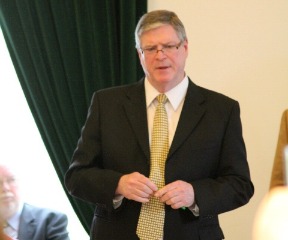
Statehouse leaders came together for a press conference on Wednesday to mark their many joint accomplishments this legislative session, but the conversation revisited one issue that appears will be an ongoing disagreement that will bleed into the next biennium.
House Speaker Shap Smith and Senate President Pro Tem John Campbell told reporters they are most proud of their efforts to reform the health care system, balance the budget, redraw the boundaries for House and Senate seats and help rebuild Vermont after Tropical Storm Irene.
They had much to agree on — including an ambitious proposal to reform the state’s sales tax system next year.
But when it came down to one of the remaining unresolved issues of the session — prescription drug monitoring — the two leaders openly disagreed in front of the TV cameras. It was a rare public instance of discord between Smith and Campbell, but both men have staked out positions they feel passionately about.
Legislation that originated from the Shumlin administration, which would have given law enforcement access to records from the state’s prescription drug database, ultimately floundered when members of the House and Senate conference committees couldn’t agree. The House wanted police to obtain warrants before running searches; the Senate opposed that requirement.
If Gov. Peter Shumlin’s failed last-minute effort to apply public pressure on the House to abandon that position is any indication, the “epidemic” of prescription drug use will likely become a campaign issue, according to Kristin Carlson of WCAX.
Smith compared the drug monitoring debate in the House to the discussion on vaccines because he said both were about “the balance between public benefit and individual liberties.”
“Members of the House felt strongly, they had a real concern about a reaching in to the prescription drug database by law enforcement,” Smith said. “It was a real challenge to see if there was any opportunity for compromise.”
The Speaker said he didn’t want to diminish concerns expressed by the governor and senators about the “epidemic” of prescription drug abuse in Vermont, but he said they’d have to find an approach that didn’t impinge on personal privacy.
Campbell openly lamented the Senate’s inability to move H.745 forward in his end of session farewell speech on May 5, and his frustration over the issue hadn’t abated four days later.
The Windsor Democrat said House members didn’t “understand” the legal ramifications of probable cause and reasonable belief. Campbell in turn blamed House members, the Vermont ACLU and some of the people who gave testimony for causing confusion about what he believes is the real issue: A need to clarify how the search process would work.
“Some of the issues the ACLU brought up were dealt with, but they were still on people’s minds,” Campbell said.
Campbell advocated for bringing together law enforcement, the ACLU and others. “It’s hard to understand without everyone in the same room,” he said.
When asked whether he thought House members were confused, Smith replied: “I think there wasn’t any confusion. People saw this issue through different philosophical lenses.”
The two men amicably agreed to disagree and then moved on to other topics.

The surprise of the presser? An open declaration that not only would Smith pursue sales tax reforms that would include cloud computing, but also that he would use it as a campaign issue. Smith said he wants to lower the sales tax to a nominal amount, from 6 percent to a much lower amount suggested by the Blue Ribbon Tax Structure Commission (between 1 percent and 2 percent) and expand the assessment to services. The sales tax currently applies largely to goods.
Smith said he supports a tax on cloud computing.
“My feeling is software that is delivered from the cloud should be treated in the same way as software bought at Staples,” he said. “The cloud issue illustrates the challenge we have with the tax structure. Now we have the opportunity to look more broadly at this issue, which isn’t going to get any easier. With the changing economy, we need to take a deep dive into these issues.”
Campbell said comprehensive reform of the sales tax issue is “not only important but also essential.” Last year, Campbell was outspoken about his opposition to the sales tax expansion proposal from the commission.
Here are the legislative accomplishments Smith and Campbell touted:
- Funding for rebuilding state infrastructure after Tropical Storm Irene ($15 million of any surplus funds in fiscal year 2012 and $12 million in redirected capital budget funds).
- Redistricting House and Senate seats in a “nonpartisan” manner (the state has a lone U.S. congressman, so is not subject to federal reapportionment requirements).
- “Pulling the trigger” on the mental health issue, as Campbell put it, by planning to build a state psychiatric facility and substituting a number of institutional psychiatric beds with community mental health services.
- Balancing a budget that started out with a $65 million deficit. “That’s a testament to our good fiscal stewardship,” Smith said.
- Providing “property tax relief” to taxpayers by shoring up the Education Fund transfer from the General Fund with 50 percent of any surplus funds in fiscal year 2013. The transfer amount was eroded when lawmakers agreed last year to “rebase” it to 2008 levels, creating a $27.5 million reduction in the transfer.
- A ban on fracking for oil and gas in Vermont and new protections for Vermont’s rivers and streams and Lake Champlain.
A reporter asked the two men what unfinished business they were most concerned about, Campbell said he was disappointed they weren’t able to get the “fair share” legislation out. The provision would have allowed the Vermont-NEA to collect dues from non-union members who take advantage of union activities. He said the measure would be his No. 1 priority in the next legislative session.