

In This State is a syndicated weekly column about Vermont’s innovators, people, ideas and places. Details are at http://www.maplecornermedia.com/inthisstate/. This week’s piece is by Terry J. Allen, a Montpelier freelance writer. She is subbing this week for In This State columnist Bryan Pfeiffer.)

They just want the American dream. And after four or five years, if they work insanely long hours, and save almost all their wages, they might own a piece of it.
Gabriel and Oscar, brothers-in-law, are married with toddlers. With a mortgage out of the question, they are trying to save enough money from their wages at a Vermont dairy farm to build small homes back in their village in Chiapas in southern Mexico. Gabriel, 24, started by buying a small plot of farmland, and then built room-by-room as he could afford it. Now only the kitchen remains. Oscar, 21, has further to go.
A third young man, David, age 26 and single, is sending money to his parents and helping his two younger sisters stay in school. He hopes a nest egg will let him marry and begin a family. Some of their fellow dairy workers are saving to start small businesses — a chicken farm, an Internet café.
The American dream will not come cheap for the Mexican dairy farm workers we’re calling David, Gabriel and Oscar. Here in Vermont, they work 14-hour days, six days a week, at $7.50 an hour, no overtime. They milk through the long winter, and clean frozen manure when the temperature drops below zero and the cows breathe heavy clouds of steam into the pre-dawn air. They milk in spring when everywhere there’s mud. In summer, they milk as the sun paints the barn walls with the same golden hue that lit their walks with a sweetheart or friend in their distant villages.
It seems such a simple pleasure, but for the maybe 2,000 dairy workers in Vermont without legal papers, just strolling in public risks incarceration and deportation. If immigration or police spot them — not hard to do in such a homogenously white state — they could spend 490 days (the average) in a detention center or federal prison before actually being sent back to their home country.
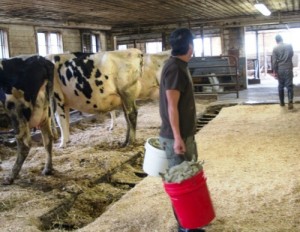
- Mexican workers do chores at a Vermont dairy farm. Photo by Terry J. Allen

Earlier this month, someone tipped off immigration officials, who then picked up seven Mexican construction workers in Essex. But unlike men on construction sites, Vermont’s dairy workers are hard to spot. They live on the farm, sleep in the farmhouse or a bunkhouse, prepare their own food, never go to movies or bars, can’t drive, and when sick, they go to a network of clinics that will discreetly treat them. They shop for food and clothes carefully, sometimes with the farmer.
Asked what they miss here in Vermont, Gabriel says, “Everything is OK. We are fine.” David raises a work-rough palm: “I don’t want people to pity me,” he says. But prompted, the men begin a modest list: I miss my wife. My baby. An afternoon playing ball. The river.
Oscar, the quietest of the three, who only recently arrived from rural Chiapas, is suddenly enthusiastic, and a smile lights his Mayan features as he remembers life back home. “In the evening, we would go out with friends, and go dancing. No one goes dancing here.”
He says he misses his country’s feast day celebrations with special foods and the children wild with excitement.
“I miss my wife, too, but I don’t have one yet,” says David, grinning while noting he is unlikely to find one here.
“I dream of being in Mexico, but I can do this job, because I know it is temporary,” continues David. He does the work in part because “My dad is 65 and can’t work much any more. … He limps. … Doctors don’t know why.”
Back in Tabasco, a rain forested state between Chiapas and the Gulf of Mexico, David grew watermelons and other fruit for his father. He had never seen snow, heard of Vermont, or worked with cows. But he has learned much about dairy farming. “Milking is boring. The cows throw off the machines. Some of them are crazy. But I don’t have to milk so much, now,” he says gleefully. “I can drive the tractors.”
“In Mexico I am free,” says Gabriel, but he adds that he worked for corn and coffee growers for only 90 pesos ($7) a day in Chiapas. “There were good years and bad, just like dairy.” Gabriel sports a rhinestone stud in one ear and sparkly peace sign on his hat.
“If we thought we were taking someone’s job, he says, “we would leave, but the boss says, ‘No, local workers can’t keep up with the schedule for long.’”

- A Mexican farmhand does chores in a Vermont dairy barn. Photo by Terry J. Allen

And long it is: 84 hours a week, 52 weeks a year, 3 a.m. to 11 a.m., a break, then 3 p.m. to 9 p.m.
How do Mexicans end up in Vermont? Most paid several thousand dollars to coyotes to guide them across the border. Some are caught. Some die of thirst in the desert of the U.S. Southwest. Others make it into an underground network and learn through the grapevine who is hiring, where. Farmers are part of it. They contact a broker, who, for a fee, delivers a worker with a will to work and a Social Security card that, real or not, generally lets employers off the legal hook. Jobs – and probably cards – pass among family members and village neighbors. The Social Security and other taxes the employer pays disappear into a governmental black hole.
When he first came to America, Gabriel cared for strawberry seedlings in Oregon; David did day-job construction in Texas, where his father works in a restaurant, and gave a coyote $2,700 to smuggle his son north. These jobs paid more than dairy and required fewer hours, but they lasted only days or months, and the danger of exposure was higher. Vermont dairy work is harder and less remunerative, but with long hours and no expenses for rent, heat or transportation, the savings mount. And the job is year-round.
Therein lies the root of the problem.
Only seasonal agricultural workers can get coveted H-2A visas that allow them to “commute” to the U.S. legally year after year for planting and harvest. But dairy farming is a year-round operation.
“We would like to work legally,” says Gabriel, “but there are no visas for us.”
So farmers and workers evade the law. The presence of more than 11 million undocumented workers in America speaks to the extent of the issue, and the fact that there were only 193,796 deportations last year speaks to a system that relies more on happenstance than justice.
States differ dramatically. In Arizona the hunt for “illegal aliens” is relentless, but Latinos blend in better there. Alabama’s controversial law, HB 56, turns local police into immigration agents and people who help undocumented immigrants into criminals. The law nullifies any contracts the workers sign.
In Vermont, enforcement is patchy. Last September a state trooper stopped a speeder in Middlesex, and turned the passengers, who looked Latino, over to immigration officials.
Gov. Peter Shumlin responded by suggesting that Vermont “looks the other way as much as we can” when dealing with what he termed guest workers. “Farmers can’t survive without them,” he said. “We know the federal government wants to send them home. And we don’t.”
Vermont’s beleaguered dairy farmers and the Mexicans who work for them hope that’s true.


