

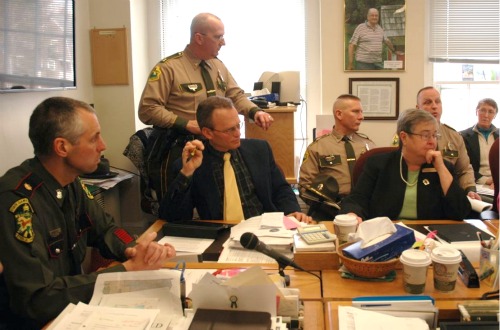
A panel of lawmakers Wednesday learned the ins and outs and complexities of search and rescue operations in a sometimes emotional hearing as it considers legislation on how Vermont should respond to such emergencies.
The state’s top state police officers and game wardens all crammed into the tiny House Government Operations Committee room, for a hearing brought about by the tragic death Jan. 9 of a missing hiker in Ripton. The search for Levi Duclos, 19, was not begun by Vermont State Police until 14 hours after he was reported missing on a cold winter night. He died of apparent hypothermia, though it was initially reported he had a broken leg.
The delay in initiating a search has prompted soul-searching at the state police and a change in protocol that formalizes calls to experienced search and rescue groups outside the state police, who were not called in when Duclos was reported missing at 8 p.m.
Lawmakers are taking a broader look at the entire system of state response and all the agencies that are – or should be – involved and how to prevent such incidents in the future. But concerns about Duclos’ death appeared to be still fresh, sparking some emotional outbursts.
A suggestion by Col. Dave LeCours, director of law enforcement for Vermont’s game wardens, that it pays to “hold back” resources as a situation unfolds or to manage stamina for an extended search drew a brisk response.
“If it were my child that was missing and I was told they were holding back, I’d go ballistic,” said Rep. Anne Mook, D-Bennington.
Rep. Robert Lewis, R-Orleans, a former state trooper and game warden, told lawmakers, “We’ve got to be careful about who we get in to help,” saying that inexperienced searchers can get injured, lost or mess up a crime scene.
“One of the biggest concerns is physical conditioning. You don’t want people (searching) to become a victim,” he said, calling volunteer help sometimes a “loose cannon.”
Rep. Willem Jewett, who hails from Ripton where Duclos died, bluntly called that point of view “backsliding” and said the state needed to open up its search system to pull in all volunteers who can help.
“If you put all these impediments in front of them they won’t do it,” he said.
Beyond the issue of who should participate in searches is the issue of who should oversee them. The panel Wednesday heard a consistent message that state police should remain the lead agency.
The state’s top officers and game wardens cited the need for a unified command to organize a search, keep communications open and make decisions to send in canines and shift a search to a crime investigation from a missing person search, which can sometimes happen. That makes the state police the best choice, they said.
“They have the manpower and resources to consolidate a search effort,” said LeCours. While game wardens are familiar with the back country and are trained in first aid, he said the small number of field officers and staff – at the max, 50 if everyone is “mustered in” – precludes his department from taking a lead role.
Game Warden Major Dennis Reinhardt seconded that view.
“I think it would be irresponsible of us to take the lead at this point,” he said. Not only is his force down to 27 field game wardens, but statute calls for state police to be the lead agency. He said the idea of shifting responsibility has currency because some states successfully use game wardens for the search and rescue role.
Duclos’ aunt, Kathy Duclos, has publicly criticized the state police response and urged state officials to set up another agency as lead in search operations. In Maine and New Hampshire, game wardens are charged with that response but in Vermont, state police have that role.
LeCours said searches are complex and varied, ranging from ones that could be a crime or accident, such as a missing toddler, or an Alzheimer’s patient who wanders off – “people that don’t even know they’re lost,” he said. State police are better suited for that variety of situations, he said.
Jewett said, in his view, timing is everything. “Delay leads to bad outcomes,” he said. Col. Tom L’Esperance of the state police told lawmakers, “We recognize we can do things better” and said he agreed that when it comes to searches, “It should be one call to 9-1-1 and everything’s delivered.”
“There is nothing we don’t agree with,” L’Esperance said, in the panel’s efforts to try to put into legislation a protocol for search and rescue. A bill being drafted by the committee calls for an interim protocol by September 2012 from the Department of Public Safety and also a study committee to look at procedures in Vermont.
Still, L’Esperance, like LeCours, pointed out the complexity of issues and nuances that can be raised by searches, such as whether it’s a missing person and a potential crime, or a missing hiker or skier.
“Yet it’s hard to determine on a 9-1-1 call what’s the difference,” he said.
“It’s easy to say, ‘Come up with a solution,'” he said, but he urged the panel to keep state police in the oversight command role because of their broad expertise.
The state police have 17 search and rescue command officers who are trained to oversee a response and organize a search, he said, and their skills are critical in oversight. Since the Duclos tragedy, state police have begun working on a database of other expert agencies and people with specialized rescue skills such as Stowe Mountain Rescue and Colchester Rescue, or sheriffs or local agencies that want to be involved, he said.
Jewett said he felt that data base was a “key” part of an effort to coordinate a prompt response when a search or rescue call arises.
State police Capt. Rob Evans, who oversees the force’s nine specialized units, said state police keep tabs on officers training and expertise and nine of the 17 search and rescue commanders are certified by a national association of search and rescue.
Evans related a recent search for a missing 5-year-old in Underhill who eventually emerged unscathed 50 minutes later from the woods and was picked up by a neighbor. Numerous agencies were called in, he said, including local fire and police and a command post was started and a helicopter was being sought to assist.
He said state police have “great working relationships” with outside organizations. “Every search incident is unique,” he said, adding sometimes “pulling the trigger early” works and other times more information is beneficial.
In response to a pointed question from Rep. Michel Consejo, D-Sheldon, Evans said the state police never consider the cost of a search in making a decision.
“If lives are at stake, the rescue will roll,” he said. He added that his experience over the last six to eight years is that it pays to push for a concerted early response.
“We’ve found that it’s more effective to put the money up front,” he said.
L’Esperance, who said he has “thought long and hard since the (Duclos) incident took place,” wondered if some “local home cooking” of community-based policing was lost when the state regionalized dispatching for state police. While that is efficient and “the right thing to do,” the state police now need to make sure dispatch and command officers know about local resources and how to call them in to help, he said.
Committee Chairwoman Donna Sweaney, D-Windsor, said one good thing that can come out of the tragedy is that Vermont can become “a leader in search management and theory,” as well as looking at other state’s that have good models to follow.
Reinhardt agreed, saying a “hybridization” of what works in other states may prove a good model for the state.
“Vermont is so small, we will continue to work together,” he said.

