


Editor’s note: A version of this story by Katie Jickling first appeared in The Herald of Randolph on Jan. 12.
State Rep. Sarah Buxton, D-Tunbridge, is submitting a bill today that will likely stir controversy among education policymakers. Her proposal would allocate more public money for independent schools and require that those private schools offer special education programs.
As the state representative for both a school-choice town (Tunbridge) and a town with a designated public high school (Royalton), Buxton treads a fine line between two differing ideas about government intervention and equality in public education.
The issue of how to incorporate school choice and independent schools in the state’s public school system has been an ongoing issue as legislators have sought to reform the state’s education system through district consolidation and other efforts. School choice proponents have often clashed with public school advocates over equity and funding.
Buxton’s proposal would require compromise from those on both sides of the issue. Her legislation would require independent schools like Sharon Academy to become certified in special education programs. It would also allow private schools to set higher tuition rates, closer to the state average, that would be met by sending towns. The proposed bill also contains basic requirements for schools receiving public money, such as complying with all state and federal assessment requirements for public schools.
“I’m not trying to make approved independent schools function like public high schools,” she said. “I acknowledge that more flexibility has helped them to have a different type of educational opportunity. Whether or not they can provide special education to everyone, I believe Sharon Academy provides an excellent education. Their standard is one I think that the public schools would like to adopt if they didn’t have those kinds of restrictions.”
The compromise approach gives her optimism about the bill’s passage.
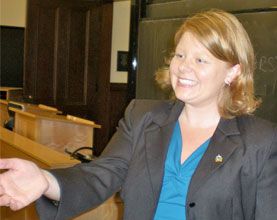
“I think it will pass,” she said. “If I can show that the two parties that have the most interest in this bill, approved independent schools and public schools, can both come to the table and say ‘we can live with this,’ then the bill can move out of the committee.”
Last year bills on regulations for independent schools that receive public money were introduced in both the House and the Senate, by Rep. Anne Mook, D-Bennington, on the House side, and in the Senate by Sens. Dick McCormack, D-Windsor, Harold Giard, D-Addison, and Mark McDonald, D-Orange.
Both bills envisioned a stringent reform for policies regarding “choice” students, requiring all independent schools — whether focused on ski or hockey, special education or general education — to meet the standards of public schools in order to receive public funds.
The justification for the legislation, McDonald argued, was equity. “Private schools would not be able to cherry-pick students and still take public money,” he said.
Under the current system, state tuition money for students of “choice” towns – towns where there is no designated public school — travels with the student to the school of their choice. Tunbridge, Strafford and Sharon are among 91 such towns in Vermont where students have school choice. As an independent school drawing from these towns, The Sharon Academy has surfaced as a source of contention in the debate.
Although some choice towns limit education options to a few surrounding schools, many others allow students to use public funds to attend any school in Vermont or beyond, provided that they find their own transportation. Private schools — or more specifically, approved independent schools — can also accept these students, though at times, as in the case of Sharon Academy, admission policies apply.
Neither bill last session gained traction. Vermont Education Commissioner Armando Vilaseca maintained that last year’s suggested measures were too strict to be effective. The proposition, he reasoned, was “too comprehensive in its expectations that all schools be held to the same standards, especially for smaller schools that have a focused and specific mission.” As a result, his department opposed the policy.
At the end of the last legislative session, S.044 in the Senate had been tabled, and H.170 remained in the House Education Committee. Neither bill, agreed both legislators and officials, is likely to be taken up again this session.
A level playing field?
Meanwhile, deep-seated and divergent opinions from the area’s educators, citizens and school administrators smolder as they weigh potential effects of the proposed changes.
Tom “Geo” Honigford is perhaps the area’s fiercest advocates for “a more level playing field” among public and independent schools. Honigford, a farmer in South Royalton, taught at Sharon Academy for several years and now serves on the Royalton School Board.
Current education law, Honigford argues, unfairly privileges school-choice students and creates inequities in how it treats mandated offerings for public and private schools.
Independent schools, he said, don’t play by the same legal rules. They don’t have to take all comers — students go through an admissions process. Teachers at private schools don’t have to be licensed. Compliance with special education and the federally mandated No Child Left Behind Act is optional. Free and reduced lunch programs are not required.

These differences have always existed between public and private education. The inequality issue kicks in, Honigford said, when independent schools exercise these privileges while accepting public money.
He has described this policy, especially the application process, as “educational apartheid.”
That’s “kind of a strong word,” he admitted, “but ‘apartheid’ means separatism.”
“Randolph, Bethel, Rochester, Chelsea are all comprehensive schools, and are teaching to the ones that are going to college and the ones that are not going to college,” he continued. “Probably some of their students will drop out of school and they’re teaching them, too.”
Honigford said he sees the value in a Sharon Academy education. “It’s not about the quality of the education,” he said. “It’s about who gets that education.”
Drawing from his work in politics and as a former Randolph middle school teacher, Sen. Mark McDonald of Williamstown was one of three senators to champion Honigford’s ideas when he co-sponsored a bill in the Senate last year.
During his career as a teacher, McDonald said, “I worked hard to make sure that every child felt entitled to go to school, even those from diverse backgrounds, and learn from each other.”
McDonald added that removing students from that environment negatively affects the whole system. “Kids make classes work by participation as part of a team. It makes the public school a less useful place.”
At the academy
In his office at Sharon Academy, Michael Livingston pulled up a chair alongside Amber Wylie, associate director of communications and admissions, and Jen Hayslett, the senior director for development and communications.
Livingston is in his seventh year as head of school, after serving six years as humanities teacher and assistant head. Previously, he served in various administrative capacities in public schools including Royalton, Norwich Elementary and Hartford.
To dispel lingering allegations of elitism, Sharon Academy administration underscored their educational philosophy as unique and challenging, but not exclusive.
The Sharon Academy, Livingston explained, was started 16 years ago with 12 students with “the impetus to create a safe, welcoming environment,” while “not isolating students with different learning styles of disabilities or interests.”
Sharon Academy also prides itself on its egalitarian approach, doing without such stratifying components as National Honor Society, advanced placement or honors classes. The high school now has 131 students, with an additional 40 middle school students housed in the Old Schoolhouse in Sharon. Some 80 percent of its students hail from “choice towns,” and so attend with public funding.
The academy uses a different methodology that isn’t always comparable to public schools, Livingston said.
“In terms of formal state regulations, we don’t provide special ed,” Livingston said, adding that the academy has its own system in place for students with disabilities or who need academic support.
Allowing that they don’t accept 100 percent of applicants, most often due to space, Hayslett asserted, “It’s not about being elitist. It’s about giving kids opportunity.”
“We get to know students well and build that trust and respect,” Livingston added, “to build life-long learners.”
And, contrary to the perception that Sharon Academy has abundant resources, the school was forced to cut its lacrosse program this year, instituting co-ed club ultimate Frisbee instead.
“Even Hartford with a huge facility can’t accept every single student,” Livingston continued. “The question is, where are we getting into massive duplication of services? We can’t be all things to all kids.”
Mill Moore, executive director of the Vermont Independent Schools Association, concurred. “Independent schools do things that the public system doesn’t want to or are unable to do,” he said. “There’s no point in being independent if you can’t be different.”
“The rules we’re playing by are the rules that are laid out,” Livingston concluded. “We’re not manipulating the rule. It’s public money for public school kids.”
Pupil shortage puts schools in competition
Parties on all sides of the school choice debate say the issue is exacerbated by low student enrollments statewide.
Fewer students results in fewer state dollars for schools, and as enrollment drops, the base costs for small schools can’t be reduced, spreading resources thinner and thinner.
“This issue didn’t exist 10 or 15 years ago,” Livingston said. “There were enough students to go around.”

Geo Honigford agreed, noting that now, “SoRo is competing with Sharon for students.”
Specifically, Honigford estimated that “If TSA was not there at all, we would probably have 16 more students, at a tuition of $14,500 per year that means $232,000.”
Most schools in the area suffer from declined enrollment, he continued. “There are kids every year that leave Randolph and move to a choice town to send their kids to Sharon Academy. For each kid that moves, that’s money being lost for the Randolph school system.”
“I can’t stress enough,” Honigford repeated, “that I think private schools have a right to exist, so I am not calling for them to not be able to accept public money. They just need to accept it on the same terms that public schools do.”
The Sharon Academy has been working to accommodate those needs. Although there is no legislation requiring them to do so, the school is currently in the process of becoming certified in two of the 14 national special education categories. Though the academy is not certified in any of the federal special education programs, through referrals and their own observation, the school develops personal Education Support Plans, its equivalent of the Individual Education Plan, a special education program used in public schools.
About 11 percent of the students at Sharon Academy have “academic diagnoses,” while 35 percent are involved with some type of academic interventions, ranging from brief to long term, according to data from the school.
Although the special education certification would placate critics, it would also increase the school’s dependency on tax dollars when it starts to receive federal funding. The administration also predicts more applications with the increase in programs, which would mean turning away more students.
To address special education, the most contentious aspect of the dispute, Buxton’s bill requires that independent schools accepting public money become certified in four federal categories, two by July 1, 2013, and two more by July 1, 2015.
This stipulation, Buxton said, would meet the standards “related to more basic disabilities, and that appeal to the broadest number of students in the state of Vermont.”
“It would not make that a completely equal playing field for both types of schools,” she acknowledged. “But I feel that by pushing this bill forward outlining 6-8 categories, both the needs (of the independent and the public schools) can be met.”
Under the current system, the public school is also responsible for tuitioning out any student they cannot serve, often at high cost, an issue highlighted by Honigford. That same burden would not be placed on independent schools in Buxton’s existing proposal.
Out of the 14 total categories, Buxton estimated that most public schools are certified in about 10.
Funding increase
Buxton’s legislation would also increase the funding that independent schools like Sharon Academy can receive from sending schools, putting the figure more on par with the state average. Currently, the academy has limited its tuition to the 2011-12 state rate, “so every student in choice towns can come here,” Jen Hayslett said.
The current tuition rate at The Sharon Academy is $12,035, compared with an average cost per student between $15,000 and $16,000 in most public schools.
The bill will also allow the application process to remain unchanged, a point that may generate controversy.
“I’m not sure that I really support eliminating the application process,” Buxton explained. “And I think that the public school could adopt a permutation of that policy. When you’re affirmatively choosing to attend that school, you take a more active role in your education than if you are just enrolled.”
Buxton recognized that “Some people could look at this and say this is a political nightmare.” But that just made her more determined to push ahead.
“I really value education, and I said, if they’re disagreeing about this, I want to be part of this conversation; people care deeply about the kids they’re serving. I think it’s important that we value that.”
Katie Jickling, from Brookfield, is a freshman at Hamilton College.
Correction: This story originally and incorrectly stated that Thetford was among the towns that sent students to Sharon Academy.
