


MONTPELIER – The dollars and details are spilling out as the Shumlin administration scrambles to spell out a drastic revamp of mental health care in the wake of Tropical Storm Irene’s devastation.
A harried Mental Health Commissioner Patrick Flood appeared before the House Human Services Committee with the first detailed take on how the state plans to rebuild the mental health system after the flooding closure of the 54-bed Waterbury State Hospital.
Lawmakers on the panel, who convened this week for a new session, also listened to mental health providers who several times used the word “urgent” to describe the need to get moving on a plan to alleviate the crisis caused by the hospital’s closure. The providers praised Flood for visiting them and many of their facilities in the past two weeks since he took over as Mental Health commissioner in a job swap with Christine Oliver.
The panel got a front row seat on the central disagreement over the plan when they were told via speakerphone by the head of Fletcher Allen Health Care’s psychiatric unit, Dr. Robert Pierattini, that the state cannot get by without a 30-40 bed state hospital staffed to handle patients needing intensive mental health care.
The governor’s plan rejects the need for a central facility that size, and that issue is shaping up to be the major point of contention.
Flood made it clear he understands anxiety and stress remain in the mental health community since Irene hit four months ago.
“We are in a situation that is evolving as we speak. There is no way around that,” he said, acknowledging as he handed out version one of the detailed plan that there already is a version two. “I know this document will change by the end of the day.”
Flood said he was impressed by the cooperation and hard work of everyone in the field, though he warned “hard choices” lie ahead.
“Together we will come up with the best choices for Vermonters, I am sure,” he said.
The governor’s proposal, unveiled last month, includes 36 acute care beds to replace the state hospital, spread out at three facilities: 14 at the Brattleboro Retreat ready as early as July; six at the Rutland Regional Medical Center as early as fall; and a new 16-bed facility to be located near Central Vermont Medical Center in the future.
It also proposes to greatly expand community services, from emergency intervention, housing, crisis beds, so-called peer services and intensive local mental health outpatient and residential services that administration officials say will preempt the need for a larger state hospital.
Flood put some dollar signs and timelines on the plan for lawmakers on Thursday. The capital costs of the Retreat beds would be $4 million; the new ward at Rutland would be $6 million; and the state-run facility would cost $16 million, for $26 million total in capital costs, he said.
Flood said FEMA may cover some of those expenses since they were created by the flooding at the state hospital. Alternatively, the costs may be built into the rates charged by the facilities.
Importantly, he said the state is now eligible for an additional $20 million because all the new sites are eligible for Medicaid and Medicare reimbursements that the federal government previously denied the state because of quality of care issues at the Vermont State Hospital.
The funds from the Centers for Medicaid and Medicare will be used to strengthen community services, Flood said.
The proposal detailed Thursday includes $1 million for four new crisis beds; $600,000 for up to 100 housing vouchers since lack of housing often precipitates mental health crisis; $1 million for so-called “peer services”; and $5.6 million for new residential program beds such as those at Second Spring in Williamstown, which takes patients whose needs can be handled in a less than acute setting.
Joining Second Spring with “step-down” beds will be a new seven-bed facility in Westminster that is under development and expected to be ready in February and another one with 15 beds in northwestern Vermont that could be available in six months once it is approved by the Legislature, he said. Second Spring will add eight beds for a total of 22, he said. In all, the plan includes 30 new community based spots.
Flood said he anticipated additional staffing costs for his department to ensure that the expanded, decentralized system is well-integrated and a new web-based tracking system for patient needs is established. He said the state is still urgently seeking a solution for housing patients under court order, since they cannot continue to stay at the correctional center in Springfield.
Flood conceded the “fewer versus more” debate over state hospital acute care beds is key, but he also noted the central Vermont facility would not be ready for two to two and a half years.
“I want to emphasize that point so we don’t get inordinately stuck on that one point,” he said.
At the same time Flood emphasized that the facility is being designed for “quick expansion” to 25 beds if needed.
Providers question plan
Pierattini told lawmakers on the panel that Fletcher Allen’s experience with taking patients who would have ended up at the state hospital before Irene has been dramatic and difficult. “We are doing our best,” he said, but “the mental health system is at the very edge of adequacy,” he said, telling stories of his own personal experiences working over New Year’s Eve.
“Our units were full, they were overcrowded, they were dangerous,” he said, and the hospital has also had to turn away patients who needed care. This was not the case before the state hospital closed, he said.
Pierattini said the state needed a “Level 1” intensive care mental health facility with 30 to 40 beds to replace the Waterbury State Hospital, and the facility absolutely needs to be in a medical center and provide the full range of medical care. He said mental health patients now at Fletcher Allen display a host of “extensive medical issues” from diabetes to suicide attempt wounds to seizures, renal failure and hypertension and drug addiction.
“These are very typical,” he said, adding that it was “inconceivable” to him that the system would try to treat the most acutely ill anywhere but with full hospital care.
“If we don’t do this people will die because we absolutely have to have these medical services,” he said, specifically excluding the idea of using a nearby hospital where response is “by vehicle.”
It is unclear in the governor’s plan how close the 16-bed Central Vermont facility will be to the Central Vermont Medical Center and what medical services it will have.
He also strongly backed the contention by the Vermont State Employees Association and Dr. Jay Batra, the head of the Vermont State Hospital, that a central facility with well-trained staff is best able to deal with patients in acute crisis, and he said the new state plan does not provide enough beds in the northern part of the state. He further raised issues of accountability when private institutions treat mental health patients under state care, an issue raised by the state employees association as well.
The state plan, he said, should be modified.
“We need a replacement hospital that is accountable to the commissioner of mental health and fully integrated into a medical center,” he said.
Ann Pugh, chair of House Human Services, pressed Pierattini on how he came to the conclusion that a 30- to 40-bed hospital is necessary, noting that Flood had testified that as many as half of the patients at the state hospital could have been served elsewhere if services and beds were available.
Pierattini said the 54 beds at the former state hospital were “not an arbitrary number” but based on trial and error and data over many years of experience. He cited a 2006 study that called for 30 to 40 beds.
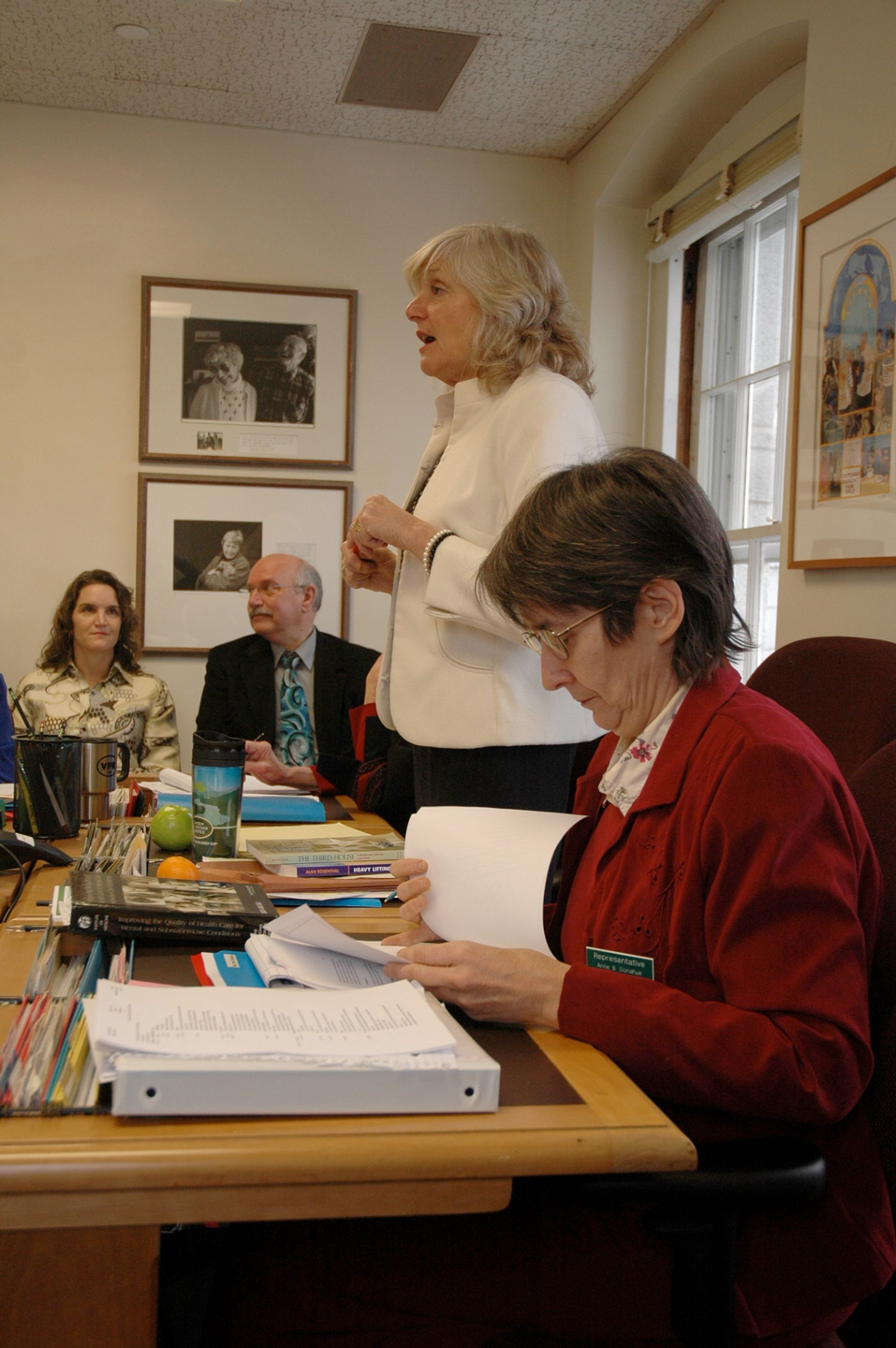
Pugh replied that if the state built 100 or 200 beds they would fill up. She said overbuilding capacity was problematic. Rep. Anne Donahue, R-Northfield, said the key was finding the right balance.
But Pierattini stuck to his guns, insisting that the system has to plan for “for peaks in census (because) the averages can be misleading.” He urged the panel to talk to more practitioners in the field and not just administrators for their advice.
“I think it’s very important to get testimony from actual mental health clinicians,” he said.
That touchy subject was raised by Rep. Topper McFaun, R/D-Barre, who asked Flood whether state hospital employees on the frontlines had been consulted in drafting the plan. Flood conceded he didn’t know the answer to that question. Batra, the state hospital chief, has testified no one from the Agency of Human Services consulted him on the governor’s plan.
Rutland Regional Medical Center President Thomas Huebner and Brattleboro Retreat President and CEO Robert Simpson both stressed the urgency of the situation and they asked the panel to move quickly to approve funding for expanded acute care beds.
They agreed with Pierattini that the system is in extended crisis, treatment is suffering, and that stressed-out staff need to know the state is working quickly to resolve the issues.
“We’d like to get a yes as soon as possible” said Huebner of the proposed six-bed facility for his hospital, which has been accepting disruptive patients who previously might have been at the state hospital and forced to turn people away as well.
Citing the severity of the need and patients who can’t get or decline treatment because of the crowding at the hospital, he said, “There are moments we really don’t sleep well at night.”
Simpson agreed with Huebner.
“The system is very shaky,” he said.
The one blessing, he said, is that a real sense of teamwork has developed among all the providers since Irene, and the closure of the state hospital has provided “a wonderful opportunity to take a stab at stigma.”

