

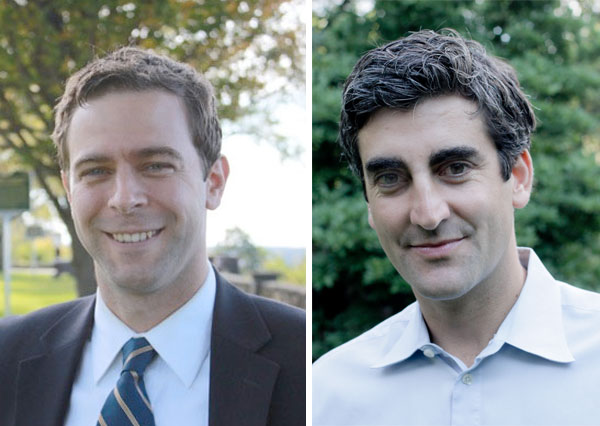
Miro Weinberger and Tim Ashe want to stay on the road to unity until the Burlington Democratic Caucus reconvenes on Dec. 11. When the two candidates for mayor ended up in a third round tie during caucus voting on Nov. 13 the meeting was suspended after more than six hours. But not everyone in the Progressive or Democratic parties is comfortable with fusion, the political strategy Ashe has proposed, or even with holding two caucuses on the same day.
“I find it incredibly disrespectful to the democratic process for the Burlington Democratic Executive Committee to schedule the continuation of their mayoral caucus on the same day and essentially the same time as the Progressive caucus,” says Elijah Bergman, vice-chair of the Burlington Progressive Party.
Bergman is not convinced that the decision by local Democrats was accidental and calls any claim that they didn’t know “an outright lie,” or else evidence that Democratic leaders don’t read news reports. He wants them to reconsider and move their caucus continuation to “a more appropriate date.”
Ed Adrian, a city councilor who serves as vice chair for local Democrats, “respectfully disagrees” with Bergman’s view. The fact that the Progressives will hold their caucus later on the same Sunday did come up “in a side discussion and people said it wasn’t relevant,” he explained. “We picked the best date. It was set that we had to do it on a Sunday, either December 4th or 11th. We looked at logistics, but we have a process to follow.”
Adrian’s basic reaction to the coinciding dates is “so what? Progressives will go to theirs and we’ll go to ours.”
Despite talk about joining forces, suspicions persist in both camps. According to City Council President Bill Keogh, many Democrats question Ashe’s loyalty to the party and suspect that he may be attempting to use the label simply to get elected. Last Friday Keogh, who previously questioned the qualifications of all the candidates, joined other Democrats who endorsed Weinberger.
At a City Hall press conference, Keogh appeared with former Gov. Madeleine Kunin, state senators Philip Baruth and Hinda Miller, and three of six Democrats on the city council. Praising both candidates and the party’s “deep bench,” Baruth nevertheless singled out Weinberger as a “gifted leader” with the ability to reach out.
His advantage, Baruth added, is the ability to directly challenge Kurt Wright, the presumed Republican candidate, for his handling of Burlington Telecom. Weinberger “can point out that he [Wright] was present and voting when the dream turned into a nightmare,” he said.
The implication is that Ashe, who was a Progressive member of the city council during Mayor Bob Kiss’ first term and continued to defend the administration until 2010, would not be as effective. “We need a clean break,” Baruth said.
Ashe has consistently proclaimed his intention to unite the two parties, which have been “unnaturally divided” since his political mentor, Bernie Sanders, defeated a Democrat to become mayor in 1981. To that end, he has pledged not to run as a Progressive if he loses the Democratic caucus, but to challenge Kiss for the Progressive nomination if he wins. Kiss has not yet announced his plans.
At the Democratic caucus, Ashe came out ahead in the first two rounds of voting. But when City Councilor Bram Kranichfeld was eliminated, his supporters went for Weinberger about 2-to-1, creating a 540 tie. It was an early sign that party stalwarts may not be ready for another run at fusion.
In 2002, Mayor Peter Clavelle made a similar proposal when he sought the nomination of both parties. The two caucuses were also held on the same day that year – Dec. 17, a Tuesday. Two decades before, Clavelle had broken with local Democrats to become part of Sanders’ administration and the progressive movement.
He won the Democratic nomination by just five votes, defeating council president Andy Montroll. Some Democrats and Progressives weren’t happy with the outcome. Ian Carleton, then a city councilor, noted at the time that shortly after winning the Democratic nomination Clavelle attended the Progressive caucus and re-pledged his allegiance. “I think frankly the jury is still out as to exactly what this means,” he said.
Two years later, Clavelle challenged Jim Douglas for governor as a Democrat and lost. In 2006, he and other Progressive leaders attended the local Democratic caucus and backed Hinda Miller. But members of his former party weren’t content and recruited Kiss to run.
A similar dynamic is at work again. Leading members of the progressive movement, including former Burlington Progressive Party chair John Franco and Sanders staffer Phil Fiermonte, who served as a Progressive city councilor, attended the Democratic Caucus to back Ashe. Others declined to participate, however, and are uncomfortable with a formal alliance.
Despite Ashe’s pledge, if he loses on Dec. 11 Progressives could still nominate Kiss or someone else an hour later.
Bergman feels that the Democrats’ decision to resume their caucus only hours before the Progressive gathering “demonstrates a lack of class.” It is not an attempt at fusion, he charges, but rather “an attempt to marginalize Progressives. If they had been scheduling it for Tim, then they would have held it this weekend as he requested.”
After the Democratic caucus was suspended, Ashe urged the party’s Executive Committee to reconvene for a final vote on Nov. 20, the earliest possible date, while Weinberger suggested Nov. 27. “My overarching goal,” Weinberger explained Monday, “was that the committee lay out a timeline and process so that as many people as possible who made the effort to attend on Nov. 13 would be able to participate. I didn’t get everything I wanted either.”
Party officials had concerns about both options proposed by the candidates. Some people were already leaving town for the holidays, Adrian explained. “To do it over a week that’s a national holiday period would raise more problems than we wanted to deal with,” he said.
Between now and the caucus date, the party plans to review the registration list and contact everyone who attended in November, more than 1,300 people. If a person who attended does not see his or her name on the list, enough time has been allowed to contest the decision by filing an affidavit. “That will take about 10 days,” Adrian predicts. “We will release the list after Thanksgiving.”
“People may be upset, but we are bending over backward not to disenfranchise anyone,” he added.
Bergman sees the date chosen as an unwelcome intrusion. “I realize in the past they have had the caucuses on the same day,” he wrote in a follow up statement. “It would have been a different matter if we had wanted that from the start like they had in years past. It’s the fact that they were separated initially and intentionally and then the Dems had a choice to keep their continuation separate but didn’t.”
When local Progressives learned that the Democrats planned to meet sometime in November, he claims that “out of respect for their party, the Burlington Progressive Steering Committee set our mayoral caucus for the middle of December. This was intended to allow both of our parties an opportunity to ‘have their day’ in the spotlight.” As it stands, around 1,000 Democrats will gather to pick their nominee shortly before a Progressive turnout that is likely to be much smaller.
After the date of the Democrats’ caucus continuation was set, Ashe declined to criticize the choice. Instead, he proposed a series of public debates. “Our campaign wants to respect the voters first and foremost and therefore will be careful to not overwhelm people over the coming holiday with unnecessary campaign contact,” he said in a statement.
Weinberger agrees about the timing and is equally eager to debate. The first one-on-one discussion, hosted by the Burlington Free Press, will be live streamed over the Internet at noon on Dec. 1.
Adrian also supports having debates. “After the decision we called the candidates on a conference call,” he said. “We went over the decisions, and I told them debates are great, but the committee won’t sponsor them. If there are some, they will be set up by NPAs or other groups.” Both the time and money involved make it difficult for the party to be the organizer, he explained.
Fusion, 20th century style
Whatever the outcome of the caucuses, it won’t be the first time that Democrats have experimented with fusion. Almost a century before Clavelle’s attempt – running for mayor as a Progressive/Democrat, then for governor as a Democrat two years later – another Burlington mayor joined forces with dissident Republicans.
In June 1906, the Democratic and a newly created Independent party purposely staged consecutive conventions in Burlington to nominate a fusion ticket. Democratic Mayor James Burke had forged an alliance with dissident Republican Percival Clement, a railroad tycoon and owner of the Rutland Herald. Both were at war with the Proctor wing of the Republican Party. Fletcher Proctor was the Republican candidate for governor that year.
Like the current push for fusion between local Progressives and Democrats, the Burke-Clement alliance was largely rooted in political expediency. Both men wanted to be governor and knew that a Democrat could not win. For some Progressives, the main reason to unite with Democrats now is that the party’s brand has been so damaged by Mayor Kiss and the BT mess that voters might elect a Republican.
In the early 20th century fusion was called the “Bennington idea,” referring to the town where a petition first circulated for Clement to lead a movement that aimed to “save the state” after 50 years of Republican rule. Clement’s supporters considered fusion with Democrats essential, and thus tried to induce Burke to join the ticket.
The mayor wasn’t convinced, however. Giving Clement the Democratic nomination for governor would effectively put him in control of the party. Some local Democrats feel the same about Ashe.
The Democrats were still divided on June 28, 1906, the day of both the Independent and Democratic state conventions in Burlington. The Independents convened in City Hall while the Democrats met at the armory. A joint committee worked out an agreement to divide the state ticket. The Democrats would field candidates for one half of the slate, Independents would take the rest. After accepting the Independent nod Clement walked with Burke to the Strong Theater for a joint assembly.
The debate over fusion was heated, some people accusing Burke of questioning the idea because he couldn’t head the ticket. The Democrats rejected Burke’s warning and approved a joint slate headed by Clement and Democrat C. Herbert Pape. Despite his reservations, Burke campaigned actively, and could still envision a popular coalition of Lincoln Republicans and Jefferson Democrats that would wipe out party lines and combat corporate lobbying on labor issues like the minimum wage.
But Fusion was defeated by Republicans united behind Proctor in November. And the following March, Burke came up short in his first mayoral race in five years – to Walter Bigelow, former chairman of the state Republican Party and night editor at the Burlington Free Press. The defeat was devastating for Burke allies who lost their jobs and watched old opponents return to power. Clement eventually became governor in 1918 – as a Republican.
A century later, two of Burlington’s political parties are still struggling with the concept. Some Democrats view Ashe’s proposal as an encroachment or an attempted takeover, while a considerable number of Progressives feel that a formal alliance would be an admission of defeat that could lead to the end of their party. At its peak, local Progressives held seven seats on the city council. Today they have two.
Due to the high regard for Ashe, the current truce is expected to last another three weeks at least. But there are several unknowns, including whether Mayor Kiss will run again or if the Progressive Party is ready to go along with Ashe’s non-competition commitment. The last time that was tried, Kiss surprised the political establishment by entering the race late and beating Democrat Hinda Miller.
The Democratic Caucus will reconvene at 1 p.m. on Dec. 11, with registration and voting until 4 p.m. Only residents who registered to vote on Nov. 13 can participate.
The Progressive Caucus will begin with a 5 p.m. potluck supper at the Integrated Arts Academy, located at H.O. Wheeler elementary school. Selection of city council candidates, and perhaps even a mayoral nominee, will begin at 6 p.m.
###

