

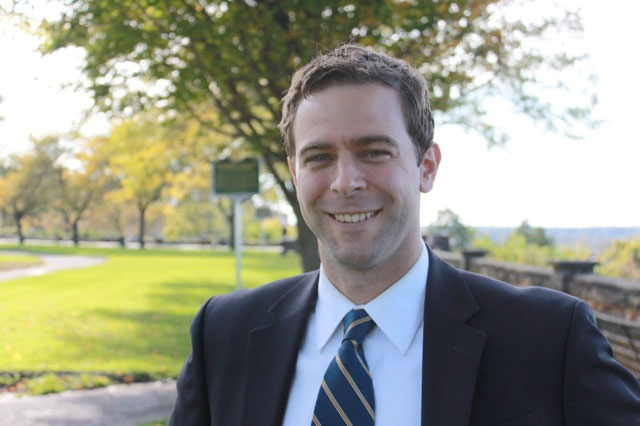
At a Democratic debate two days after publicly declaring his run for Burlington mayor, State Sen. Tim Ashe described himself as the one candidate “who can bring people together and end the partisan fighting.”
His strategy is to become a “fusion” candidate for both the Democratic and Progressive parties.
Three other Democratic contenders in line for the job were seated nearby at the Champlain Elementary School. City Councilor Bram Kranichfeld, D-Ward 2, talked about the need to restore fiscal responsibility, trust and accountability. Airport Commissioner Miro Weinberger described his relevant leadership experience. State Rep. Jason Lorber told a moving personal story about values, trust and strength. Over the next weeks, VTDigger will look at each candidate.
The general election is still more than four months away, but the Burlington Democratic caucus will be held early this year. The biggest turnout in decades is anticipated Nov. 13 at Memorial Auditorium. The next day the party will hold a unity event.
In an interview last week, Ashe, a 34-year-old lawmaker who has been immersed in Vermont politics for more than a decade, described how he sees the race.
Although his first job after graduating from UVM in 1999 was with Bernie Sanders and he served three terms on the City Council as a Progressive, since 2008 he has been elected to the House and Senate with the support of both parties.
“In two races I have attracted a tremendous amount of support from Democrats,” he recalled. “When offered an honest, different path forward, many people supported that path.”
This time, he wants to be the Democrat in the race. He said that he also “will accept” the Progressive nomination – but only if he wins the Democratic nod first. If he doesn’t, Progressives will have to scramble for another nominee, or settle for Bob Kiss, an embattled incumbent who has frustrated much of his base.
Six years ago, Kiss was a last-minute Progressive pick, after Mayor Peter Clavelle and others in the local movement backed a Democratic candidate. They had concluded that a Progressive couldn’t win. Some progressives employed by the city were concerned about losing their jobs. Progressive Party leaders disagreed and nominated Kiss, who scored an upset in part due to instant run off voting. Three years later, he was re-elected.
But complaints about IRV led to its repeal. Next March, there won’t be a run off unless no candidate wins 40 percent of the vote.
Kiss says he will announce his plans in November. If he opts for re-election, Ashe says he won’t “openly challenge.” But that leaves room for others to introduce his name at the party’s Dec. 11 caucus. When asked if he was running against Kiss, he agreed.
Ashe is in an unusual, delicate position. Under Progressive Party rules, only someone who has already run solely as a Progressive can subsequently also accept the nomination of another party, according to Elijah Bergman, vice chair of the local Party. No other Democratic candidate qualifies.
On the other hand, it is precisely Ashe’s allegiance to the Progressive Party – an outgrowth of the coalition that displaced the last Democratic mayor from City Hall 30 years ago – that leaves some Democratic stalwarts skeptical. Although Ashe argues that his ties to both parties make him the best option for preventing a Republican victory, Weinberger claims that Ashe is likely to be seen by many people as a political ally of Mayor Kiss.
At the debate, one audience question went straight at the issue of party loyalty: Would the losing candidates actively support whoever wins the caucus? The other three hopefuls were unequivocal, but Ashe suggested that his backing, while likely, wasn’t unconditional. It will depend on “a compact that all candidates live up to,” he said. “We’ll see if the high road is taken.”
Dysfunction and lost opportunities
Some Progressives harbored hopes that Brian Pine, Burlington’s assistant director for Housing & Neighborhood Revitalization, would enter the race. But Pine, a Progressive Councilor for two terms in the 1990s, couldn’t run because federal funds help pay his salary, a restriction imposed by the Hatch Act.
Two weeks ago, during a debate over whether to drop party designations in local elections, Kurt Wright pointed to this restriction, noting that in party-based races some qualified people are “Hatched out.” The Council’s two Progressives, as well as six Democrats, voted against dropping party labels.
Ashe doesn’t think that political parties are the real issue. What he calls “the political dysfunction, the constant theater at city hall,” is one of two “deep sets of problems” that ultimately prompted him to run. “Anyone who has followed the council knows it has been dysfunctional and marred by constant sniping,” he charged. The other set is financial pressures, he said, mentioning the handling of Burlington Telecom, a $50 million pension liability, and looming budget cuts.
He placed much of the responsibility on Kiss, charging that he has demonstrated “a complete lack of leadership. His primary deficit is failure to communicate,” Ashe said, adding that “so much of the good will he ought to have was squandered.”
His view of the mayor has changed significantly since 2009, when Kiss ran for re-election. Ashe expressed “deep support” for his fellow Progressive at a January 2009 press conference, and he praised the mayor’s team for pulling “rabbits out of hats.” Kiss “cleaned up financial messes,” he said. “If that’s drifting, then let’s keep drifting.”
This was before the public learned that Kiss and chief administrative officer Jonathan Leopold kept a $16.9 Burlington Telecom debt to the city treasury secret until after the election. Last week Ashe went public with his revision of history. “He didn’t share information with the public,” Ashe said of Kiss. “This hasn’t happened since Day One.”
Ashe directs equally harsh criticism at Wright, the likely Republican candidate. In response to Wright’s recent proposal that the city reduce its debt by selling the Burlington Electric Department, the city-owned utility, Ashe said the idea was “totally half-baked” and “insane at this point in a campaign.”
In 2007, after several years on the city council together, they competed for the job of Council President. Wright won on an 8-6 vote with the support of some Democrats, who didn’t nominate their own candidate.
Ashe wasn’t pleased. “Democrats have been quite concerned with this vote,” he said at the time. “I’m not sure it’s all been fair.” After leaving local office for the State Senate, Ashe nevertheless complimented Wright for his leadership on the Council and Board of Finance.
The local mood changed dramatically within a year, however, especially after revelations surfaced about BT finances. The council put Leopold on paid leave and began to investigate. Wright and others, both Republicans and Democrats, backed resolutions to consider recall and impeachment charter changes.
Although disappointed with Kiss, Ashe wants to “preserve the progressive legacy.” Despite many changes, “we need a mayor who reflects the values ingrained for three decades.” Learning from what he sees as one of Kiss’s mistakes, he says the key is “an inclusive approach.”
When the prospect of a climate change partnership with military contractor Lockheed Martin emerged last year, for example, Ashe would not have considered it “unless the city council took ownership.” He commended the Council for developing community standards and wasn’t pleased with the mayor’s veto.
Uniting to preserve a legacy
Ashe was born in Framingham, Mass., and moved to Burlington to attend UVM. After graduation, he became a member of Sanders’ staff, then he attended Harvard’s Kennedy School of Government before joining the City Council in 2004. In a special election he replaced Carina Driscoll, daughter of Sanders’ wife Jane, and became the Council’s youngest member.
By this time he had met his partner, Paula Routly, publisher and co-editor of Seven Days. On Wednesday, Routly announced in the newspaper that she will not “assign or edit stories or columns about Burlington politics for the duration of the campaign.”
After working with low-income residents in mobile home parks at the Champlain Valley Office of Economic Opportunity, in 2006 Ashe became a Project Manager at Cathedral Square, a nonprofit developer of affordable housing for seniors and people with disabilities.
As a councilor he made affordable housing a major focus, and he took controversial stands, even if it meant forming unusual alliances. In 2008, for example, he worked with Democrat Ed Adrian, a frequent critic of the administration, on a ballot question that would have asked local voters to decriminalize small quantities of marijuana possession. The council rejected the proposal in a 7-6 vote.
Those were more upbeat times, before the financial collapse of 2008, the cultural backlash following Barack Obama’s election, and widespread outrage about corporate greed and government overreach. Looking forward, Ashe sees “real financial threats” on the horizon. “Jobs and programs will be on the line,” he said. “To not recognize that is to be asleep at the wheel.”
Still, proposals to sell off city assets like Burlington Telecom or the electric department “should give people pause,” he believes, as should suggestions that the Burlington waterfront’s “North 40” be intensively developed. He could support selective improvements such as a botanical garden, “but no casinos.” As for the pension fund’s troubles, he warned that “every time you lower benefits, it becomes harder to recruit people.”
His core message is that the looming threats, combined with Burlington’s unique political dynamics, call for someone able to unite a new majority to defeat Wright, who came close to winning in 2009.
That said, fusion isn’t a familiar concept for many Vermont voters. Candidates do sometimes win multiple party endorsements, even running as Republican/Democratic candidates. It’s usually due to a lack of competition, however. A few Progressives in the legislature run with Democratic support. But fusion is an urban, and also partisan, political strategy.
In New York, for instance, it was once the only way for a Republican to become mayor, a vehicle to bring together clean government supporters across party lines in the name of “reform.” The most famous fusion politician was Fiorello LaGuardia. Although he was a Republican, nearly half his votes for mayor in 1933 came from Progressives and Fusionists.
“There are two prerequisites for the next mayor,” Ashe believes, “the experience to do the job, but secondly, the person making the decisions must embody the values of the vast majority – on energy efficiency, peace, health care, economic equity – all the things that make people proud of Burlington. None of the others can measure up in both areas.”
Nevertheless, his challenge over the next four weeks is to convince enough Progressive supporters – many of whom are weary of Kiss but remain “hard-core Ps,” as one political staffer put it – that attending the Democratic caucus won’t undermine their Party. At the same time, he must persuade wary Democrats that this isn’t a takeover and he truly wants to pursue a less partisan path.
He tried to convey the latter at the Democratic debate, debunking attacks on the Internet that he is the mayor’s lackey. “I’ve taken an unusual path to be in this room,” he admitted. “But I don’t apologize.” Rather, he believes that his successful Senate run, with the active support of both Democrats and Progressives, “changed the culture of the Senate” and created the possibility of a “new era of collaboration.”
At the same time, however, he wants to preserve “a legacy we can be proud of,” namely the projects and achievements of three Progressive administrations since 1981.

