


The call caught me while reading at the breakfast table. The female voice that greeted me on the phone was insipidly chirpy and relentlessly upbeat, far more than anyone has a right to be early in the morning. Needless to say, it was a recording.
“Hello, this is Charlene. Please hold the line for an important message from Survey RC.”
I have a policy (we set policies in my house, though I get to break them whenever it suits my purposes) to never deal with recorded phone calls. So I hung up and went back to my reading and cup of java, slightly put out at the interruption.
But the call got me to thinking. No, not about the fact that I’d bet my morning coffee her name was not Charlene, or whether anybody in their right mind actually holds on after a recorded message.
I was wondering this: Do words actually mean anything anymore? And also: George Orwell sure put his finger on the situation, even back from his vantage point more than half a century ago. (More on him in a bit).
In more ways than you can count, the English language has become unhinged from its meaningful moorings, sort of like a sailboat tossed like a salad in the uncertain bowl of words, if you get my adrift.
To put it another way, we have devolved into an utterancy of gibberish. I conceive an utterancy as a sort of fiefdom or failed state – of mind – of the deviously verbally lost.
All this from mere (reputed) Charlene.
But evidence is everywhere. It is irritating enough that many of us continue to get calls despite the fact that 198 million consumers have placed their names on the Federal Trade Commissions “Do-not-call” registry. But as the FTC notes, exemptions in the statute permit continued robocalls, and clearly companies continue to skirt the law — the agency has brought more than 70 enforcement actions since the do-not-call law was enacted in 2003.
More troublesome to me is that Charlene symbolizes a linguistic degradation so obvious, routine and pervasive across every facet of daily life it is virtually obscured to observation: To wit, if Charlene really had an important message for me, would she not deliver it live?
What Charlene was really saying in her recording is, this message is not important, but we hope you, dear sucker, stay on the line to hear it. Because we want to sell you something, phish your credit card number, or sign you up for some bogus program (extend your car warranty, provide debt or credit card counseling help, etc.)
None of that is important to me. In fact it’s a waste of my time, and more than likely, may be harmful.
Yet this sort of conscious upending of meaning is rampant today.
Now granted, some recorded messages are important: Tornado and flood warnings, school closings when you have to reach a lot of people in a hurry. Technology has made this possible. But technology has also served a more dubious function of putting a long distance between humans and anything remotely personal or convenient or honest, infusing the world with what I like to call “counter-speak.”
I define this as language that means the opposite of what the words imply, as in: “Please hold the line: Your call is important to us.”
Once your brain begins to notice doublespeak, it’s everywhere.”
Right. If it was important, someone real would answer the phone.
Comedian Stephen Colbert wittily put his finger on this phenomenon on the political side of things, coining the phrase “truthiness” to describe comments that masquerade as truth but are, in fact, far detached from it.
Colbert joins a long lineage of distinguished and trenchant linguistic observers, prominent among them The New York Times’ former columnist William Safire.
In this vein, let me dredge up George Orwell, who speaks to us from the 1940s with a prescience it is worth noting. Orwell, of course, is best known as the author of “Animal Farm” and “1984,” classic novels warning of the dangers of totalitarian regimes and an all-controlling “Big Brother,” long before movies like “The Matrix” delved into the same theme.
In his less well-known essays, which I studied in journalism school, he was spot-on about the misuse of words (though he clearly didn’t have Stewart’s funny bone). Writing in “Politics and the English Language,” he warned of a direct connection between degraded, unclear language and decline in culture and politics.
“One ought to recognize that the present political chaos is connected with the decay of language, and that one can probably bring about some improvement by starting at the verbal end,” he wrote.
He also said, “Political writing in our time consists almost entirely of prefabricated phrases bolted together.”
To that I could say, “Does that ring a bell,” except that Orwell also railed against vacuous metaphors. So I’ll just say, Dude, right on.
Orwell drew a line tying misuse of language to misuse in society, education and politics, arguing when language loses meaning, it allows, indeed enables, mundane and pervasive deception. Looking at Hitler and Stalin as Orwell did in the 1940s, Orwell warned of language being twisted a step further, in the pursuit of intense evil: Witness the seemingly innocuous phrases “ultimate solution” or “purification,” or in the Vietnam war where I served, the infamous “burning the village to save it.”
To which Orwell wisely opined: If thought corrupts language, language can also corrupt thought.
Walking around this corrupted world of ours, it is hard not to hear Orwell sputtering, “I warned you.”
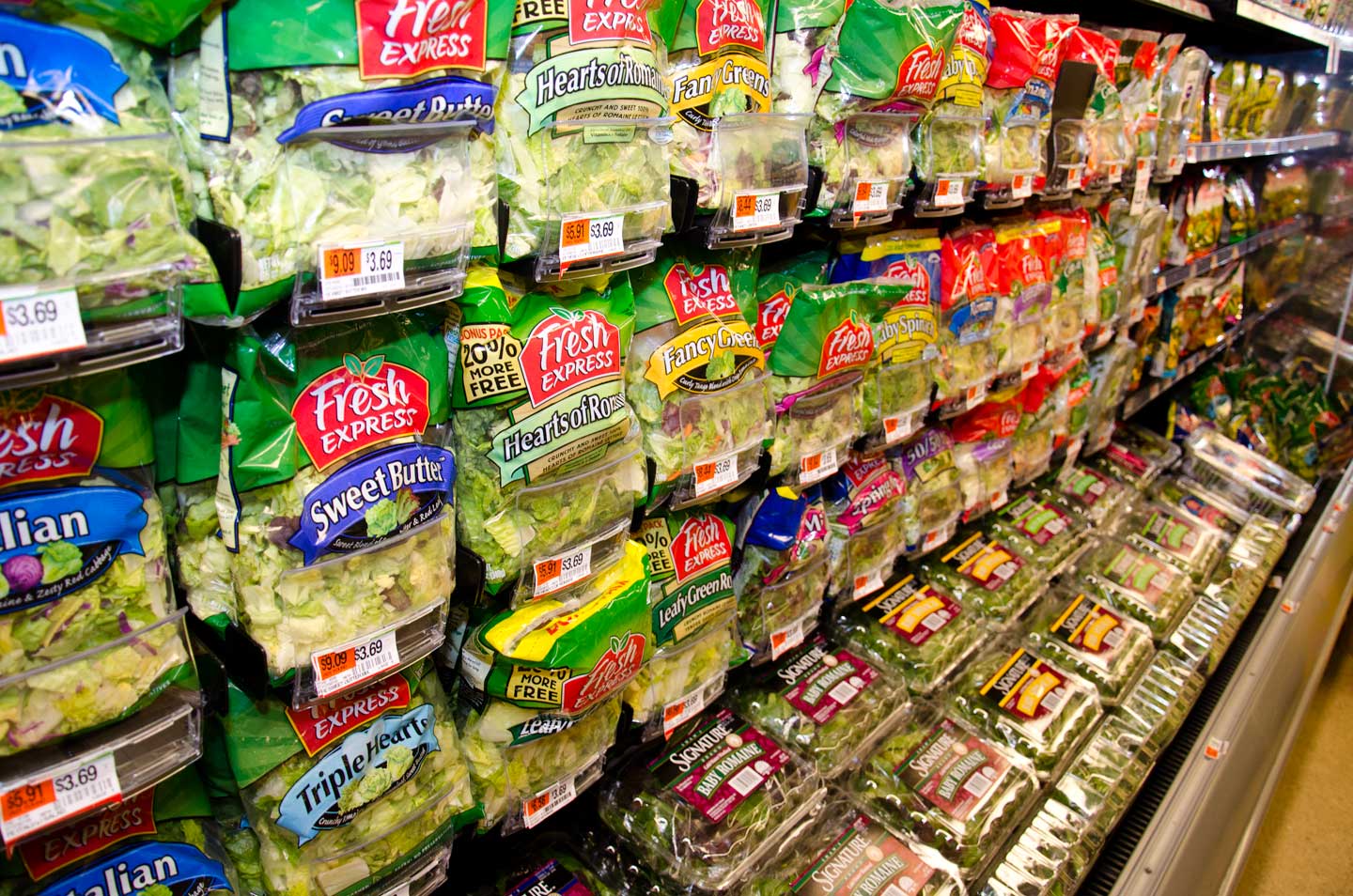
Last January, I was going down the aisles of a local supermarket lamenting the start of the roughly three-month annual dead zone in the produce section. My eyes lit on a sign that said “Fresh green beans.” I stared in disbelief. The beans were wilted and crinkled, a sight that would give even a starving man pause. They had left “fresh” behind a long time ago and moved down the scale past stale and pathetic to land decidedly at “time to compost.”
The food aisle is often “ripe” for examples. “Ripe” southern peaches? Right — after a week, when they soften up and instantly rot and turn to mush. Have you ever actually beheld a “ripe” peach in a grocery? Or a ripe tomato? (I would love a store that instead of bogus labels rated its vegetables by how long ago they had been picked or been in storage. Dream on.)
For ubiquitous mislabeling and deception, it’s hard to beat chain restaurants. Read a fast-food menu and look at the pictures and you’d think McDonalds was the second coming of Pete’s Greens. Ever look inside a Big Mac and try to find the lettuce, let alone guess what the expiration date on the greens were? (In research I stumbled upon a hilarious website dedicated to one person’s disassembling of fast food deception.)
Once your brain begins to notice doublespeak, it’s everywhere.
“New, lower price!.” This classic sin of omission hides the fact the box of cereal/crackers/pasta has gotten smaller, so the actual cost per pound or portion is higher.
“Due to the huge response, we have extended our (car, furniture, appliance, clothing) sale for an extra week.” Well, this makes no sense on the face of it, since if the response was huge they would be sold out. Yet we hear it all the time.
I sometimes fantasize what honesty in advertising or messaging would sound like.
Thus: “Our sale tent collapsed, it rained two days out of the week, we’re still stuck with 31 clunkers poorly rated by Consumer Reports that we need to get rid of to make our numbers this month and pay off the interest charges and our staff. So we’re extending our sale, which by the way, is bogus, since we’ve raised the prices to account for the sale price. And don’t forget to read the fine print, where we discount all your savings. ”
And instead of hearing “your call is important to us” from a big bank, telecom or health insurance company, you’d hear: “We’ve outsourced contact with people to a call center in Mumbai that pays lower wages so we can increase profits for our shareholders and boost pay for our CEO. Our least concern is interacting with you, our actual customer. You may have to hold the line for a half-hour or more in our effort to discourage personal contact, and the connection will probably be poor too. If you’re calling to complain, we hope this may discourage you.”
I recently canceled my dial-up Internet service since I now have broadband. I endured a lengthy discussion with a nice fellow in India who told me how valued a longtime customer I was and how the company wanted to continue serving me, and they were willing to cut the monthly fee in half to keep me as a dial-up customer.
After 10 years, now they tell me? If I was really so valued and loved, they would have cut my monthly fee years ago. As Click and Clack, NPR’s “Car Guys,” would succinctly say, “bow-gus.”
I am not so naive as to think lengthy phone queues will vanish, let alone that ads and labels – not to mention politicians — will ever veer back closer to reality and the truth.
It would be nice, though, if we were not forced to listen to tepid falsehoods with our daily taste of inconvenience and not be treated as fools or easily led sheep in our dealings with corporate America.
That would make both me and George Orwell very happy. It would also require a dishonest suspension of belief.

