

Editor’s note: This article, by Jeffrey Thomson, was first published on SCOV Law.
State v. Smith, 2011 VT 83
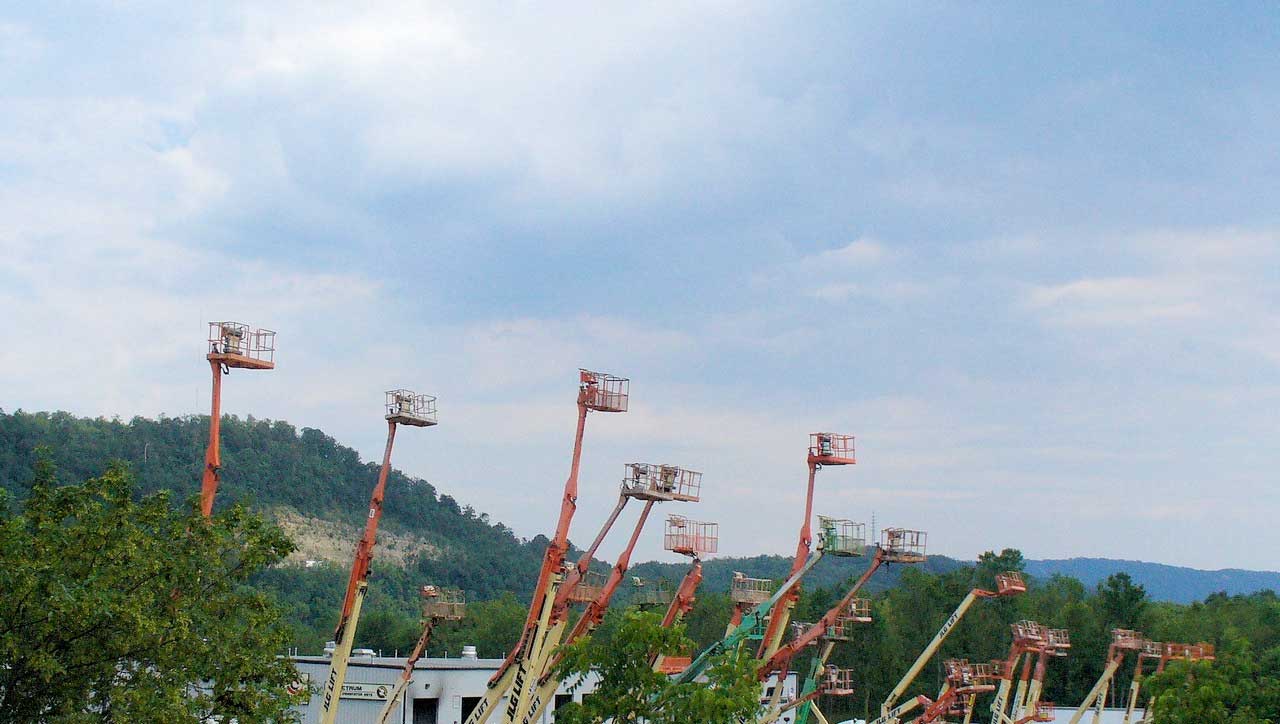
The Vermont State House has made some very interesting exceptions to what constitutes a “motor vehicle” under Vermont’s DUI laws. These exceptions include farm tractors (drinking while farming is not a crime), snowmobiles (it’s all in fun, right?), and highway building equipment (we’ll look the other way as long as we get these dang roads fixed). However, the statutes fail to say anything about boom lifts—those big machines that you see on construction sites with a single arm attached to a large basket on the front.
The boom lift is used to elevate workers and materials to high and hard to reach places on a work site. Alcohol is used to descend the senses into low and hard to reach places in the psyche. In today’s case, Defendant attempted both at once and ended up in jail with a suspended license.
Defendant argues, “Hey man what’s the big deal. This thing only goes like 5 mph and I was only moving it across the street.” [Note: These are not the Defendant’s actual words but you get the picture.] The Trial Court agreed, holding that defendant did not drive a “motor vehicle” as that term is used in the applicable statutes. The State appealed to the SCOV arguing that a boom lift is indeed a “motor vehicle” and does not fall under any of the exceptions set out in the statute.
Vermont’s DUI statute prohibits a person from operating, attempting to operate, or being in actual physical control of “any vehicle on a highway” if he or she has an alcohol concentration of 0.08 or more. A “Motor vehicle” is defined as “all vehicles propelled or drawn by power other than muscular power, except farm tractors, vehicles running only upon stationary rails or tracks, motorized highway building equipment, road making appliances, snowmobiles, or tracked vehicles or electric personal assistive mobility devices.”
The State argues that the plain meaning of the definition covers the boom lift. The boom lift can be driven from location to location by its gas or oil motor and is therefore “propelled or drawn by power other than muscular power.” Further, it does not fit under any of the exceptions in the statute.
In contrast, defendant argues that a boom lift’s design indicates it is not a motor vehicle because it is meant to be used primarily in a stationary position; it is not used for transportation and lacks common characteristics of motor vehicles such as a steering wheel and seat. Defendant also argues that it is similar to many of the machines that are in the list of exceptions in the statute and therefore should be considered as an exception.
In determining the scope of a statutory provision, the Court first asks whether the language of the provision is plain and unambiguous. If so, the Court will look only to the words of the statue and not add any meaning of its own. The SCOV finds that the language “propelled or drawn by power other than muscular power,” found in, is plain and unambiguous and that “the facts clearly establish that a boom lift is powered by a motor rather than muscular power; therefore, it falls within this express definition of a motor vehicle.” Because the statute is plain and unambiguous, that is as far as the Court needs to go in reasoning that the boom crane is a “motor vehicle” under the statute.
This leaves the Court with only the argument that the boom lift falls under the exceptions laid out in the statute, because of its similarity to the listed exceptions. Again the SCOV finds that the list of exceptions as set out in the statute are plain and unambiguous. Therefore, it will not read into the listed exceptions a type of vehicle that is not plainly listed. The SCOV explains, “If the Legislature had intended that exceptions comparable to those explicitly mentioned be recognized, it could have drafted the language to make the list of exceptions nonexclusive. Without such an authorization, we have held that ‘where express exceptions are made, the legal presumption is that the Legislature did not intend to save other cases from the operation of the statute . . .’”
The SCOV recognizes that despite the plain and unambiguous rule, statutes must be construed in such a way as to avoid irrational results which go against legislative intent. The SCOV finds that defining a boom lift as a motor vehicle is not an irrational result of the law and keeps with the legislative intent to protect the public. The Court explains, “The boom lift may proceed slowly, but it is a large piece of heavy machinery that could inflict personal injury or property damage if it ran into a person or personal or real property.”
If you don’t agree with that statement, go ahead and look up “boom lift accidents” on Youtube.com. That is all the evidence I need to be happy with the Court’s decision.
