

For Vermont children from food-insecure families who rely on school lunches as their most dependable meal, advocacy groups are filling the summer gap with free meal programs.
At a food site in Burlington at the Community Resource Center, an average of five to 10 kids a week stop by and are met with a food shelf, soup kitchen and community space that serves free hot meals for families to sit down and eat.
The site is one of four operations within Feeding Champlain Valley, a food program from the Champlain Valley Office of Economic Opportunity.
“I think that’s kind of important as a kid growing up around here,” said Anthony Hunynh, the marketing and event specialist at Feeding Champlain Valley. “You want to be able to eat nice fresh food, but if you don’t go to school, that’s not possible.”
As kids enter their summer breaks, families that regularly get their meals from food sites will begin coming more frequently and utilizing more of the programs available, including programs specific to children. For kids in middle school and high school, Hunynh said the options for food become “pretty limited” during the summer. Partnering with Hunger Free Vermont and the Vermont Foodbank, the program focuses on addressing childhood hunger in Vermont, Anna McMahon, associate director of Feeding Champlain Valley, told VTDigger.
On average, the Burlington kitchen serves close to 300 free meals a day and sends out anywhere from 1200 to 1500 free meals a week through their food access network.
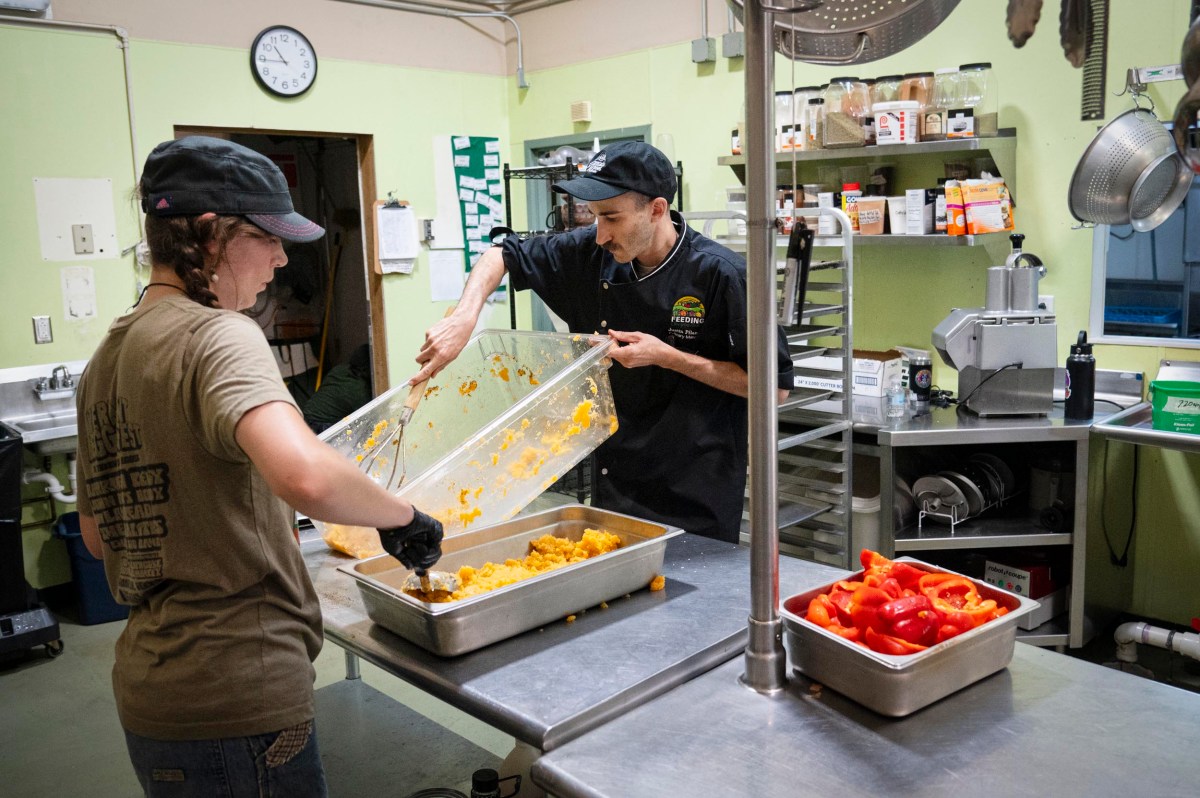
Throughout the week at Feeding Champlain Valley, Vermonters of any age can pick up weekly groceries, prepared meals and household items that are delivered daily to the pantries, shelters and soup kitchens. Using a delivery system, they also allow food-insecure Vermonters to order online in select counties including Addison, Chittenden, Franklin and Grand Isle.
The priority for Feeding Champlain Valley was providing a variety of food options for multigenerational families that are accustomed to eating more than just canned foods, which partly led to the creation of the hot meals.
“A common thing that happens in a lot of food shelves is normally they don’t have the staples that some new American families have, like rice, beans and grains,” Hunynh said.
While the hot meals are typically served from 9:30 a.m. to 11:30 a.m., the food shelf operates until 2:30 p.m., providing a wide range of perishable and non-perishable goods such as fruits, vegetables, eggs, dairy products, oil, protein and grains.
The food is made up of overstocked food outsourced from grocery stores like Shaw’s and Hannaford, as well as food gleaned from local farms and leftover bulk items from food banks, including fruits, vegetables and dairy products.
Celicia Williams, 28, who recently moved to Vermont this year with her 4-year-old daughter, found her way to the food site in Burlington through Feeding Champlain Valley’s parent company, CVOEO.
“Since moving to Vermont, CVOEO has helped me a lot,” Williams said. “It feels like everybody is welcome here, which is nice. Even waiting in line, I’ve seen people from different types of backgrounds.”
When her daughter starts school in a couple years, Williams said she knows the food site will prove even more beneficial to her in making sure there is not a food gap for the two of them during the summertime.
Feeding Champlain Valley recently expanded its online ordering program in Chittenden County, with a focus on delivering to more schools throughout the Burlington area, including C.P. Smith Elementary and Edmunds Elementary, McMahon said.

While the food sites are not specific to only kids, Justin Pflanzer, the culinary manager at Feeding Champlain Valley, explained that the two to three chefs in the Burlington kitchen try to make foods that both adults and children find enjoyable, adding that snacks and juice boxes are often included to make children feel more welcome.
“When people come to meal sites, it’s good to make them feel as at home as possible,” Pflanzer said. “That’s one way to do it, especially for kids who are nervous about coming here and are scared.”
Meeting kids where they are
Comfort and accessibility is also an emphasis for Hunger Free Vermont, a nonprofit organization dedicated to ending hunger in the state. The organization promotes a child nutrition program that provides children up to 18 years old with free summer meals.
The program is administered statewide to families through the Vermont Agency of Education. Schools can work with local sites, such as libraries, recreation programs, pools, parks and summer camps, to connect to federal dollars that reimburse giving meals and snacks to kids.
“There’s no registration, no ID, nothing required on the kids’ parts, and it kind of supports filling that gap and hunger in the summer when schools aren’t in session,” Erica Morrell, Hunger Free Vermont’s meal specialist, told VTDigger.
The food given out at the meal sites meets federal dietary nutrition guidelines by working with local farmers to source local products, Morrell added.
To track the summer meal sites, the organization introduced a new virtual map. Users can hover over the icons to learn what times the sites run for and what resources they provide.
The map is updated on a weekly basis as meal sites are added or change locations throughout the summer.
At the food site in Burlington, Feeding Champlain Valley has seen an average of 100 Vermonters stop by every day, with the number sometimes reaching 200, said Morgan Heyl, the organization’s distribution and receiving coordinator.
Often seeing the same faces every day, Heyl said she is able to form relationships with the people coming in. Newcomers will often show after hearing about the pantry through word of mouth.
Hunger Free Vermont makes it a priority to reach out to as many families as it can by producing newsletters, posters and brochures, along with videos translated in 19 different languages through the Vermont Language Justice Project.
Outside of the child nutrition summer program, the organization offers complimentary year-round child nutrition programs for when school is in session.
“Using the program helps everyone, because the more people who use it, the more federal dollars come in, and the more is spent locally on groceries,” Morrell said. “So it kind of acts as almost a local economic stimulus program.”
Clarification: An earlier version of this story mischaracterized Hunger Free Vermont’s role in the state’s child nutrition programs.