


On Monday, Republican Lt. Gov. Brian Dubie issued his first official policy statement since he began his bid for governor in October 2009. He released his 26-page plan, “Pure Vermont: Blueprint for Job Growth and Economic Expansion,” with great fanfare to a group of business leaders in Barre.
Dubie’s economic development plan sets the stage for the General Election – no matter who emerges the winner among the three Democrats. The recount begins next week following a close five-way primary on Aug. 24. (Sen. Doug Racine, who was the runner up, has asked for the recount; in the meantime, he and Secretary of State Deb Markowitz, who came in third, and Sen. Peter Shumlin, who won the primary by about 200 votes, will campaign together until final results are available.)
The campaign has now been defined for voters as a study in significant contrasts: a choice between two sharply differing policy positions and governing philosophies.
Dubie’s plan radically differs from his Democratic opponents’ ideas. His vision for the state’s economic future is based on Reaganomics 101 (a frequent refrain in his speeches is a paraphrased quote from the Gipper — “the best social program is a job”).
Dubie believes the best way to boost the economy is to reduce taxes. He is proposing a 33 percent cut (from the current rate of 9 percent to 6 percent) in the highest marginal income tax rate for the state’s richest residents, along with graduated reductions for Vermonters who fall in lower tax brackets. He also wants to curb government spending and loosen environmental regulations for development. Vermonters, he says, are overtaxed and over regulated. Dubie suggests that our income-tax-free neighbors in New Hampshire have the ideal tax policy.
Read Dubie’s economic development plan: Pure Vermont
The Democrats — Shumlin, Racine and Markowitz — who issued economic development plans earlier in the summer, have said they want the state’s bureaucracy to become more efficient, but they believe the government must play a key role in the economy to ensure a balanced, humane future for Vermont. They, too, have proposed changes to the state’s regulatory structure, but ones that are less dramatic in scope.
In his plan and in numerous statements from the campaign, Dubie has tried to define the Democrats as big spenders who want to increase taxes willy-nilly.
None of the Democrats, however, has suggested that state benefit programs should be expanded. Nor do they support increases in broad-based taxes, such as income or sales taxes, as a solution to the state’s $112 million shortfall in fiscal year 2012. (Scroll down to “Dubie’s tax relief plan” for more details about the discrepancies between Dubie’s and the Dems’ tax records and plans.)
No one has a better handle on the stark dissimilarities between the two approaches than Dubie himself. “Whether my opponent ends up being Peter Shumlin or Doug Racine, our plans to address the economic challenges that face Vermont could not be more different,” Dubie stated in a recent press release. In that statement, he also challenged his Democratic contenders to 12 debates between now and Election Day, Nov. 2. “I look forward to letting Vermonters decide who they think best represents the interests of Vermont families, workers and job creators.”
There are also some areas of agreement. Dubie and his Democratic rivals all believe Vermonters are tapped out on tax increases. They also hold the same views on the benefits of more energy efficiency, the value of Green branding for Vermont, the need for broadband expansion and the efficacy of improvements to the state’s IT system.
But the Dems and Dubie are divided by a philosophical gulf on more difficult issues. The Dems believe government, on the whole, offers essential services, goods and programs for Vermonters; Dubie takes issue with the efficacy of state government spending, particularly on education and Medicaid programs, which he believes need to be reined in.
Here are a few of the policies eschewed by Dems and strongly embraced by Dubie:
*Spending and property tax caps based on a finite, inflexible percentage;
* Widespread government deregulation;
*Mandatory education spending cuts or caps based on the often-disputed assertion there are too many teachers for too few students when the ratios are actually skewed by ever-rising special education teacher needs;
*Income tax cuts for all, regardless of wealth (Shumlin says he would cut income taxes, but he doesn’t see a way to pay for them);
*A significant increase in tax credits for businesses, despite the fact the effectiveness of the Vermont Economic Growth Incentive tax credit program is often disputed by critics. (Skeptics say jobs would have been created with or without tax credits);
*Allowing “master plans” for fast-track development. (A very small percentage of developments are held up by Act 250);
*Shifting resources from K-12 education to preschool and higher ed. (Shumlin would shift money from Corrections to early education);
* Changes in eligibility standards for Medicaid-funded health benefits and strong opposition to government-sponsored health reform, including single-payer. He favors, instead, cost-containment through enhancement of preventive care, hospital coordination and tort reform.
*Unspecified alterations to the current pension system for state workers and teachers.
Dubie paints his vision for Vermont in broad brush strokes, and he often substitutes anecdotes and folksy sound bites for hard data and basic information about his proposal. (“We need economic sustainability and environmental sustainability. When you work in the woods, tapping maple trees, you’re always thinking about the next generation.”)
Dubie says, for example, that he would give tax cuts to “all Vermonters in all brackets,” but his campaign won’t say what the targets are for each of the brackets, with the exception of the top level, which would drop from 9 percent to 6 percent, according to Kate Duffy, his communications director.
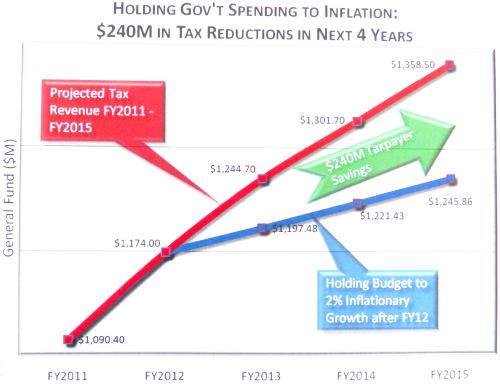
One critic said his tax plan, which would significantly reduce the income tax burden for the wealthiest Vermonters, would “cost a fortune.” Dubie doesn’t say what the pricetag would be for the tax cuts. In his speech, he pointed to a chart showing that, as state revenues increase and spending is capped at 2 percent, the difference would be parceled out to taxpayers as an “Automatic Tax Reduction.”
Some of the facts in Dubie’s plan are misleading; others are inaccurate. In a graph he uses to illustrate how he would give back $240 million to taxpayers, he conflates projected tax revenues with state spending. He cites Rhode Island and Maine as states that have 5 percent tax rates for the wealthiest taxpayers. Both states are on a par with Vermont taxwise.
“Growing” state government
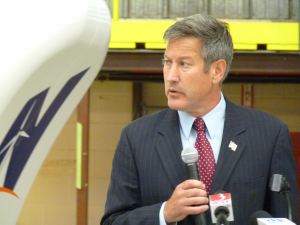
Dubie presented his 10-point economic development plan at Northern Power Systems, a high-tech wind generator manufacturer in Barre. Several business owners, including John Danner, CEO of Northern Power, and Burlington-based real estate magnate Ernie Pomerleau, introduced Dubie to more than 100 business leaders who convened on the factory floor.
Dubie said his plan was crafted from conversations with “thousands” of Vermonters “gathered all over this great state.”

“We’ve crafted it from you business owners, from you managers, from you employees and George Clain, the members of IBEW,” Dubie told the crowd. “I’ve asked what helps, what hurts, what doesn’t help. I’ve listened to your answers and learned from your inputs. Pure Vermont is my vision drawn from your wisdom.”
Dubie reiterated his No. 1 priority, which is reducing state spending. He repeatedly invoked the name of Gov. Howard Dean as a touchstone throughout his speech. Dubie said his proposal is more palatable than Dean’s plan to level fund the state budget in the early 1990s. Dean cut spending in 1993 by 2 percent and raised it by 2 percent in 1994, effectively level-funding the budget for a three-year period, according to information from the Joint Fiscal Office, a nonpartisan arm of the Vermont Legislature.
“I’m proposing a 2 percent level funding, which our experts anticipate inflation to be something like 1.4 or 1 percent,” Dubie said. “I’m proposing to grow state government, but at a disciplined rate.”
By reining in spending at 2 percent, Dubie said the state can put $240 million into taxpayers’ pockets. However, Dubie cautioned that it would take time to cut taxes for families and businesses. That assertion appears to be borne out by a graph he referred to which ends at fiscal year 2015, when $113 million would be returned to taxpayers. Apparently, the graph would have to be extended into four years or more, to reach the $240 million mark. CORRECTION: The graph indicates that $240 million, cumulative would be saved over three years: 2013, 2014, 2015.
“State spending cannot grow more than our underlying economy without bankrupting our economy,” Dubie said.
Just two and a half hours after Dubie gave his presentation, Shumlin, the presumptive Democratic candidate for governor, and two of his rivals in the primary, Markowitz and Racine, held a press conference. One after another, they disparaged Dubie’s blueprint. They said that it’s impossible to reduce taxes without going into deficit spending. They also said he plans to cut Medicaid, which would amount to a cost shift to Vermonters who have private health insurance and property taxpayers because health care premiums represent 12 percent of school budgets.

Markowitz called the proposal, “a George Bush style plan of cutting taxes.”
“While the five of us were listening and talking about how to jump start the economy, Brian Dubie was invisible,” Markowitz said. “Now he’s come out with his plan for his Vermont. He was visible on Web sites for The New York Times, Boston Globe and The Wall Street Journal, saying Vermont is bad for business. That is not the Democratic vision. What we all agree on here is that Vermont is a great place to do business, and we hear that from businesses around the state. We have our challenges, but we also know that we can meet those challenges by focusing on our strengths, not by talking about what a terrible place Vermont is to do business.”
Racine took a slightly different tack. In a play on the Jim=Jobs slogan Gov. Jim Douglas used in his 2002 campaign, Racine said Dubie=Deficits.
“This is make-believe,” Racine said. “The numbers don’t add up, and it shows a real lack of understanding of how state government operates and what it takes to build a strong economy and what it takes to balance a budget. In many ways, it’s an indictment of Brian’s participation, or I should say lack of participation, in state policy and state government over the last eight years.”
Is a 2 percent cap really growth?
Depending on how you look at it, the 2 percent cap on state spending can look like slow growth or a straightforward cut in state spending – and therefore services.
Under Dubie’s plan, the state would spend $1.245 billion in fiscal year 2015 – $44 million less than it paid for services in fiscal year 2010, including federal stimulus money.
Dubie told business leaders: “We need to keep state spending at affordable levels. In the past two years, our economy has suffered. Income has dropped, and everyone has tightened their belt. State spending has gone up in the past two years 7 percent. Human services spending has gone up 20 percent. Obviously, that’s not sustainable. I propose that we limit the growth of state spending to no more than 2 percent a year, effectively the same rate as our family budgets grow.”
The money Dubie refers to didn’t come from Vermont tax revenues, however; the bump came from the federal American Recovery and Reinvestment Act funding, which was designed to help states provide more benefits and services to workers laid off in the recession. According to figures from the Joint Fiscal Office, state spending increased 1.8 percent in 2009; 5.45 percent in 2010 and 0.7 percent in 2011, including the stimulus funds.
General Fund expenditures over that same period show a pattern of level funding. The state’s budget, not including ARRA funds, was $1.146 billion in 2009; $1.087 billion in 2010 and $1.143 billion in 2011, JFO figures show.
In an interview with reporters, Dubie was critical of the federal stimulus. “When you borrow money from the Chinese and add debt to your children, that’s not sustainable,” he said.
Dubie also insisted that a 2 percent cap is not a reduction in government spending. “I’m not cutting,” Dubie said. “I’m proposing to grow. This is not a cut. This is a 2 percent increase in spending. I’m proposing that we grow government higher than the rate of inflation.”
Economist Jeffrey Thompson, assistant research professor at Political Economy Research Institute at UMass Amherst, said Colorado tried an inflationary cap on state spending, and it’s been “largely panned as a huge failure.”
That’s because inflation goes up at a higher rate than 2 percent for things like fuel, health insurance premiums and other goods and services, Thompson said. In Colorado, the TABOR Law, as it’s called, has so badly restricted the state’s ability to fund higher education and fundamental services, he said, that “they’ve put themselves in a budgetary straitjacket.”

Thompson said such a cap is designed to shrink government over time.
“A 2 percent formula wouldn’t even keep up with inflation,” Thompson said. “It wouldn’t keep up with population growth, and one of the things that we know from what’s actually happened in public state and local expenditures and taxes is that the things we ask government to do, namely educate our children and (provide) health care (to qualified beneficiaries), those are things that have actually grown faster than the rate of inflation.”
There is a common misperception, Thompson said, that state government is a drain on the economy, when in fact it provides essential services and infrastructure and is part of a successful recipe for growth.
Dubie on the budget deficit
The state faces a looming deficit of $112 million in fiscal year 2012 and has committed to $72 million in savings through the Challenges for Change government restructuring effort that have yet to be fully identified.
Dubie’s plan does not propose other solutions to the budget shortfall, nor does it provide guidance on the Challenges for Change process, or suggest cuts in state government for the coming legislative session. The 2 percent cap on government spending would not be imposed until fiscal year 2013, according to “Pure Vermont.”
Instead, Dubie makes general assertions about excessive state spending without specific proposals for cuts. Those details, he says, will be part of a “conversation” with the General Assembly in January. Even when pressed by reporters in a 12-minute briefing, he reiterated the same key phrases four or five times. (See Vtdigger.org’s article “More time, sir? Um, probably not.”)
Dubie says revenue growth in fiscal year 2012 would be used to reduce the $112 million deficit. The state’s consensus revenue forecast is for a $15 million increase in tax receipts – about $100 million short of the mark.
Shumlin has proposed cutting $40 million from the Department of Corrections budget and adopting a single-payer health care system to fill the budget gap. Racine would look for efficiencies that can be gained through upgrading the state’s IT (computer) systems, use $30 million of the rainy day funds and introduce targeted sales taxes on junk food or Internet merchandise. Though Markowitz is critical of Challenges for Change, she has suggested she would eliminate or upgrade outdated state programs.
Dubie’s plan for reining in spending
Dubie said his budget-tightening targets would be health care and education, though he didn’t offer specifics on how those areas of state spending would be reduced. He also wants to make changes to the government subsidized pension system for teachers and state workers.
“We’re going to have to look everywhere,” Dubie said. “There is a perfect opportunity to find savings as our student numbers decline. There’s a significant number of retirements with our teachers, many of which entered the profession in the Vietnam era. There are going to be a lot of layoffs, a lot of long-distance opportunities, global classroom, all kinds of innovation for us to manage the retirements, manage the fact that our student populations are decreasing, and this is a great place to start the conversation.”
Dubie on education
Dubie said Vermont’s student enrollment has dropped 12 percent (a loss of 12,500 students over 10 years from a high of 108,000, and school spending has increased more than 70 percent. The state’s student population is expected to decline by an additional 8,500 students, he said.
In the blueprint, Dubie said education spending should “grow even more slowly (than inflation) given the ongoing decline in our school-age population.”
He proposes a “commonsense cap” on per-pupil spending and property taxes. He also wants to dismantle Act 60, Vermont’s state-aid-to-education formula. In addition, Dubie is an ardent proponent of school choice.
“Voters in Massachusetts passed a cap 30 years ago, and even the Democratic candidate for state of New York Andrew Cuomo is proposing a 2 percent cap,” Dubie said. “Vermont needs to find a reasonable way for a cap to be imposed, and I look forward to that conversation.”
He said he also wants to create a cabinet level Secretary of Education who would be appointed by the governor and be under direct control of the administration. The commissioner of the Department of Education is currently selected by the State Board of Education and has a certain degree of autonomy.
Dubie on Medicaid
Another major target for the budget knife in a Dubie administration would be Medicaid.
Dubie told Louis Porter of the Vermont Press Bureau on Aug. 1 that eligibility standards for Medicaid spending must be changed. (Medicaid money is used to pay for the state’s suite of subsidized health care programs, such as Dr. Dynasaur, Catamount Health and VHAP, under Green Mountain Care.)
Dubie said he will look at spending by government subsidized nonprofit groups, such as the “designated agencies” that provide regional mental health and developmental disabilities services. In the interview with Porter, he said his administration would examine the operational spending and salaries of these organizations, along the lines of Tiger Team cost-saving proposals developed under the aegis of Tom Pelham, a deputy secretary in the Douglas administration.
“These organizations have developed responding to a need. I greatly appreciate the work they do, and I would involve them in any solution,” Dubie told the Vermont Press Bureau. But “all of us must acknowledge we are going to be forced to do things more efficiently and more effectively.”
Thompson, the professor from UMass, says cutting Medicaid is “deeply troubling” in the current economic environment.
“Medicaid spending is one of the things that brings in the most federal dollars,” Thompson said. “It’s heavily matched. If you cut Medicaid dollars, you’re going to be taking far more money out of the state and that’s an absolute job killer. I think anyone proposing a move that’s going to lose that much in federal dollars is basically telling you they want to reduce employment in the state.”
Dubie on state pensions
Dubie also wants to “address major pension liabilities.” He says the combined “unfunded pension liability for state employees and teachers in retirement is in excess of $2 billion.” He pegs the annual cost to state government at $100 million a year. Though his plan doesn’t include specifics, he references the recently negotiated pension deal with Vermont teachers as a model for state employees.
The total unfunded pension liability over the next 25 to 30 years is actually $1 billion, according to Jeb Spaulding, the state treasurer. If you add in state contributions for retiree health care costs, however, Dubie’s figures are correct, according to Spaulding.

Last year, the state paid $48.2 million into the teacher retirement system and $37.2 million into the state workers’ pension system. Health care payments to teachers were $20 million; contributions for state workers were budgeted at $27 million. Health care is a “pay as you go” obligation; the pensions are, in fact, a long-term unfunded obligation.
Spaulding, a Democrat who supports Shumlin, said he thinks Dubie’s plan is a “pretty thoughtful document.”
“I think he’s right to identify retirement plans, including retiree health care as a challenge for this state,” Spaulding said. “Retirement security is a huge issue nationally. I think he’s right. There are things that need to be done. I personally believe that we’ve made very significant reforms in teacher retirement and health care, and we don’t need to go there again for several years.”
The state’s teachers agreed to work longer and contribute more to their pension plans this year. Spaulding hopes to renegotiate health care and pension benefits for state workers this fall.
“Accounting standards have changed now, and health care is part of our unfunded liability,” Spaulding said. “For the teachers, we made pretty significant revisions in pensions and retiree health care.”
He said until this year, the state paid 80 percent of the health care costs for teachers who had worked in the system for 10 years for the rest of their lives. Now that figure is 40 percent after 15 years of service.
Dubie’s tax relief plan
Dubie has made taxes his signature issue. He proposes an “Automatic Tax Reduction” for taxpayers that would be tied to the gap between increasing revenues as the economy recovers and the cap on state spending.
He told reporters that he would be looking at tax-rate reductions for “all Vermonters in all brackets.” Dubie cited 6 percent as a target rate for the marginal income tax rate for the highest bracket tax filers. A married couple, filing jointly, for example, that earns more than $372,950, currently pays a marginal rate of 8.95 percent on the first dollar after $372,950, according to the Department of Taxes. Dubie proposes a 3 percent drop in that top tax tier, and graduated reductions for the four brackets fall below it. (Income above $56,700 is currently taxed at the 3.55 percent rate; income above $56,700 is taxed at 6.8 percent; income above $137,050 is taxed at 7.8 percent; income above $208,850 is taxed at 8.8 percent and anything over $372,950 is taxed at 8.95 percent.)
The effective rate — or the amount the average tax filer who earns more than $372,950 pays on adjusted gross income (before deductions) — is 5.4 percent. The effective rate for a Vermonter earning more than $1 million is 5.3 percent. (Editor’s note: This section has been updated to clarify the impact a tax reduction would have on wealthy filers. It also includes new effective rate information from the Vermont Department of Taxes. For a complete listing of rates, the number of tax filers in Vermont and download 2008 Vermont Personal Income Tax Returns — Dollars, the effective rates are the percentages in the far right column.)
Download a listing of Vermont tax brackets
Dubie’s campaign said the four lower tax-bracket rates – 3.55 percent, 6.8 percent, 7.8 percent and 8.8 percent — would be reduced proportionately.
The cuts are necessary, Dubie said, because the states of Maine, Rhode Island, and Massachusetts have a 5 percent income tax rate. Maine’s top rate, however, is 8.95 percent, and it is applied to tax filers who earn as little as $19,750. Rhode Island’s top rate is 9.9 percent, and, similar to Vermont, it’s applied to people who make $372,950 in income annually. Perhaps he meant to refer solely to Massachusetts, which has a flat tax rate of 5.3 percent. Duffy wrote in an e-mail that Dubie is not, however, proposing a flat tax.
Download a PDF of tax rates listed by state
“We’ll still have a higher income tax than our neighbors in New England,” Dubie says. “New Hampshire has zero income tax, so it’s a goal, and this is a great opportunity to say that’s not going to happen overnight. It’s going to take time. It’s going to take time to have that conversation about how we can get there.”
Dubie’s plan also references a 2.5 percent property tax cap imposed by voters in Massachusetts 30 years ago, and quotes The Wall Street Journal saying “this move helped the state drop its ‘Taxachusetts’ stigma.”
According to Dubie, the state saw no decline in student achievement as a result. He also cited a recent campaign promise from Democrat Andrew Cuomo, who is running for governor in New York State, that places a 2 percent cap on property taxes.
“Vermont must explore commonsense caps on property taxes and per-pupil spending as one of the many measures needed to fix the broken system of education built on the Act 60 framework,” Dubie said.
Of the Democrats, only Shumlin is proposing that the state consider changing the top rate for the 1 percent of Vermonters with the highest incomes. Like Douglas and Dubie, he worries about taxpayers in the richest tier, who contribute 25 percent of the state’s income tax revenues, leaving the state, according to his economic development plan.
Shumlin presided over the Senate when the state lowered income taxes in 2009 and passed a $26 million tax increase, which included the removal of a 40 percent capital gains tax loophole.
” The truth is that in the last 8 years, Brian has overseen significant tax increases,” Shumlin said in a press release. “The sales tax was increased from 5 percent to 6 percent and by supporting the budget veto, Brian endorsed increasing property taxes on Vermonters by almost $100 million. In the Senate, I helped pass 3 major reductions in income taxes, lowering the top marginal rate from 13.5 percent to 8.9 percent and led the effort to reduce the sales tax from 6% to 5% and eliminated it completely on clothing and shoes.”
Racine voted against a bill in 2009 that lowered income taxes for all tax brackets and increased estate and capital gains taxes by $26 million in 2009. Shumlin presided over the Senate when the bill was passed. He negotiated with Gov. Jim Douglas to reinstate the loophole this year.
In a press release, Racine said, “it was the wrong package.” He has said he would look at targeted taxes — a sales tax for merchandise sold on the Internet or a junk food tax.
As Secretary of State, Markowitz has not been involved in tax policy decisions.
So, do tax cuts in a recession really boost state economies?
Not really, says Thompson, the economist from Political Economy Research Institute. But it’s a tough question, in his view, because tax cuts come at a cost and most states are required to balance their budgets. (Vermont doesn’t have to balance its budget by law, but it does so in practice.) On the other hand, freeing up capital in a downturn economy is also important, he said.
“You want to be encouraging in a downturn where people are holding onto their money because they’re not sure about the economic environment, where firms aren’t hiring because there isn’t sufficient demand,” Thompson said. “You want people to spend. When you raise taxes on households they’re going to spend less, but the issue here is that because of the balanced budget requirement also spends less when you cut budgets. So it’s a tough call, and at the end of the day, it’s the judgment of myself and a lot of other economists, that it’s worse to cut state budgets if those taxes are targeted to affluent households. Why is that the case? It’s the case because the state spends everything it gets within the state. Affluent households save a lot of money and what they do spend is based on things produced outside of the state. So the actual short-term impact on the state’s economy is going to be worse if you cut the state budget than if you are sustaining state spending by raising taxes on affluent households.”
State Treasurer Spaulding disagrees. He said the state needs to consider tax breaks for the richest Vermonters because of their mobility.
“We need to make sure we’re competitive,” Spaulding said. “I think in Vermont it’s the combination of all of the expenses … income taxes and property taxes (that are a problem).”
