


Editor’s note: This story, by Kirk Kardashian, is the fourth in a series of profiles of the six major party gubernatorial candidates.
It’s a sunny afternoon in early June. The Tucker Box Café in White River Junction is buzzing with the sounds of espresso machines and caffeinated patrons tapping away on MacBooks. In walks Matt Dunne, the democratic gubernatorial candidate from Hartland, standing out from the crowd in a starched blue shirt and a red tie. Earlier in the day, he was at City Hall in Burlington to accept the endorsement of nine Vermont legislators. Tonight he will be in Springfield for a candidate forum. It’s just another day on the campaign trail, and while a cup of coffee might be welcome, he seems to lack the time to drink it.
Dunne, however, can depend on the energy of his youth. At 40 years old, he’s the youngest candidate in the 2010 race — a fact that can be both an asset, in terms of vigor and freshness of perspective, and a liability, in the minds of those who equate youth with naïveté. But, as with most jabs of offense, Dunne has a pre-packaged parry: He notes that he’s the same age as Howard Dean and Tom Salmon when they took office, and a few years older than Phil Hoff and his predecessor F. Ray Keyser Jr., both of whom hadn’t cracked their fourth decade when they assumed the highest executive position in the state.
Dunne feels a kinship with Hoff, who in 1963 was sworn-in as Vermont’s first democratic governor in 108 years. “He was a young leader who was able to bring a new generation of Vermont thinkers and doers into state government,” Dunne explains, “and really transform the enterprise in a way that hasn’t been done since then.” On the national level, there is a similarity between 1963 and 2010: a young, democratic president is in office playing the role of the agent for change. Hoff rode the popular wave of John F. Kennedy. Dunne hopes Barack Obama’s victory, and his success with a politics of service, is contagious.
On the local level, Dunne says Vermont suffers from ills that plagued the state when Hoff was elected, most of which stem from an anemic economic engine. That’s why his key issues are job creation and economic development with “Vermont values.” He lists huge deficits, sky-rocketing health care costs, small businesses and farms going bankrupt, and pay cuts for state employees, as evidence that the state needs a different approach. “This is a time when you can bring people together, bring new ideas to the table and go forward in a new way of doing government, economic development, and health care,” he says.
Hoff, reached at his home in Burlington, seems to agree, at least in principle, with Dunne’s assessment. He says that every 40 or 50 years a transformation of government is necessary, and that his administration’s accomplishments in re-apportionment, education and environmental legislation represented such a sea-change.
Is this one of those times? “In some ways, absolutely,” Hoff says. “One of them is financial. It requires a definite change in thinking about how we finance our objectives and who pays for it. That’s a gigantic challenge.”
The question, then, is if Dunne is up for the challenge. “I know Matt and I like him and respect him,” Hoff says. “But I’ve been a longtime Racine supporter and I remain so.”
Not a quiet household
Dunne lives with his wife — Sara Stewart Taylor, a journalist and mystery writer —and three children in the Hartland farmhouse where he grew up. The house was a place for spirited political discourse when Dunne was a kid, as both of his parents were progressive liberals grappling with the social and environmental conundrums of the day.
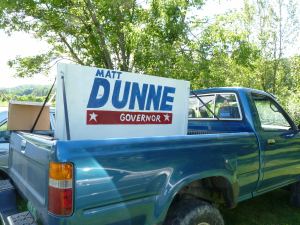
Before becoming a parent and a lawyer, Dunne’s father participated in the civil rights movement and was jailed for three months for standing up for equal rights in North Carolina. Dunne’s mother was one of the first women to become a tenured professor at Dartmouth. “It was a place,” Dunne says of his childhood home, “where even during the dark times of the late Nixon administration and the cynical times of the late Carter and Reagan administrations, there was still a belief that the public sector was honorable and a good way to make a difference.”
Their kitchen was also the crucible for the Vermont Land Trust. Dunne’s father, John, was instrumental in the new organization’s first major success: the conservation of 200 acres in South Woodstock. It was 1980 and the VLT had $20,000 in the bank, according to Darby Bradley, who directed the organization for many years. The South Woodstock property was about to be sold to a Boston developer, and its price was out of the land trust’s reach. But instead of relying on grants and donations to raise money, John had the idea to borrow the necessary money and create charitable creditors, which were people who pledged to absorb a portion of risk if the purchase of the property, and its eventual sale with a conservation easement, resulted in a financial loss to the land trust.
“One of the things that was so ingenious about the thing is that anyone in the community could participate,” Bradley recalls, “and only the land trust and the individuals knew whether you were in for a thousand or a hundred thousand. So everybody could participate; from the custodian to some of the wealthiest people in the community.” In the end, the VLT it didn’t need to call on anyone for their pledges of credit. “John was certainly one of the most extraordinary people I’ve ever met,” Bradley says. “He just had this can-do attitude that overcame almost anything.” Dunne appears to have inherited his father’s gumption and intelligence, which partly explains the impressive resume he has crafted in a short period of time.
While Dunne was talking about the importance of prime-agricultural soils with his father, he was being introduced to politics by Peter Welch, whose wife was a friend of Dunne’s mother. When he was 10, Dunne campaigned with Welch, handing out flyers to people in the community. “I was clearly intrigued by the whole process,” he says.
A few years later, John Dunne succumbed to melanoma. It stunned everyone in Hartland, and the community helped the family get through the tragedy by cooking meals for them and driving Dunne and his brother to school and soccer practice. “It was a humbling experience,” Dunne says. “We were a family that had resources, yet the community felt that everyone’s equal and that when there’s a tragedy the obligation is to help a member of that community. It actually helped me really understand the meaning of community.”
Into Politics
Dunne left Hartland to attend Brown University, where he majored in public policy and spent a lot of his free time in the theater. He was fascinated by the intersection of economics, policy and politics, but also felt a duty to his Hartland neighbors. So when he graduated, the natural choice seemed to be a position in state government. That summer, at the age of 22, Dunne met with Peter Welch and told him he was considering a run for state representative. “Matt,” Welch said, “if you work hard, you’ll win.” On the spot, Welch wrote a check out to “Matt Dunne for State Representative.” Dunne then had to open an account under that name to cash it. “It was an important moment,” Dunne says. “It was someone whom I looked up to saying, this is the right decision.”
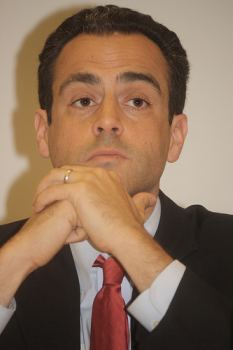
As today, Dunne ran as a pro-business Democrat with progressive values. His one radio advertisement was about using land recycling — also known as brownfields legislation — to spur economic growth without affecting farms and forests. He won the seat and served four terms, focusing on getting youth involved in government and community service, and the redevelopment of Vermont’s downtowns. At the same time, Dunne did marketing for Logic Associates, a Wilder-based company that designed business management systems for commercial printers.
In 1999, Dunne was asked by Bill Clinton to be the director of Americorps VISTA, a national service program where volunteers fight poverty by partnering with non-governmental organizations and local governments. At the time, the program had a budget of $85 million and a staff of 6,000. How does one go from being a state representative to leading a federal agency? “Better lucky than good,” Dunne says. It turned out that Clinton was looking for someone with Dunne’s particular credentials. They wanted a person with experience in state government, marketing, and technology, and someone young from a rural state. “Only because my community gave me that start was this possible,” he says. At Americorps VISTA, Dunne revamped the training programs and launched the Entrepreneur Corps, which was designed to empower low-income people by educating them in financial literacy and small business development.
Dunne returned to Vermont in 2002 and was elected as a senator from Windsor County. Before he was even sworn in, he says, he was trying to shake things up in the Statehouse by creating a new senate committee for economic development. He worked on the effort with Hinda Miller, a democratic senator who has voiced her support for Dunne’s gubernatorial bid. “He is young, energetic, practical,” she says, “and has considerable experience in the private technology industry, non-profit and government sector, a good balance for the complicated issues facing Vermont.”
The designation of a committee for economic development is what Dunne cites as his most important accomplishment during his four terms in the senate because “it created the structure to be able to focus on job creation,” he says. He also worked on some early broadband grants, secured a preference for veterans for state jobs, and put together a seed-capital fund to give early stage resources to entrepreneurs.
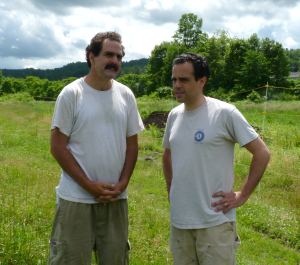
But, after leading Americorps VISTA, Dunne found the role of a legislator a little stifling. “What I learned is that as a legislator you can set the table but you can’t serve the food,” he says. By this he means that legislators can create opportunities for better government, but without the administration’s support, the opportunities will melt away. Dick Mazza, a democratic senator who worked with Dunne on the Institutions Committee, says he picked up on Dunne’s frustration. “He certainly had an agenda and was very impatient about it. He wanted to move it along, and that can be a good thing or a bad thing,” he says.
That was one reason Dunne ran for lieutenant governor in 2006. He won the Democratic primary, but then lost a close race to the person who holds that position today: Brian Dubie. When asked why he thinks he can beat Brian Dubie this time, Dunne exudes confidence. “My belief in being able to win now comes from the strength of the grassroots support I received in that first race,” he says. Dunne also explains that the public doesn’t know what a lieutenant governor does, while the governor’s job is understood and important. Furthermore, he says, “2010 is a very different time from 2006, with the economy, health care costs, our energy future and an awareness of climate change.” Dunne’s hope is that the focus on this race, and his improved name recognition, could put him over the edge.
Predictably, Dunne feels that Dubie is out of sync with the majority of Vermonters, citing Dubie’s staunch pro-life stance, his opposition to civil rights for gay and lesbian couples, and his support of using taxpayer dollars to fund religious schools. “That’s just not Vermont,” Dunne says. “We can’t afford to go backwards as a state.”
Full speed ahead
Down Main Street from the Tucker Box is Dunne’s new campaign headquarters. It’s across the street from the Tip Top Building, where his other office — the one he uses as manager of community affairs for Google — is located. Dunne went on leave from that job in May to focus on the campaign.
The campaign office, on day two of Dunne’s occupancy, resembles an Internet startup in its early days. The only sizable piece of furniture is a couch, on which two 20-somethings sit, staring into the screens of their laptops dreamily. As of now, Dunne has a small staff to help manage the daily operations, “but the core of our effort is based around the volunteers across the state,” he says. Dunne adds that his fundraising effort has been “steady” and he expects to have the resources to win the primary and general elections. However, “this race is not going to be about who is going to raise and spend the most money,” he asserts. “It’s going to come down to who is able to most effectively communicate a vision for Vermont and connect with others.”

The 21st Century Democrats think Dunne’s the man who can do that. The Washington D.C.-based organization exists to build a network of populist Democrats at the local, state and federal level, and they’ve had their eye on Dunne for a number of years now. In March, they officially endorsed Dunne’s run for governor. The group was particularly heartened by his ideas on health care. “He advocates a Vermont-based health care plan to cover all residents of the state,” says executive director Crystal Plati. “That’s huge for us.”
A less popular issue that Dunne has adopted is government transparency, and it’s caused one of the few tit-for-tat episodes in the race so far. The way Dunne tells it, he asked the Legislature in January to pass a bill requiring political candidates to file financial disclosures. When that didn’t happen, Dunne announced his intentions to file the disclosure form that members of Congress must fill out, and encouraged the other candidates to follow suit. Dunne released his form on his campaign’s Web site in mid-May. In response, Deb Markowitz’s campaign manager, Paul Tencher, made some critical comments about the strategy to the Times Argus.
Vermont ranks 49th in the country in government transparency, mostly because the state doesn’t have rules on the topic. In Dunne’s view, it hasn’t been a priority “because it seems expedient to not be transparent. And because we haven’t had a monstrous scandal yet, there hasn’t been the grassroots pressure to overcome the inertia.” He intends to change that.
None of the tension from the transparency quarrel is present later in Springfield, at the Windsor County forum. The five candidates sit at a table on the stage of the high school auditorium, in alphabetical order. There’s a lot of white hair in the audience. Susan Bartlett introduces herself and her agenda first, in her usual cheery but technical way, and then it’s Dunne’s turn. Drawing on his theater experience, his voice reaches for the cheap-seats and crescendos as he shouts “Springfield, Vermont!” It proves to be the loudest moment in the entire evening. From those heights he pivots to a somber note about the economic crisis, stressing the need to bring broadband to the “last mile” in every town, “leverage the Vermont brand,” and “move our state into a new era.” Deb Markowitz and Doug Racine use the word “excited” numerous times in their introductions, but it comes off as awkward and forced. Peter Shumlin rivals Dunne’s performance by calling attention to a Dubie operative in the audience with a video recorder, and asking him, on behalf of the other candidates to “set Brian Dubie free” and let him come out.
Over the course of the event, Dunne’s position on a few issues becomes clear. He agrees that Gov. Jim Douglas was right to turn down the federal Race to the Top educational funding, and stresses the importance of early childhood education. He confirms his support of local and regional planning commissions, instead of a more top-down approach. On energy, Dunne favors decommissioning Vermont Yankee, and believes wind needs to be a part of the mix, but that Vermont needs to discuss it as a community. He supports decriminalizing marijuana use as a way to reduce the prison population, but also thinks it’s important to “connect the dots” between substance abuse and crime.
By the end of the forum, all the candidates come across as thoughtful, experienced, intelligent, capable — and, in the substance of their positions, quite similar. Dunne’s task over the next few months, therefore, seems less about differentiating himself than gaining the trust of Vermonters and proving that he can beat Dubie in November. “We’re going to need all of you to make the changes we need as a state,” Dunne tells the audience in his summation. No argument there.
Kirk Kardashian is a journalist who lives in Woodstock.
