

Vermont taxpayers aren’t getting their money’s worth — that was the message reiterated by panelists, keynote speakers and participants at Vermont Tiger’s fourth annual symposium Tuesday.
The daylong conference, “Crunch Time,” was sponsored by Vermonttiger.com, a Web site run by Geoffrey Norman, a former editor for Esquire Magazine and an author of 15 books. Norman started Vermont Tiger in 2007, and he has attracted a stable of bloggers with conservative credentials – including John McClaughry, founder of the Ethan Allen Institute; Art Woolf, an economics professor at the University of Vermont; and Hugh Kemper, a retired J.P. Morgan investor, among others. The blog now has a following of 1,500 to 2,000 readers.
Norman bills Vermont Tiger as nonpartisan, but the themes sounded at the symposium – the inefficiency of state government, the costly nature of the state’s public education system and the burdensomeness of regulations and taxes on businesses – are cornerstone issues for Republicans.
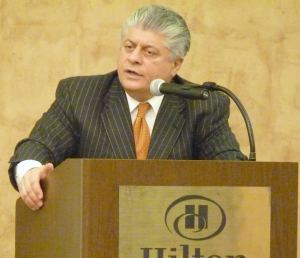
The star of the conference — Fox news commentator Judge Andrew Napolitano — went beyond the usual carping about unionized teachers, welfare moms and punitive taxation. He capped the conference in Burlington’s swishy Hilton Hotel yesterday with a riveting speech on the Patriot Act, constitutional law and a short history of the sedition act.
Napolitano, who describes himself as a “Ron Paul guy,” liberally quoted Thomas Jefferson’s stances on states’ rights and deemed the newly passed health care reform law unconstitutional. See video footage of Napolitano at the end of this story.

Two of Vermont’s conservative stars – Brian Dubie, the Republican lieutenant governor and candidate for governor, and Tom Evslin, point person for Challenges for Change (the reorganization plan for the state’s bureaucracy) – gave pointed speeches about the inefficiencies of government programs and high tax rates. (Press link: For an excellent summary of Dubie’s speech, see Nancy Remsen’s story in today’s Burlington Free Press.)
Evslin gave a talk about the ramifications of the federal stimulus package on Vermont and his attempts to shape the Challenges plans. He opened with a description of how Vermont was plunged into deficit spending.
Though Vermont’s situation isn’t as dire as that of other states burdened with higher unemployment rates and bigger deficits, the Green Mountain State’s fiscal problems are still profound, in his view. Many people can’t afford to live in Vermont now, Evslin said, and those who can feel “ripped off.” “They’re absolutely terrified of dying here,” he quipped pointedly. “I like to look at Vermont as a business, and if you look at it as a business, it produces a great product,” Evslin said. “But unfortunately, the product is overpriced.”
He compared Vermont to a retailer that tries to make up for lost revenues by hiking up prices. Like many failing companies, he said, the state has “let (its) costs get too high.”
The Great Recession, in his view, was a wakeup call for Vermont. Until the state was hit by a wave of plunging tax revenues “we were living in a bubble” of profligacy, and now, he said, the state needs to permanently cut the cost of government.
Evslin, who was also the state’s stimulus czar, said the $1 billion the state received from the federal government did some good but also prolonged the agony. Vermont needed, he said, to face four major problems in the wake of the recession: bureaucratic inefficiency, the “black hole” of the education fund, government providing services it shouldn’t and tax exemptions that narrow the tax base (the number of individuals and companies paying full freight).
The Challenges proposal, he said, addressed only the first two problems, and it only partially succeeded in one area. The Legislature and the administration agreed to about $30 million out of a target of $38 million in permanent spending reductions in state government.
In the end, Evslin argued, there were a number of “missed opportunities” — and reining in education costs was chief among them. The state “totally failed,” he said, to address the school spending problem (the state’s student population is declining, while costs continue to rise).
In addition, he said the administration was unable to move forward with its plan to consolidate regional development corporations and regional planning commissions, which would have saved about $1 million. Its proposal to cut funding for community mental health and developmental disability agencies by 5 percent also backfired. Evslin blamed the failure to advance these two provisions on the organizations that would have seen reductions in state funding under the Challenges plan.
“They won; I lost,” Evslin said. “They were very powerful.”
Most of the administration’s proposals to restructure state government, however, were successful, he said. In future, he believes the state will be able to take advantage of workforce attrition rates to further shrink spending. Over the last three years, he said, 8 percent of the state’s positions have been eliminated, and employees have taken a 3 percent pay cut. “They’re becoming more efficient,” Evslin said. Evslin’s speech on video follows this story.
The two panel discussions – one on Vermont’s business climate and the other on education costs – reiterated the two main focal points of the conference: taxes and spending.
Though the Legislature agreed to partially roll back the estate tax and capital gains taxes, the business panelists, financiers Bruce Lisman and Michael Gardner, said this wouldn’t be enough to encourage more companies to operate in Vermont: They advocated for a complete elimination of the taxes.
The education panel was led by Emerson Lynn, publisher of the St. Albans Messenger; Hugh Kemper, a retired investor; Rob Roper, former head of Vermonters for a Better Education, a school choice advocacy group; and Bob Rosane, superintendent of the Franklin Central Supervisory Union.
Kemper said primary and secondary schools are the biggest cost driver in state government, accounting for 56 cents out of every dollar generated in taxes. The state, he said, needs to find $200 million in permanent savings, and he cited a chart from the Douglas administration that shows how much the state would save if it mandated minimums for student-to-teacher ratios in the state’s schools. (At roughly 11-1, Vermont has the lowest ratio in the nation.)
Education Out of Balance chart from the Douglas administration
Vermont K-12: enrollment, staffing, spending and funding chart
Lowering the state’s educational costs could be achieved through school choice, according to Roper. He said the state should come up with a set rate (he threw out the number $12,000) for tuition vouchers that would empower parents to decide where their children go to school. This would enable the marketplace to decide who the winners and losers are: The weakest schools, in this scenario, would simply close for lack of support, he said.
Rosane emphasized the role schools play as an economic development driver in communities. “Schools should be seen as an asset, not a liability,” the superintendent said. The problem is that schools are supporting too many different programs that aren’t education related, he said, and local school boards are constantly reinventing the wheel instead of coming up with common solutions to policy issues that can be applied regionally. For video footage from the education panel, see the end of the story.
“Local control is cumbersome,” Rosane said. “And we need to be nimble now.”
Of the 100 people who attended “Crunch Time,” many were GOP stalwarts, including party movers and shakers, such as Roper, who is the former chair of the Vermont GOP; Ralph Colin, a prominent fundraiser for the party; John McClaughry, founder of the Ethan Allen Institute; Ken Davis, former head of Property Owners Standing Together; along with Republican politicians – Dubie, Mark Snelling, who is running for Dubie’s seat as lieutenant governor, State Auditor Tom Salmon, Sen. Randy Brock, Rep. Patti Komline, the House minority whip; and Rep. Heidi Scheuerman of Stowe.
Douglas administration officials were also on hand: Evslin, Neale Lunderville, secretary of the Agency of the Administration; David O’Brien, commissioner of the Department of Public Service; Kevin Dorn, secretary of the Agency of Commerce and Community Development; and Tom Pelham, deputy secretary of administration.
“Crunch Time” was sponsored by Vermont Energy Partnership, a pro-Vermont Yankee organization, whose members include Entergy Corp., which owns Vermont Yankee, IBM, the International Brotherhood of Electrical Workers, Associated Industries of Vermont, Efficiency Vermont, Central Vermont Public Service, Green Mountain Power and the Vermont Chamber of Commerce.
Read Geoffrey Norman’s closing remarks.
