


This story by Tim Calabro was first published in the White River Valley Herald on Oct. 8, 2026.
When the Rochester Café closed early this summer, residents worried about losing more than a place to get breakfast. The café had been a gathering spot in the village center, and its closure came just before hundreds of visitors were expected for the annual Green Mountain Suzuki Institute.
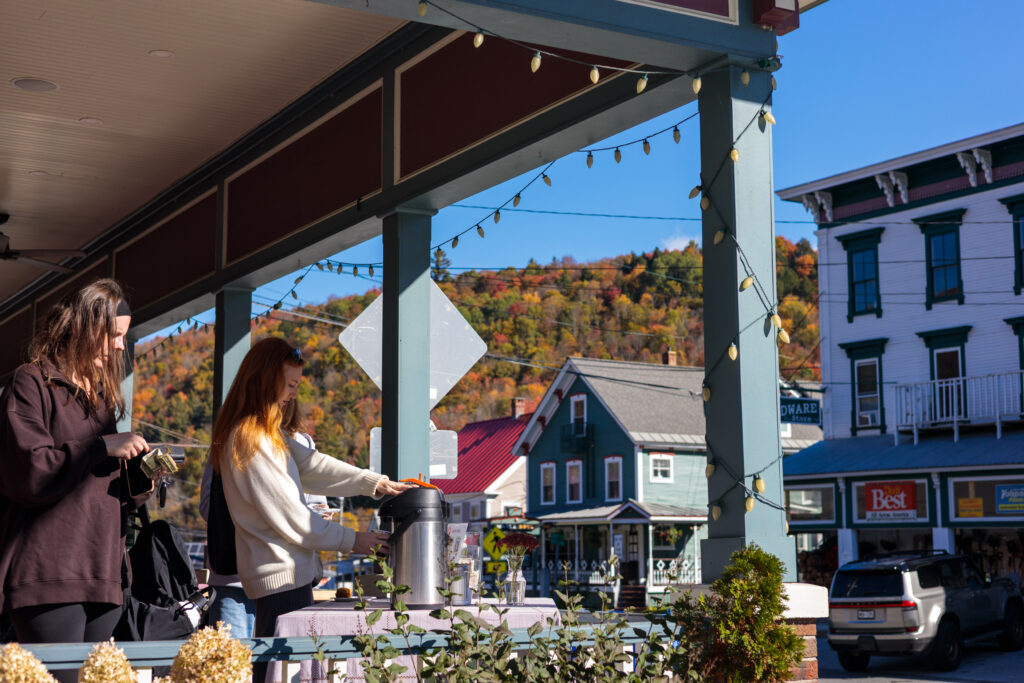
So a group of residents improvised. Beginning around the Fourth of July, volunteers turned the porch of the closed café into a weekend pop-up, serving coffee and homemade baked goods. Different local organizations took turns hosting, and what began as an effort to keep some activity in the center of town evolved into a summerlong community gathering place that raised nearly $24,000 in donations for local organizations.
“The entire goal of this, it was secondary that we raised money, but the first goal was to create visibility and vitality in the town when people were driving through,” said Peggy McKinley, one of the coordinators. “We didn’t want to look like our town was closed.”
The idea emerged shortly after the Rochester Café shuttered. About 10 or 12 people gathered for a dinner that included Chris Landis, owner of the Kendall Building, which houses the café. With the Suzuki program approaching and an estimated 400 additional people expected in town for a week, the conversation turned to what the café’s absence would mean for both visitors and the village.
“We started talking like, how are we going to feed these people?” McKinley recalled. From there came the idea of serving coffee and pastries on the café porch. Landis agreed to let the volunteers use the space for the summer.
The pop-up initially operated daily during Suzuki week and then settled into a weekend schedule.
McKinley took on much of the scheduling, making sure a group was lined up to host each weekend and helping coordinate a network of volunteer bakers.
She emphasized, however, that the project never belonged to one person or even one organization. “It was an amazing group effort,” she said. “There really wasn’t just one person kind of driving it.”
The Valley Hub, Feeding the Valley Alliance, Rochester Farmers Market, Park House, Big Town Projects, Rochester Public Library, the Rochester Stockbridge Unified District farm-to-school project, local first responders, the parent-teacher organization, White River Valley Players, the Rochester Democrats and Rebuild Rochester Foundation all hosted pop-ups over the course of the summer.
Changing organizations each weekend brought a different circle of volunteers and customers to the porch and helped expand the pool of people supplying baked goods, McKinley said.
Along the way, a core group of bakers also emerged who contributed week after week.
“We’re not talking like boxed muffins,” McKinley said. “We’re talking coffee cakes and croissants.”
Local businesses also helped get the project started. McKinley said the Singh Shop, Valley Grocer and Maple Soul, along with Rebuild Rochester, contributed money for signs and supplies.
McKinley and her husband developed a system of four storage bins filled with supplies to make it relatively easy for a different organization to take over each weekend. With Landis’ permission, the bins stayed on the porch and contained coffee cups, coffee makers, serving utensils, tablecloths and other supplies. Written instructions explained how to set everything up.
“People’s talents rose to the surface,” McKinley said. “Everybody took the role that worked for them.”
Nearly all of that work was done by volunteers. The group also found Alix Albert and hired her to set up coffee service and, at the end of a weekend, take supplies home to wash and restock them. Startup donations initially covered that expense, with proceeds from a few later pop-ups used after that money ran out.
Feeding the Valley Alliance volunteer Ann Van Dusen said the pop-ups filled some of the social role the café had previously played.
“It’s kept the food vibe here going and it’s a place where people can gather,” Van Dusen said.
In some ways, the porch developed a social character of its own.
Debby Scherrer, another Feeding the Valley volunteer, said that inside a restaurant, customers might simply wave to someone they recognize. On the porch, strangers were more likely to strike up conversations.
“There’s so much mixing that’s going on,” she said.
Visitors passing through town sometimes stopped after seeing the activity. McKinley said some stayed for half an hour to talk with residents, while locals sometimes spent two and a half hours visiting on the porch.
She jokingly came to describe it as “a happy hour” for breakfast and coffee.
There were impromptu attractions, too. A traveler from the Midwest who was camping nearby once brought out his guitar and played, and local musician Greg Ryan performed during a pop-up hosted by the White River Valley Players.
During Suzuki week, families camping near Chittenden Mountain arrived early one morning after a large storm, looking for someplace to warm up and get coffee. On another weekend, Scherrer recalled, a visitor from Idaho met local residents on the porch and ended up making plans to help them in their garden that afternoon.
People also continued arriving at the building expecting to find the Rochester Café open. Volunteers would explain what had happened and what the pop-up was about.
“Nine times out of 10, they would hang out and have coffee and danishes and enjoy the moment,” McKinley said.
The summer experiment also became a substantial fundraiser. McKinley estimated the pop-ups raised close to $24,000 overall, distributed among the participating organizations.
For Feeding the Valley alone, Van Dusen estimated the events brought in about $2,500.
But both women returned repeatedly to the gathering place the porch provided.
Organizers initially were unsure whether people would actually sit at the outdoor tables, Van Dusen said. Instead, people began making plans to meet friends there.
“It’s not like having the café open,” she said, “but it’s as close as we’re going to get” for now.
The hope now is that the temporary substitute will once again give way to a permanent café.
The Kendall Building is being marketed for sale or lease, according to property manager Dorie Davidson.
McKinley said reopening the café would be the best outcome for next summer. If that doesn’t happen, she said, the pop-up experiment could potentially return.
“I think what we’re all thinking is we hope by next summer that the café is open again,” she said.
Whatever happens with the building, McKinley said the success of the pop-ups demonstrated what residents could accomplish without a formal organization behind the effort.
“Everybody played a role,” she said. “Without people stepping up and playing those roles, it wouldn’t have happened.”
