

This story by Marin Howell was first published in the Addison Independent on Sept. 17, 2026.
LINCOLN — The fate of a proposed personal aircraft strip in Lincoln no longer rests in the hands of that municipality, but some residents are seeking another opportunity to weigh in before the quasi-judicial Vermont Transportation Board decides the project’s future.
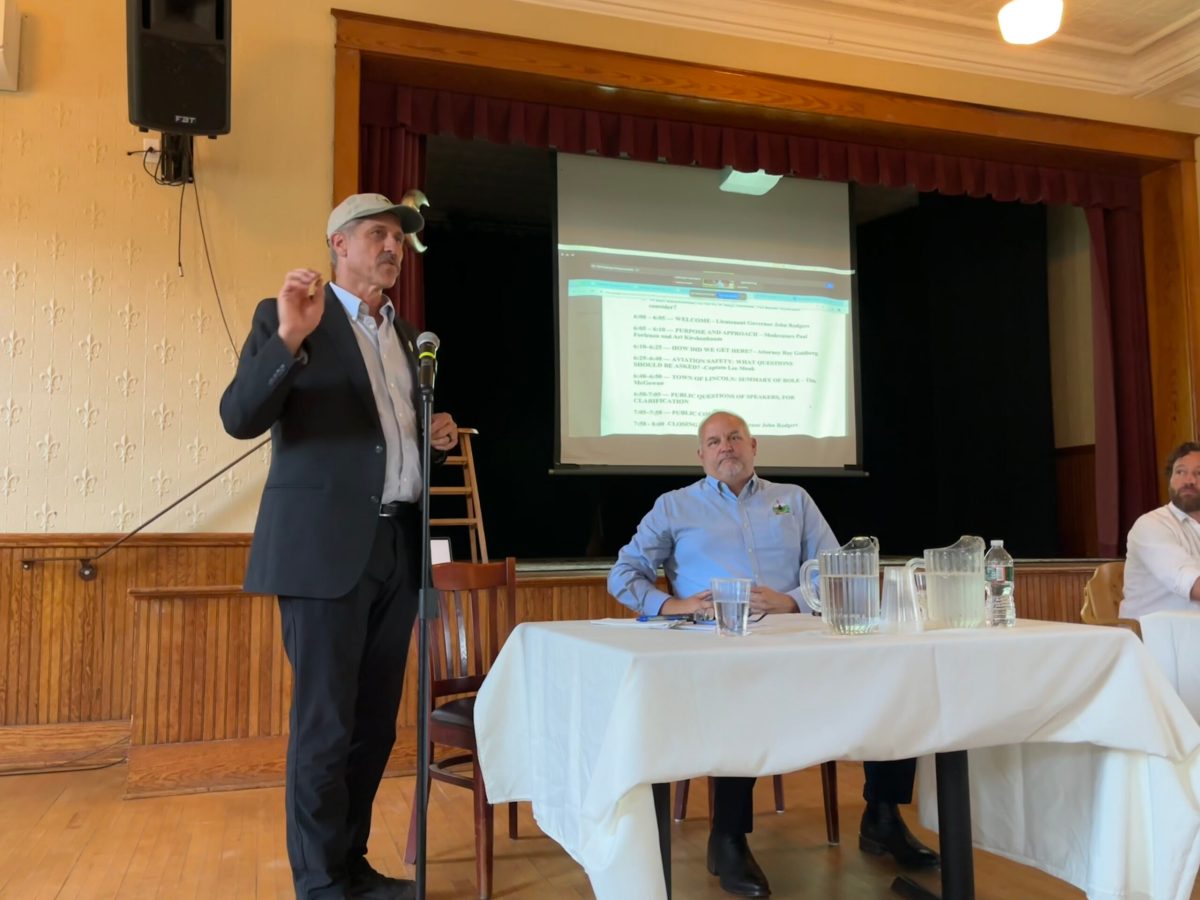
“I’m here tonight because I believe the people of Lincoln, and especially those who will be affected by this proposed airstrip, deserve a full and fair public process,” Lincoln resident Coco Moseley said at a forum held in Burnham Hall on Monday.
Moderators at the meeting clarified that the gathering was an informational forum and was not being hosted or sponsored by the town of Lincoln or any government agency. The meeting is not part of the decision-making process for the landing strip, which Lincoln residents Kyle and Katie Clark have been seeking approval to operate at their property since 2022. Kyle Clark is CEO of the electric airplane manufacturer Beta Technologies, where Katie Clark serves as head of brand, creative, culture and spaces.
The forum was hosted by Vermont Lt. Gov. John Rodgers after a group of around a dozen Lincoln residents sent emails to state officials last month sharing concerns about impacts the proposed airstrip could have on safety, the surrounding environment and the character of the area, among other things.
Project history
The group of residents has expressed such concerns since 2022, when Lincoln’s former zoning administrator issued the Clarks a permit to build the landing strip on their Orchard Road North property. The decision to issue that permit was appealed by Lincoln resident Marilyn Ganahl. Following a series of public hearings, the town’s Zoning Board of Adjustment denied the Clarks’ the permit.
Lincoln’s zoning board was dissolved soon after and replaced by the Development Review Board, which in 2023 denied a separate conditional use permit application submitted by the Clarks for a proposed personal landing area.
The Clarks appealed those decisions to the Vermont Environmental Court. Although the court ultimately OK’d the land-use portion of the Clarks’ application, it stated noise and safety aspects of aircraft operations “are preempted by federal law” and would thus not be considered when analyzing the personal landing area’s compliance with Lincoln’s zoning regulations.
Such questions were expected to be addressed by the Federal Aviation Administration and the Vermont Transportation Board. The FAA issued a conditional determination to the Clarks for the airstrip last year and denied a petition for reconsideration this summer. Vermont Agency of Transportation officials recommended “operational approval and certification” of the restricted landing area to the Transportation Board following a visit to the site in June.
Thus, a decision from the Vermont Transportation Board could mark the last step in the approval process for the airstrip. In their emails to state officials, Lincoln residents said they were told that process would include a public hearing and that without one, residents haven’t had a chance to be heard on concerns around safety and the public interest as the application has made its way through various channels.
“My perspective and the reason I’m here is because I believe when a town and a selectboard have asked a state agency for a public hearing that the agency can clearly have, that they should have it, and I’m going to keep asking them to have it on your behalf,” Rodgers said at the meeting. “I have said from the beginning, I don’t want to put my thumb on the scale either way. I want to make sure the process has been carried out and the public and the town officials have had their say before a decision is made.”
Regulatory gap?
That process and how it’s unfolded have been viewed in different ways. Some note that the project has made its way through the necessary channels and say issues like safety have been addressed. Others argue that questions around safety and the public interest remain and that the project being weighed by different entities has created a regulatory gap.
“Sometimes in government, the best intentions run into the fact that some people, some courts do something, some agencies do something else,” Roy Goldberg said at the meeting. He is an aviation attorney based in Washington, D.C., who’s represented Lincoln residents opposed to the airstrip.
“Safety is obviously very important, so we just want to make sure the tires on safety have been kicked by all the necessary parties, and that this aircraft operation … will be fully vetted before operational.”
A statement provided to the Independent by a spokesperson for the Clark family noted the project has been deemed safe by state and federal agencies.
“Over four years, the Clark family has followed the required permitting, safety review, and approval processes to construct a safe, limited use personal landing area at their home,” the statement reads. “They are disappointed by opponents’ attempts to usurp the official processes and take away the Clarks’ freedom and liberty to enjoy the use of their private property. … Their hope is that there will be a resolution through the official process soon.”
“The Clarks have prevailed at the state’s environmental court because this is a permitted land use under Vermont law,” the statement continues. “The FAA has deemed the landing area safe and permissible. And, the Vermont Agency of Transportation completed a site inspection and deemed it safe, and recommended approval to the Transportation Board. We hope to have resolution from the Transportation Board promptly because this permitted use has undergone years of inspection and process, as required, for approval.”
Sept. 14 forum
The Clarks did not attend the Sept. 14 forum, which saw over 70 people gather in Burnham Hall. Among those in attendance were state Sen. Ruth Hardy, D-Middlebury, Addison-4 Reps. Karen Lueders and Herb Olson, and Franklin-4 Rep. Matt Walker, who chairs the House Committee on Transportation.
Along with a presentation by Goldberg, attendees also heard from Lincoln Selectboard Chair Tim McGowan and Lee Moak, a national aviation expert and consultant hired by Lincoln residents to conduct a safety assessment of the proposed airstrip. Moak summarized his report Monday, highlighting concerns such as operations being described by the FAA as “highly challenging” because of the terrain and runway length.
In his remarks, McGowan offered his understanding of the town’s role in the process, saying that the selectboard has “maintained a neutral monitoring posture” and focused on supporting the work of its local boards.
More recently, the town has participated in the process as an interested party. McGowan said the town’s participation is intended to request a public hearing “so that the interested parties have an opportunity to address the application,” provide information on the town’s concerns and seek clarification on “inconsistencies or ambiguities within the application and related documents.”
“The town recognizes that certain subjects, including aircraft safety, pilot operations and noise, are outside the scope of local zoning regulations and must be addressed through state and federal processes,” McGowan said. “In other words, Lincoln is not attempting to usurp the Transportation Board’s role. Rather, the town is requesting that the appropriate state process be fully vetted and that Lincoln residents are granted a fair opportunity to be heard on matters currently before the state.”
The Independent reached out to Vermont Transportation Board Executive Secretary Rachel Dimitruk, asking if the board planned to hold a public hearing and when a decision from the board could be expected. Dimitruk said the board does not comment on ongoing cases and referred to the process for personal restricted landing areas outlined in state statute (5 VSA 207) and the Aeronautics Rules and Regulations.
At the Sept. 14 forum, Hardy said she believes the process needs to be clarified, specifically around whether there should be a public hearing.
“One of the things that I had introduced as part of a bill was to create a sort of advisory committee on aviation issues that includes members of the public that are impacted by aviation facilities,” she said. “So, I’m hoping that Rep. Walker … if we’re both back in the Statehouse, that we can work together on this to make sure that there’s a clearer public process when there’s a proposed new facility or something that might impact the public and the broader public good, which has been part of the conversation tonight.”
Monday’s forum featured about an hour of public comment and questions. Multiple residents used that opportunity to reiterate concerns about the proposed airstrip’s impact on nearby farms, residents and the surrounding environment.
While residents at times shared differing opinions, Rodgers encouraged attendees at the start of the meeting to keep discussion respectful.
“We’re neighbors, and no matter how this ends, you’re all going to be neighbors when it ends, and so we hope we can all be good neighbors,” he said.

