

This story by Molly Hughes was first published in the Valley News on Aug.27, 2026.
NORWICH — Vermont farmers can’t afford to own the land they farm, and the federal money meant to help them has become a paperwork contest that pays out late, if at all.
Those were the two problems that came up most when six farmers sat down Thursday at Honey Field Farm in Norwich with U.S. Sen. Peter Welch, D-Vt., in a two-hour roundtable organized by the Northeast Organic Farming Association of Vermont.
“It’s so funny that we hear about this farm bill and the people arguing it,” said Amy Huyffer, of the Strafford Creamery. “The question they should start with is, ‘Did I eat today, and do I want to eat tomorrow?’”
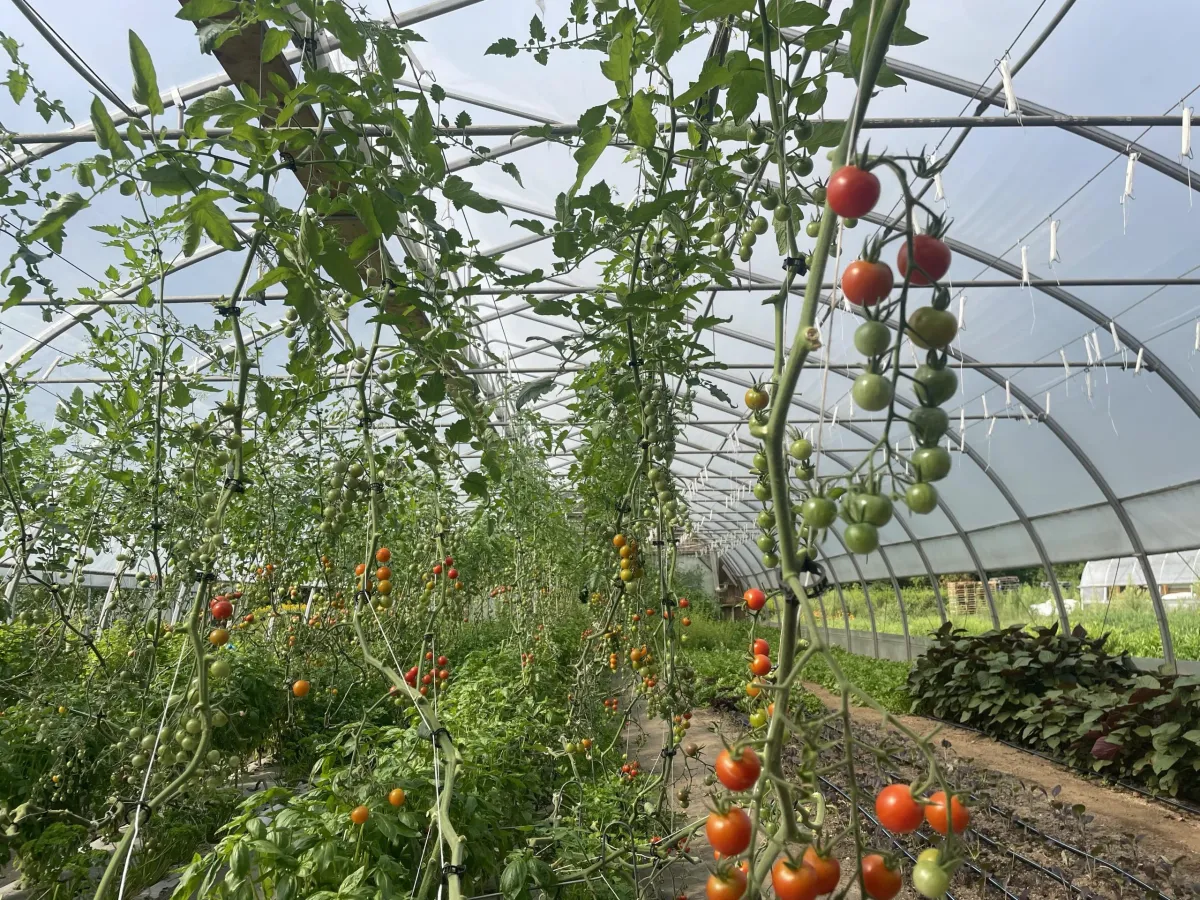
For Eli and Valerie Hersh, who run Honey Field Farm, the idea of ownership is still aspirational. The couple took over the vegetable and nursery operation seven years ago through a lease-to-own arrangement with Dirt Capital Partners, a private investment firm that bought the farm when the Hershes couldn’t. They hope to complete the purchase next summer.
“It kind of illustrates the need for so many different methods of doing that farm transfer, so that this farm, which is such a legacy, could continue as a farm,” Eli Hersh said.
That barrier was the through-line of the morning.
“We don’t own any of the land we farm,” said Shona Sanford-Long, who runs Flying Dog Farm in Tunbridge and started her livestock business in 2020 with animals from her parents’ farm and no savings.
She said her generation is trying to build ownership structures that don’t come with “that huge burden of a mortgage that makes everything else impossible” — while also covering the fencing, water lines and barns it takes just to begin.
Her mother, Suzanne Long, has run Luna Bleu Farm in South Royalton since the 1980s and is now working on the same problem from the other end. She and her husband are renovating a smaller house on the property so they can hand over the one they live in to a poultry-farming couple who have been land-insecure for at least five years.
Their transition is part of a broader effort through the White River Land Collaborative, a Tunbridge-based nonprofit organization, to keep local farmland in production as older farmers age out.
“How can this farm that we work so hard to build, and these soils that we work so hard to build, still continue to be a farm and be an asset to the next generation?” she said.
Long said the trap runs in both directions: Older farmers whose only wealth is their land and barns can’t afford to leave, and younger farmers who came up through the system can’t afford to buy in.
“You have to have other money, family money — or else have a different kind of job, and then come to farming,” she said. “But for those folks that have come up through farming, it’s really tough.”
The federal programs meant to ease that squeeze are, farmers said, increasingly unreliable.
Sanford-Long described a fencing contract funded through the U.S. Department of Agriculture’s Natural Resources Conservation Service that was supposed to be installed last fall. Since the money comes as reimbursement, the government shutdown stalled it — but she had already paid a deposit and couldn’t front the rest. The project slipped to spring. Payments on newer work have been delayed again, she said, this time by USDA restructuring and staff eliminations.
Even approved grants can sit unused for years, she said, because farms don’t have the cash to spend first and wait to be reimbursed. And the applications themselves have started to crowd out the work.
“That’s what farming is becoming,” she said. “It’s like, ‘OK, how good of a grant writer am I? How well can I fit my story into what the grant is asking for?’”
Welch was blunt about the USDA staffing shortage behind the delays. “Right now, they’re supposed to be staffed at 47 people, and they’ve got — nine,” he said. “That is horrifying.”

He said he planned to stop by the state office that afternoon to thank the people still there.
Underneath the access problems is the issue of pricing. Nationally, farmers received just 11.8 cents of every dollar Americans spent on domestically produced food in 2024, according to USDA’s Economic Research Service. After production expenses, farmers and ranchers kept about 5.8 cents, per an American Farm Bureau Federation analysis of the same data.
Stephen Leslie, of Cedar Mountain Farm and Cobb Hill Cheese in Hartland, pointed to dairy: milk prices “flatlined” by 1993, he said, while costs to produce it kept climbing — a gap that hasn’t closed since.
Long put it in consumer terms. “Everyone’s talking about how expensive eggs are,” she said. “The conversation is all about ‘We can’t afford to eat,’ but the farmers can’t afford to produce food at that price.”
Sanford-Long said farmers absorb the difference themselves. Any of them could pivot to a high-end specialty product that actually covers costs, she said, “but then if the goal is to actually feed people, the people we want to feed aren’t going to be able to afford that.”
Welch traced the gap to consolidation beyond the farm gate. The Farm Bill mostly subsidizes equipment, seed and fertilizer companies, he said in an interview, and the challenge is “to reorient the Farm Bill towards feeding America nutritious foods and producing it locally, as opposed to just providing subsidies to Big Ag.”
That pressure carries a human cost. Valerie Hersh, who had worked with the federal Farmer and Rancher Stress Assistance Network, told Welch that farmers “historically have one of the highest suicide rates of any occupation,” and said a national mental-health program serving farmers and farmworkers, Cultivemos, was ended by a stop-work order last year.
A 2023 CDC report found male farmers, ranchers and agricultural managers died by suicide at a rate of 52 per 100,000, compared with 32 per 100,000 among men in other occupations.
There is no comparable data from women in farming.
Long said the strain gets internalized. “You keep saying, ‘How come after 10 years I’m still struggling? How come after 15 years? How come after 20 years? What am I doing wrong? I must not be good enough,’” she said.
Several farmers proposed a structural answer: guaranteed income.
“Universal Basic Income for farmers who are able and willing to adopt organic, regenerative practices,” Leslie said, framing it as payment for ecological repair as much as for food.
Eli Hersh said farmworkers get left out of the conversation entirely. Honey Field’s top wage is about $25 an hour, which he said isn’t enough for someone to build a life, and the farm gets by on part-timers who farm elsewhere, too. He said talented young people cycle through and leave for jobs that can cover student loans.
“It’s devastating to think about your kids having interest in farming, but knowing that you can’t, with good conscience, recommend it as a career option when it’s the most vital career that someone should have,” he said.
Labor pressure on Vermont farms isn’t only about wages. The state’s dairy sector relies heavily on immigrant workers — roughly 1,200 to 1,500, according to a study done by the University of Vermont.
Asked afterward about stepped-up immigration enforcement, Welch called it “outrageous” and “destructive,” and said it is “really hurting our farm community.” He said the country can and must have a legitimate farm labor program instead.
The biggest obstacle to passing the bill is a fight over nutrition funding. Republicans’ tax and spending package cut benefits by hundreds of billions of dollars, and Welch said he is pushing to restore the longstanding link between farm programs and nutrition programs.
Huyffer said she doesn’t want the Agriculture Committee to be moved by sympathy. She recalled a Washington event where farmers’ hardship stories were read aloud to staffers, and said that framing gets it backward.
“I don’t want Sen. Welch or anybody in the ag community to take care of us because we’re a sad story, or even an admirable story,” she said. “I would like people to have sustainable food policy because they want to eat tomorrow, and they want to eat next year, and they want their kids to be able to eat in 20 years.”
