



Updated at 6:14 p.m.
NEWBURY — Aly Richards, who led a lobbying group that won major increases to public child care funding in Vermont over the past decade, is running to be the state’s next governor, she announced Monday.
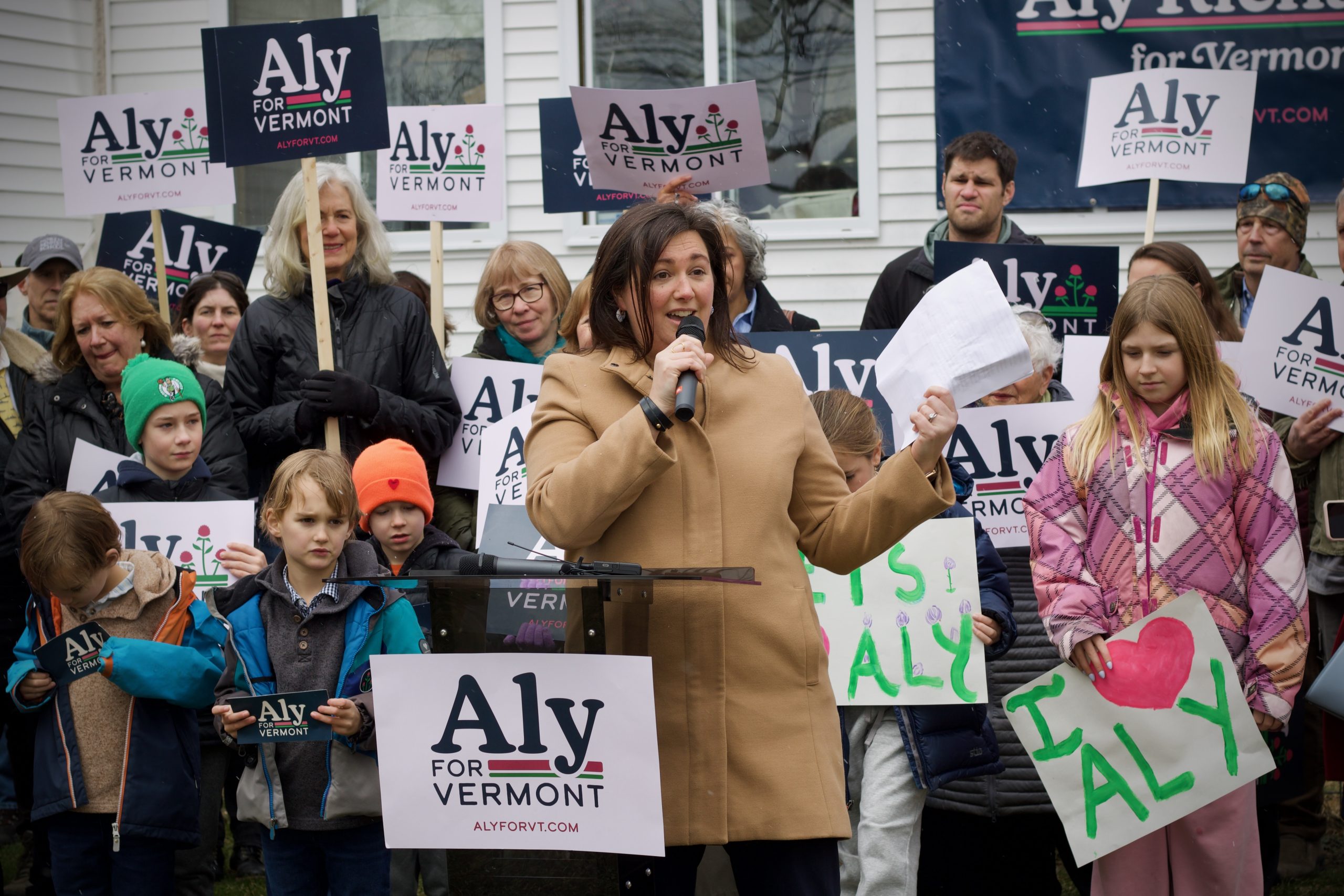
Flanked by dozens of supporters on a snowy morning outside the Newbury Village Store, the former CEO of Let’s Grow Kids said she sees “a five alarm fire” of social and economic challenges facing Vermont “everywhere we look.” And she took aim at the opponent she could face in the general election, Republican Gov. Phil Scott, whom she said hasn’t done enough to fix those challenges since he was first elected in 2016.
“You’ve got to ask yourself: Are you better off now than you were 10 years ago?” Richards asked the crowd, many of them holding white and blue “Aly for Vermont” signs. “When people can’t afford to live here, you know we’ve got a problem, OK? It’s not working. It’s time for a new approach.”
Richards is the second Democrat to launch a bid for governor this year. Amanda Janoo, an economist from Strafford, announced her campaign last month and has already reported raising a substantial amount of campaign cash. As of Monday afternoon, Richards’ campaign had not filed its first batch of campaign fundraising data.
Richards, who is 40, was raised “just up the street” from the store in Newbury, she said, though now lives in Montpelier. Before taking the helm of the child care juggernaut, she worked on former President Barack Obama’s 2008 campaign and then in the office of former Vermont Democratic Gov. Peter Shumlin, finishing her tenure there in 2015 as deputy chief of staff.
To be sure, it’s not clear yet that Richards, or Janoo, would face Gov. Scott in an election this fall. Scott hasn’t announced whether he will seek a sixth two-year term. In past election years, the governor has waited to announce his campaigns until after the Legislature is out of session, which is typically in May.
If Scott does run again, the winner of this year’s Democratic primary would face a tough fight. None of the last three Democrats to challenge Scott garnered more than 30% of the general election vote, and Scott remains deeply popular across Vermont.
But Richards made the case in an interview late last week that Scott has done little more than call out the problems the state is facing, namely that it has grown increasingly unaffordable, it doesn’t have enough housing and its population is aging without younger residents staying to build up the workforce.
“I think the diagnosis of the challenges has been correct. I think the methods have not worked,” she said.
Richards said the success of the Let’s Grow Kids campaign — including a 2023 law that created a new payroll tax to support income-based subsidies to families paying for child care — shows that she has the political skills to tackle major state issues.
Rick Davis, the philanthropist who founded Let’s Grow Kids, threw his backing behind Richards in a speech at Monday’s event. Michele Asch, an executive at a Winooski skin care company who was one of the child care campaign’s largest donors, also spoke. A number of current and former state legislators were also in attendance.
Richards said after the event that she would release more detailed policy positions in the coming weeks.
Asked about the topic that’s dominating discourse in the Statehouse right now — education reform — she told reporters she does not support forcing school districts to consolidate, something Scott has argued is essential to reducing the overall costs of the education system.
Last week, the House Education Committee passed out a proposal that would create a process to facilitate voluntary mergers of the state’s 119 districts, but stops short of requiring consolidation. The bill, H.955, advanced on a party-line vote, with all seven Democratic committee members voting in favor and all four Republicans voting against it.
