


Rose Gale misses the good old days, in the early 1960s, when she would ask to hunt on a neighbor’s land over a cup of coffee.
“Usually in the end he also ended up with a couple of steaks,” the Salisbury woman told the House Environment Committee Wednesday.
But in recent years, Gale said she’s seen more landowners put no trespassing signs on their property, closing off access to hunters. It’s “a clear indication to me of changing times,” she said.
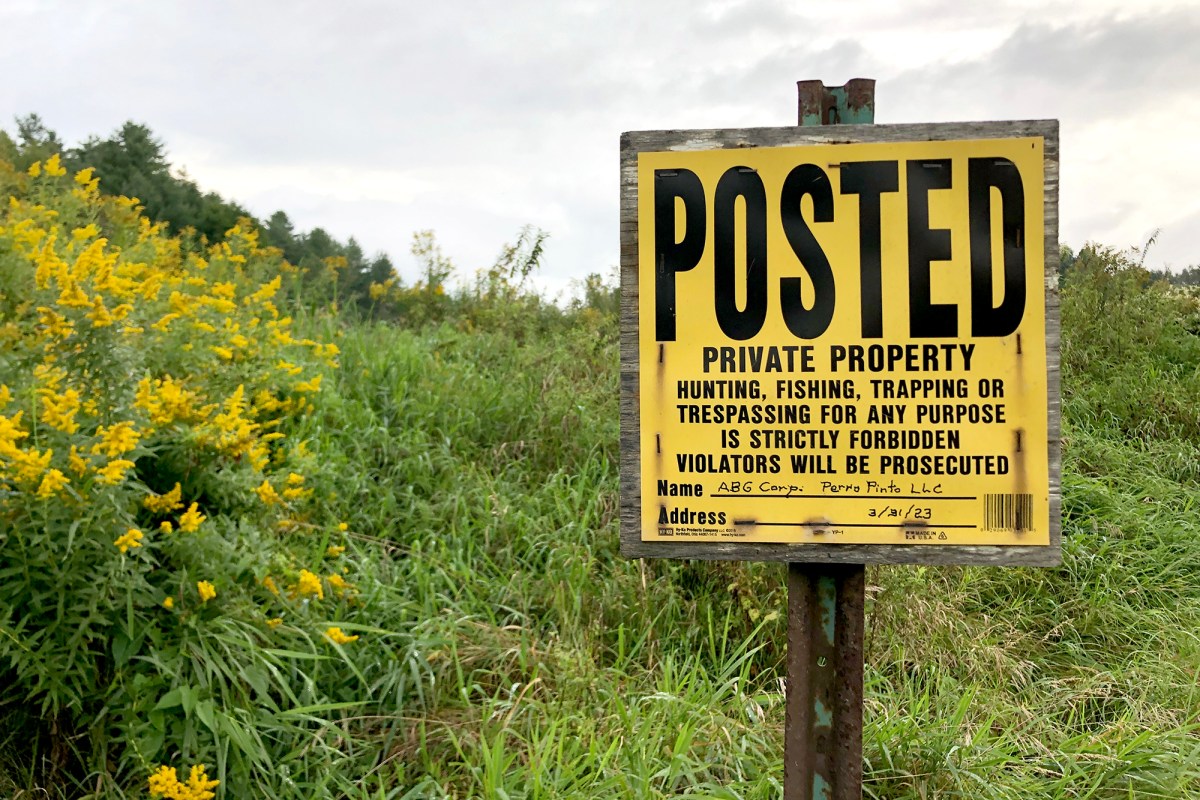
Lawmakers in the committee are considering a bill that, in its most recent form, would allow landowners to restrict hunters’ access to their property by posted signs or purple paint markings on trees. The bill, H. 723, has opened up a debate underpinned by concerns about class divides and a fanaticism for Vermont hunting traditions.
Between 78% and 82% of all land in Vermont is privately owned, according to Jason Batchelder, commissioner of the Vermont Department of Fish and Wildlife. And many hunters worry they will have less land to hunt on if property owners can easily restrict access with a simple stroke of a brush (and paperwork filed with their town’s clerk). Hunting activists are especially trying to look out for hunters who may not have the money to own large plots of land themselves.
The Vermont Constitution gives hunters the right to trek through private property that is not enclosed. And under current state law, a landowner has to post signs around the entire perimeter of their property and register their land with the town clerk for it to meet the legal criteria.
Mike Covey, executive director of the Vermont Traditions Coalition, which advocates for hunters’ land access, gave the committee his interpretation of the state constitution’s intent. Its authors, he argued, wanted to make sure that not only wealthy landowners would have access to wildlife.
“While the land is a finite resource that can be owned, the wildlife is a renewable resource that we all collectively have access to,” Covey said.
Covey said he didn’t support marking property with purple paint because it would restrict the land that hunters have access to. Earlier in the meeting, Covey said that lacking access to land is the primary barrier to partaking in the sport.
“There’s an assumption or an expectation that adding in the option for purple paint will further restrict access to private land,” said Rep. Larry Satcowitz, D-Randolph. He asked Covey if he had any evidence of that happening in other states that have paint laws.
“I don’t know that it causes more land to be posted,” Covey said. But he did worry that purple paint might last for years, making it easier to enclose land for longer.
— Charlotte Oliver
In the know
Gov. Phil Scott plans to vote against the school budget proposal for the upcoming year in his hometown district, he told reporters at his weekly press conference Wednesday.
Scott, who lives in Berlin, said the Washington Central Unified Union School District budget would lead to “significant” property tax increases, per initial estimates, in several of the five towns in the district, which he can’t support. The Republican governor was holding a copy of a tri-fold created by the district to explain its budget proposal — which he’d pulled out of his suit jacket just moments before — while answering the question on how he’d vote on Town Meeting Day.
Washington Central was in the news earlier this month when Calais and Worcester residents both voted against shuttering the community elementary schools in their towns. While the governor’s sweeping education reform plan, laid out in Act 73, does not mandate school closures, the broader district consolidation he wants to see will likely lead small, rural schools to close their doors.
— Shaun Robinson
If Vermont chooses to couple its tax code to the changes made in the federal “One Big Beautiful Bill Act,” or H.R.1, it may cost the state more than $21 million in tax revenue, according to new analysis from the Vermont Tax Department and the Joint Legislative Fiscal Office. That could rise to more than $34 million in fiscal year 2027, according to the projection.
Lawmakers are considering decoupling some of Vermont’s tax code from federal law to blunt the impact of H.R.1’s tax breaks on the state’s revenues.
— Ethan Weinstein
On the Hill
A World War II veteran from Castleton was among the numerous guests that President Donald Trump honored during his State of the Union address Tuesday night. Trump commended George “Buddy” Taggart — who is set to turn 100 years old on July 4 — for his role in a 1945 U.S. military operation that liberated a Japanese-run internment camp in the Philippines. Taggart was wounded while serving in the war, Trump said, and later awarded a Purple Heart.
“Buddy, you’re a brave man, and we salute you,” the president said.
On Wednesday, Rep. Bill Canfield, a Republican from neighboring Fair Haven and a veteran himself, said Taggart has long been “very well respected at all of the Rutland County American Legion posts” — and is “always a gentleman.”
— Shaun Robinson
Notable quotable
“The President has a fairly big ego — and he likes to see his name on everything,” Gov. Scott said Wednesday, asked what he thought about Trump putting his own name on buildings around Washington, D.C., and hanging up banners with his own face on some others.
— Shaun Robinson

