

This story by Will Lindner was first published in The Bridge on Nov. 25, 2025.
She lies at the head of a path into the woods, deceased, supported by a low table and swathed in a white shroud adorned with images of nature. A homemade wreath of autumn leaves, ferns and flowers has been placed upon her. Loved ones gather under a gray October sky, their conversation subdued, but not darkened, by the task before them. They are resolute. In a moment they’ll shepherd her — their mother, grandmother, great-aunt, friend — deeper into the woods to her burial site. Her time upon the earth has ended; her time within the earth, and of the earth, will begin.
Paul Acciavatti, who serves as sexton, or cemetery manager, at the Vermont Forest Cemetery high above Roxbury village, provides instruction. They’ll use straps that pass beneath the body and the board she lies on, and will drape across the necks and shoulders of the bearers on either side. Four volunteers step forward — two young men and two young women. They prepare themselves, then lift. Someone quickly steps forward to support the rear, Paul withdraws the low table, and they set off, followed by the rest of the entourage — 15 or 20 people in quilted vests, sweaters and caps, jackets and jeans; clothing suitable for the season and the moment.
The path descends gradually, then bends to the left. They stop for a rest. Then soon they’re at the gravesite, which Paul has prepared. The mound of dirt beside it is covered with a tarp, and then by a dozen branches in golden foliage.
“And look,” says someone, peering into the grave. “There are soft leaves on the bottom. It’s so pretty.”
The bearers set the board, and the shrouded figure whom they are honoring, across planks that span the opening. They step back.
And there is silence. It lingers. … The moment has come. The forest is still.
Natural burial, legalized in Vermont in 2015, is a custom as old as the human race, but provisions have crept into cemetery regulations — such as a requirement to encase the deceased in concrete boxes to stabilize the ground surface — that thwarted the practice. Not that there was much demand for standard burial practices like embalming; and the use of formidable hardwood caskets reflected an entrenched revulsion at the thought of decomposition.
The 2015 law responded to more recent perceptions of our relationship with the environment. Through natural burial, those who wished could purposely merge with nature, helping sustain it as it sustains us. A summary of the law describes the practice as “the burial of unembalmed human remains . . . that rest in either no burial container or in a nontoxic, nonhazardous, plant-derived burial container or shroud [which thus] accelerates conversion of human remains to soil.”
But a problem remained: Vermont’s requirement that graves be at least five feet deep. The mycelial network — fungi that break down organic matter and convey the nutrients to surrounding organisms — operates closer to the surface. The five-foot depth defeated the purpose of legalizing natural burials.
Advocates rallied to amend the law. Among them was Michelle Hogle Acciavatti, a 2005 graduate of Bennington College who later worked in neuroscience and ethics at Boston Children’s Hospital. There, she developed an interest in aiding families facing the loss of a loved one. Over her career she has pursued both conventional and innovative paths to provide these services, working as a funeral director at Guare & Sons Funeral Home in Montpelier, and privately as a death doula.

“What I came to specialize in was less the dying,” she says, “and more what happens after people die, returning to people the skills for caring for their own dead instead of calling in a funeral director. And then I was really fascinated with natural burial and the ability to give our bodies back to the earth.”
When a bill emerged in 2017 to change Vermont’s minimum grave depth to three-and-a-half feet, Michelle (who is married to Paul Acciavatti) lobbied legislators and traveled around the state giving educational presentations on natural burial.
“I would say, like, ‘If you want this for yourself you have to contact your representative and say please pass this bill.’” she said. “We got it to the House floor, and to the Senate floor, and it passed overwhelmingly, because we had a ton of popular support.”
With natural burial now legal, and shallower mandatory depth consistent with its objectives, towns began offering this option in their municipal cemeteries. Calais, where resident Jennifer Whitman had championed the legislation, was one. In Montpelier, Green Mount Cemetery created a section for natural burials. It became a regional movement and now more than 70 cemeteries in New England permit it.
Yet there’s a difference — irrelevant to some potential customers, but hugely significant to others — between a designated section in a town-maintained cemetery and an undeveloped setting where a body can merge with a robust natural environment. Nothing like that existed in Vermont. With the relevant laws changed, Michelle Acciavatti assumed someone would fill that void.
“I was off to mortuary school,” she says, “because I had this big idea that if I work in a funeral home I’ll be able to reach more people. I was working at Guare’s in Montpelier; we were the first funeral home in the state to have a natural-burial package, and Green Mount, right in our community, was adding a section.
“Then COVID hit.”
People typically mourned together in funeral homes, but the pandemic quashed indoor gatherings. This dilemma for the aggrieved broadened Michelle’s thinking: natural burials, in safer outdoor spaces, could allow mourners to take upon themselves the ritual of burying the dead, personalizing the ceremony and meeting their own emotional needs.
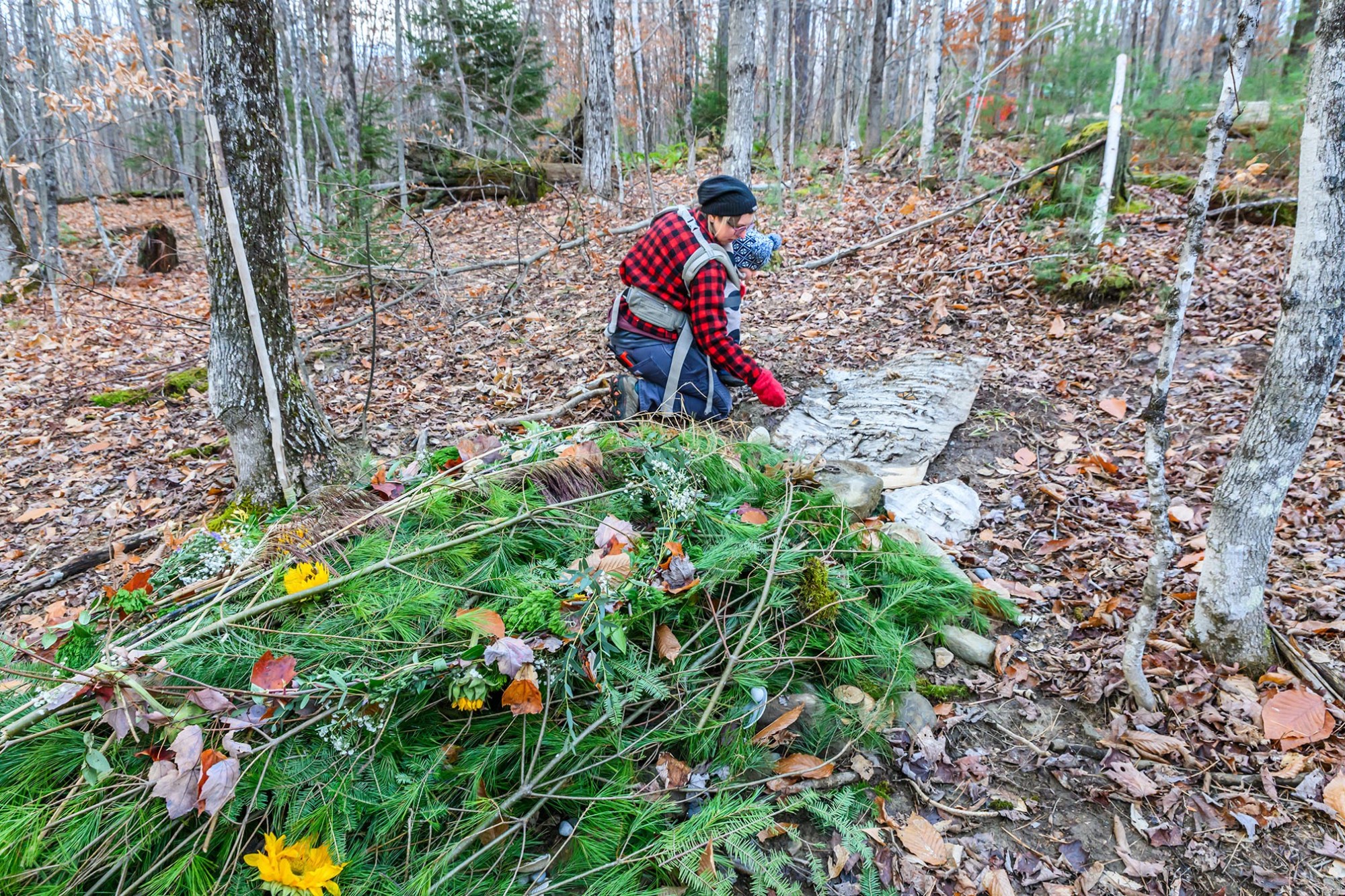
“So,” she says, “in the summer of 2020, I left the funeral home to start a cemetery.” (As she speaks, with leafy graves near at hand, she sways her 10-month-old son, Nico, in the baby strap around her shoulders. He coos. The cycle of life vibrates like silver around us.)
The Acciavattis (returning to 2020) began looking for land. Real estate prices, besotted by the pandemic, careened wildly, but in the spring of 2021, a logging company that had planned to develop 56.7 acres on Beaver Meadow Road above Roxbury as a source for Norway spruce decided to sell it instead.
“It had everything we needed,” Michelle recalls, “and it was reasonably priced.”
They used money that Paul’s late mother had left to him unexpectedly. They formed a nonprofit to own and operate the cemetery (headed by an active, participating board drawn largely from supporters whom Michelle had met while advocating for the legal reforms). There were some regulatory hurdles; neither the Act 250 district commission nor the Roxbury selectboard had encountered a land-use proposal like this before; Michelle recalls fielding a question about whether, if a tree blew down in a storm, it would catapult bodies out of the ground.

In the end, their applications were successful. Lots of work lay ahead of them (and still does): developing the gravel parking area at the entrance, the wooden shed there that serves as an office, the curvy dirt road down to another parking area that’s the main gathering spot, and trails that wind through the woods so that people can reach the places within that speak to them of solace and solitude, regeneration and kinship, soil and fungi and roots, and perhaps the spirits they perceive in the ecosphere.
The Vermont Forest Cemetery opened on Oct. 7, 2023. Three days later, on Oct. 10, a person named Ron was buried there, the cemetery’s first permanent resident.
The cemetery’s property, which is proceeding toward conservation through Vermont Coverts, spans two hillsides that straddle the Third Branch of the White River. Its contours, and statutes applicable to all Vermont cemeteries, leave some areas unusable.
“We probably have about 20 burial acres,” Michelle estimates.
But it’s all one forest. Michelle (now listed as its founder and head cemeterian), Paul (vice president and sexton), and Michelle’s father, Jim Hogle (formerly chair of Harvard’s biophysics program, but now the president and outreach coordinator for the forest cemetery) have noticed that a gravesite often becomes less central to returning visitors; they partake of the whole forest that has incorporated the person they loved.
It’s also true that as seasons pass gravesites become less distinct. Conventional headstones are not permitted. People find ways to adorn graves, but the cemetery’s emphasis on natural materials means that eventually nature will take them over. Sometimes, Michelle acknowledges, “we have to compromise between the needs of the forest and the needs of the people.”
A Marine veteran was buried recently, and the memorial coming from the Veterans Administration will not entirely conform to the cemetery’s standards. The forest will deal.
Inevitably, then, there’s a degree of anonymity implicit in forest interments. But Paul Acciavatti or Treasurer and Cemeterian Bailey McLaughlin bury a detectable bronze marker, stamped with identifying information, in the center of each grave.
“We keep track of everybody,” Michelle says. “It’s required. We maintain a map, which is duplicated in the town of Roxbury. Plus, it’s in the cloud.”
And the graves may not forever be distinguishable, but she doesn’t want people’s stories to disappear. There are plans to generate long-form obituaries to accompany the cloud map, recounting the lives of the people who have chosen an inconspicuous resting place.

This is a comparatively inexpensive form of burial, especially if the family conducts most aspects of it (cemetery staff prepares the gravesite). A current ballpark cost is about $2,700. Costs increase as the staff provides more labor, and winter burials cost more. The cemetery can connect people with artisans who offer appropriate wooden or wicker caskets if they prefer something more substantial than a shroud.
Buying in ahead of time — even when there’s no hint of mortality — helps the organization meet its expenses. It is not possible, however, to select a precise spot until death is nearing, for the forest is ever-changing and the cemetery must be able to respond to immediate, seasonal demand. But for family members who wish to lie close together, room can be left for a partner or partners once the first person is interred.
The VFC website also addresses questions about cremains, pet burial, and other concerns. Jim Hogle and Michelle Acciavatti are responsive to calls and emails.
In all, the VFC projects that there will be room for perhaps 2,000 burials in their woodland cemetery. As of mid-November, there were 37.
Most importantly, they hope they’re in the forefront of a movement.
“We’re not right for everybody,” Michelle acknowledges. “Some people tell us. ‘This is too rustic,’ or ‘It’s too far for us.’ Or, ‘I want to be buried where my friends are.’
“Also, I say that grief is a participatory emotion that demands action. We encourage you to come and help carry the body to the grave, to lower it down and to fill that grave. It’s healing. We have volunteers to support you if you can’t or don’t want to do that. But there are cemeteries, like Green Mount, where it’s more full service.
“My hope, though, is that every community will have a place dedicated to natural burial that responds to the need of the community. I hope we don’t remain the only site for long.”
The contemplative silence, and the soft weeping that accompanies it, ends as naturally as it had begun. Recognizing that it’s time, Paul says, “When you’re ready, and only when you’re ready, have folks lift on the straps and Bailey and I will pull the boards out from under, and then you can slowly let her down.”
He waits for a moment; then, “One, two, three, lift.”
They remove the planks, and her descendants ease her to the leaf-strewn bottom, three and a half feet below. Then Paul shows people how to take up the beech boughs from atop the dirt pile and place them down upon her. It’s almost festive, with the golden leaves flickering in the air.
Someone calls out, “We love you, Mom.”
Then people take up the shovels and hoes the cemetery has provided, and begin filling the grave. The first shovelfuls weigh heavily, but as she fades from view the pace quickens, and within a few minutes the dirt has reached ground level. They finish by spreading the topsoil the staff had set aside when they prepared the grave, which has more nutrient value than the deeply subterranean dirt and will help reconnect the surface vegetation.
The burial is done.
Now the decoration starts! They pile shimmering green spruce and pine boughs on the grave, and overspread the boughs with sunflowers, baby’s breath, and leaves of red, brown, and orange. They’ve brought lemon balm and lavender from her garden, small fragments of nature that ornamented her home. They build delicate stone spires.
They have transformed the somber grave into an artistic creation, and they’ve done it together. They stand silently for a moment, regarding their work, then one of the daughters clasps her hands and says, “She really would have loved this.”
