

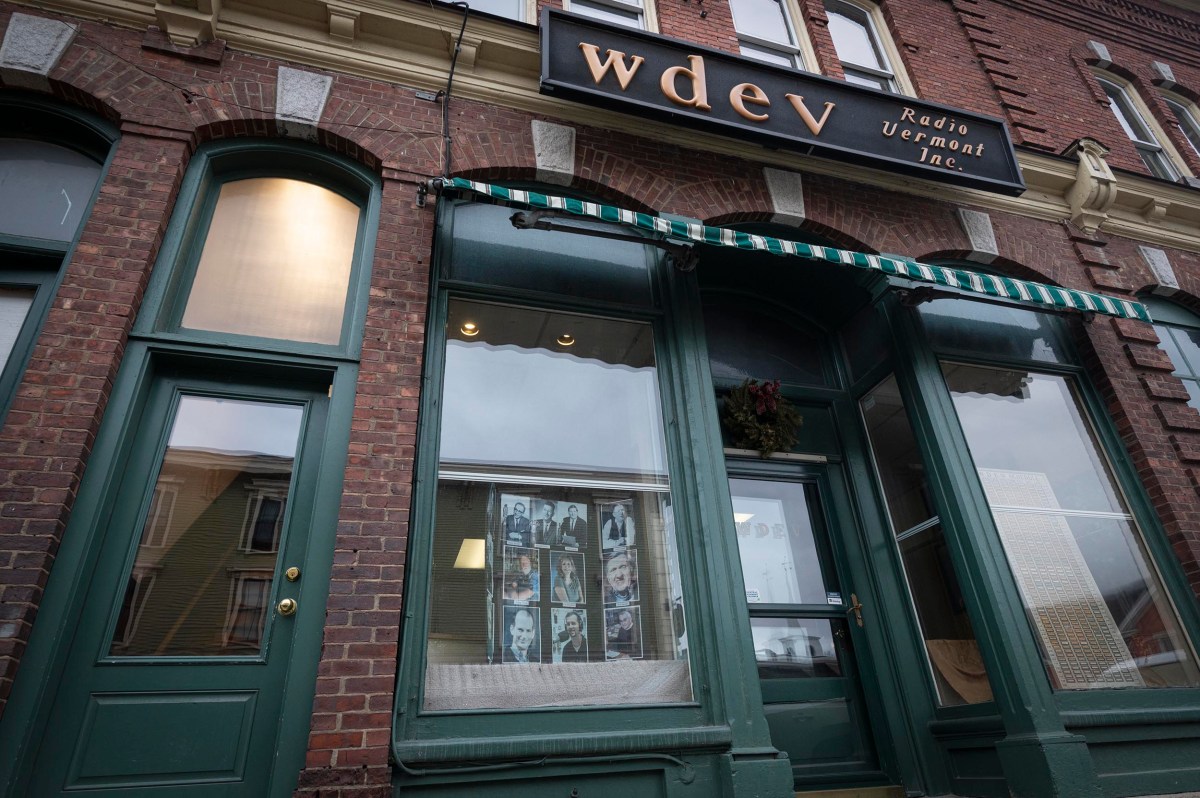
On its face, the partnership between The Nation magazine and Myers Mermel, the new owner of WDEV-AM, is an unlikely one.
Earlier this year, Mermel, who previously served as president of the conservative Ethan Allen Institute and once ran for the U.S. Senate as a Republican, entered the fabled Vermont radio station into an exclusive deal with the progressive monthly and online publication.
Every weekday afternoon, WDEV now airs podcasts produced by The Nation, featuring left-leaning voices from the magazine like Jeet Heer, whose show “The Time of Monsters” is broadcast on the station each Monday.
“When we bought the station people were like, ‘Oh, well Mermel, he’s going to turn it into Fox News,’ right?” Mermel said. “But that’s not what Vermont is. We’re trying to serve a community.”
The deal with The Nation is one in a constellation of sweeping changes that Mermel has enacted since acquiring the station from the Squier family last year. After 88 years of ownership, the family sold WDEV and its sister stations — WCVT-FM and WLVB-FM — to Mermel, his business partner Caroline McLain and his associate, Scott Milne, another former Republican candidate.
Although the Federal Communications Commission technically only signed off on the deal this month, Mermel has been serving as the station’s main owner and operator for just over a year, he said.
Under the leadership of Ken Squier, who died in 2023, the station developed a reputation as a paragon of independent media, celebrated for its emphasis on local culture and its lineup of eclectic, and often eccentric, shows like “Music to Go to the Dump By.”
But since taking over, Mermel has begun to nudge WDEV in a new direction, trying to maintain what he called “the station’s DNA” as a community radio station while branching out in new directions.
Mermel has funded upgrades to the station’s infrastructure, including new microphones and computer systems. He has simultaneously been overhauling much of WDEV’s traditional programming, injecting more “talk” and syndicated news into its lineup, largely with the hope of courting Vermont’s younger, more politically liberal population.
“We felt it was very important to try to improve certain areas where we could, and capitalize on missed opportunities,” Mermel said.

A new lineup
In addition to the programming from The Nation, WDEV has introduced a spate of new hosts to pad out its roster of commentators.
One of the new voices on air is David Zuckerman, a progressive and the state’s former lieutenant governor. He recently began serving as the Thursday host of “Vermont Viewpoint,” WDEV’s flagship daily talk program, which features a different host each day.
Featuring discussion of a wide range of topics from food insecurity to health care, the segment is aimed at “cultivating a reasonable presentation of a perspective that maybe some folks didn’t hear that much in recent years,” Zuckerman said.
Ross Connolly, regional state director of Americans for Prosperity, a conservative libertarian advocacy group, has joined the station as another host of Vermont Viewpoint. Joseph Woodin, president and CEO of Copley Health Systems, has meanwhile begun to host “Vital Signs,” a weekly show about healthcare in Vermont.
“I imagine (Mermel) is trying to get a wide range of voices to continue what WDEV had very much been, which is a community radio station, which means having a range of voices,” Zuckerman said.

But the new programming has been accompanied by a string of staff and host departures in the year since Mermel took over.
Most recently, in late March, Jack Donovan, who hosted the weekly “Outlaw Saturday Morning” on WDEV, announced he would be retiring after half a century on the airwaves.
Just a month earlier, Brady Farkas, host of a daily hour-and-a-half sports talk show, abruptly announced he would be leaving WDEV (Farkas and Mermel declined to specify whether the longtime host was fired or quit).
The station has also moved Greg Hooker’s “The Getaway” and George Thomas’s “Dinner Jazz” off live air, making the two beloved music shows — previously daily, hours long live programs — available as podcasts instead.
Radio personalities aren’t the only ones who have left WDEV since the station changed hands.
Last March, just months after Ashley Squier initiated the sale of the station to Mermel, she announced that longtime general manager Steve Cormier was leaving his role.
Besides Cormier, the station has also seen the departures of just under ten of its former sales and production staff in the last year, according to current and former WDEV employees, who spoke to VTDigger on condition of anonymity citing concerns about professional retribution.
Like the departed hosts, other staff members have reportedly left the station for a variety of reasons, including retirement, health issues and, in some cases, personal disagreements with Mermel, current and former staff members said.
Mermel declined to comment on the nature of any specific departures, but he acknowledged the station had gone through a transition period and said it had recently taken on more people than it had lost.
“I think as we have refocused on our mission, we’ve had a lot of buy-in for what we want to achieve,” he said. “For some people, they wanted to pursue different opportunities, but we’ve been able to staff up with people who agree with where we’re headed.”

‘I’ll take “change” over “gone.”’
According to Mermel, WDEV, which broadcasts 168 hours a week, has changed less than 10% of its programming since coming under his control. But longtime devotees of the station say those changes have struck at the heart of what made WDEV unique.
Up until recently, Dwight Day, 66, tuned into the station every morning, a ritual he had maintained for over 25 years. “I used to turn it on as soon as I woke up,” he said.
An early riser, Day, of Duxbury, was an avid fan of “The Trading Post,” the call-in show that for over 70 years aired daily at 6:35 a.m. and allowed Vermonters to buy, sell and swap goods on air.
But as the station has shifted its schedule, some classic segments like “The Trading Post” — which now only airs on Saturdays — have faded from the airwaves.
“Music to Go to the Dump By” is still around, but many of Day’s other favorite programs are no more. As a result, Day has found himself tuning in less and less, if at all.
“It was always good to get some local news and then some other stuff,” Day said. “But the way it’s gotten now, it’s almost just non-stop news.”
Day is hardly the only listener to bristle at the new programming. Before it was recently taken down, the comment section on WDEV’s website had been rife with fans venting their frustration over changes in the station’s lineup.
“I try to avoid the comments right now because they hurt,” Ashley Squier said in an interview. “I’m not surprised about how people are feeling.”
Squier briefly took over ownership of the station after her father, Ken, died in November 2023, and she facilitated the sale of the station to Mermel, which had been negotiated prior to Ken’s death.
Squier acknowledged the station had shifted its orientation in the intervening months, but said she fully supports the changes Mermel has made, which she considers necessary for the station to survive in a struggling industry.
Unbeknownst to most listeners, Squier said, WDEV had been operating at a deficit for much of the last few decades, maintained only by her father’s largesse.
According to Squier, Ken Squier spent “well over a million dollars” in recent decades to keep afloat the station, which she said occasionally lost as much as several hundreds of thousands of dollars in a given year.
“I knew that no matter who ran the stations going forward, changes would be necessary,” Squier said. “I’ll take “change” over “gone.”’
Clarification: This story was updated to include a third owner of WDEV and its sister stations.
