

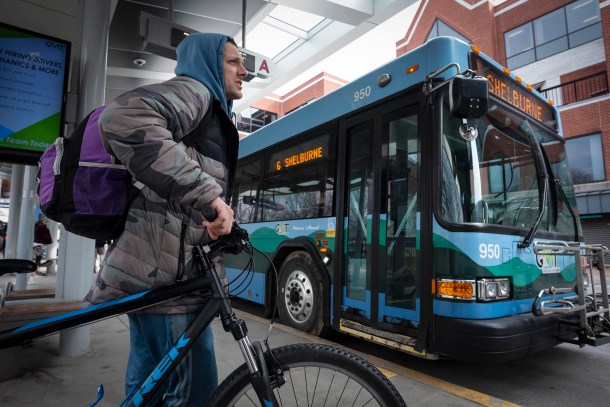
Green Mountain Transit riders can expect slightly higher fares — and new ways to pay them — starting early next year on many of the bus system’s busiest routes.
For the first time since the onset of the Covid-19 pandemic, the transportation agency plans to start charging for rides on its local and commuter routes in Chittenden County, and LINK Express routes to Montpelier and St. Albans, effective Jan. 2. The agency has operated all of its bus routes statewide fare-free since March 2020.
While Green Mountain Transit leaders have publicly discussed the return of fares since January, the agency shared more details this month about what riders can expect.
A ride on the local, commuter and LINK Express routes is set to cost $2 next year. That’s a 50-cent increase over the pre-pandemic fare on local Chittenden County routes, but equal to the previous fare on commuter routes. It’s also a $2 decrease to the fare on LINK Express services versus March 2020.
Clayton Clark, the agency’s general manager, said bringing back fares — and for some routes, increasing them — will help the transit agency make up for the impending loss of federal Covid-19 relief funding that has buoyed its coffers the agency throughout the pandemic.
The transit agency’s roughly $25 million annual budget is funded largely with federal and state dollars, but also local assessments on the cities and towns its buses serve. Clark said that fare revenue — estimated to total about $1 million in its first year back — will help keep local taxpayers from picking up a larger share of the tab.
“Nothing is as good as free,” Clark said in an interview, but reinstating fares “will really mean that we won’t have to jack up the prices to the municipalities.”
While ridership on the agency’s local routes in Chittenden County has largely returned to pre-pandemic levels this summer, the system’s commuter and LINK Express buses still are seeing far fewer riders than they were before the pandemic, the agency said.
The local routes saw about 132,000 total rides in June, according to the agency’s most recent ridership data online, but commuter lines saw only about 6,200 trips that month.
A proposed fare plan states that the agency has seen fewer people taking its commuter routes and the LINK Express services to and from their jobs in recent years; instead, most riders are using them to get to medical and human services appointments.
When fares come back, the agency plans to charge a reduced rate of $1 to riders who are under age 17, over age 60 or who have a disability. It also plans to continue operating its rural services — those in Washington, Lamoille, Franklin and Grand Isle counties — fare-free, according to Clark.
New payment options
Green Mountain Transit had planned to reinstate fares on its Chittenden County routes in July, but the agency said it needed more time to get its fare collection system up and running.
Now, Clark said the agency has started installing new fareboxes that, for the first time, will allow riders to pay onboard with a credit card or a smartphone, instead of just cash and coins. Clark said that while 90% of bus riders likely have smartphones, it was important, from an equity perspective, to continue allowing onboard cash payments.
Under the new system, called Genfare Link, riders will be able to download a mobile ticketing app and, when boarding a bus, open the app and wave their phone over the farebox to pay.
Riders who do not, or cannot, use the app will be able to get a physical bus pass at a Green Mountain Transit center, which works in much the same way. At first, the pass would need to be refilled at a transit center, but Clark said plans are for riders to be able to add money to the card at local stores, such as CVS and Walmart, in the future.
Clark said riders who use the Genfare system would also be eligible for a new, planned fare structure that caps the amount riders spend in a given period of time.
The transit agency plans to introduce a daily cap of $4 (or $2 for reduced-price riders), meaning riders would not need to pay after taking two trips in a day. Riders would also be capped at paying $40 (or, for reduced fares, $20) in a month — the equivalent of 20 bus rides.
Clark said these caps were created so that, even with a higher fare in place, regular bus riders would not pay more than the $40 cost of a monthly bus pass on the system’s local routes pre-pandemic. Monthly passes were more expensive for commuter lines.
Clark said the agency will be encouraging riders to take advantage of the new caps.
Sandy Thibault, executive director of the Chittenden Area Transportation Management Association, said her organization — which advocates for public transportation use in the county — was glad to see more modern payment options being put into place.
She said having the same fare across local and commuter routes will “provide, I think, more consistency for people traveling within the region,” adding that “we’ve got to make it easy” to take the bus in order for more people to consider a bus over driving a car.
A January report found that Green Mountain Transit could expect to lose more than 15% of its riders if it started charging again. Clark said he hopes the new fare caps will help keep the bus affordable to more people and limit the impact on ridership.
Green Mountain Transit held a series of public meetings on the proposed new fare plan earlier this month. Clark said agency leaders did not hear any objections to the plan, though noted that attendance at the meetings was extremely low across the board.
Clark added that while Green Mountain Transit’s board of commissioners may make some tweaks to the plan, he expects few major changes before it goes into effect.
