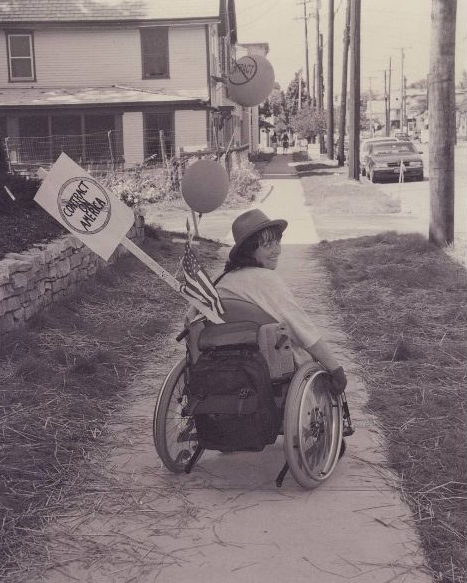
Deborah Lisi-Baker devoted her life to advocating for Vermonters with disabilities.
“If you were to look at somebody who might be like a mother of independent living in Vermont, that’s who I would think of,” said Sarah Launderville, executive director of the Vermont Center for Independent Living, who succeeded Lisi-Baker in that role.
Lisi-Baker died unexpectedly at her home in Waterbury last Friday. She was 69.
Born with cerebral palsy, Lisi-Baker used a wheelchair and drew on her personal experience as inspiration for her work.
“An icon,” “a mentor,” “a philosopher,” “a leader.” Those were some of the sundry ways Lisi-Baker’s peers — gushing admirers all — described her.
Her friends and colleagues remember her as a tireless and unparalleled fighter for disability rights in Vermont, a person whose quiet leadership inspired a generation of like-minded change-makers.
In addition to her time leading the Center for Independent Living, Lisi-Baker was associate director of the University of Vermont’s Vermont Center on Disability and Community Inclusion, and worked with the Vermont Coalition for Disability Rights and the Vermont Coalition for Ethnic and Social Equity in Schools. Her advocacy work spanned four decades.
Launderville, a longtime colleague, recalled Lisi-Baker’s role as mentor in the independent living community.
“She was always this person that wanted to see other people thrive and succeed,” Launderville said. “She is one of the most kindhearted people that you would ever meet. But she also was this powerful and thoughtful policy thinker.”
Lisi-Baker’s advocacy spanned sectors, from housing and transportation to recreation, voting and the arts, Launderville said.
No matter how serious and troubling the issues they were fighting for, Launderville said, Lisi-Baker always kept spirits high.
“We would go to D.C. and do civil disobedience. Get arrested, you know, that type of stuff,” Launderville said. “I remember being on the sidewalk, moving along with her. And she just started singing. And I don’t remember what the song was, but it was a social justice song, because she was just so moved to sing in that moment, and it was so beautiful.”
“When you’re in those moments of protest, you realize that you’re in something so much bigger than yourself,” she said.

Ed Paquin, who led the Vermont Coalition for Disability Rights and worked as executive director of Disability Rights Vermont, praised Lisi-Baker’s ability not only to lead but to listen.
Paquin served in the Vermont House of Representatives from 1991 to 2002, working with Lisi-Baker on policy advocacy during those years and the decades to follow.
“She really affected me quite profoundly,” Paquin said. “A person can thrive living with their disability.”
In 1988, an injury affected Paquin’s use of his legs. He said Lisi-Baker and other folks at the Vermont Center for Independent Living helped him learn what it meant to live with a disability.
“I think she understood on a pretty profound level that what limits a person with a disability is not so much the physical or mental limits that one might work with. It’s the interaction with society that makes it a disability,” Paquin said. “In other words, what’s limiting is not so much the difference that a person has in their own abilities, but how society keeps its opportunities open to everyone.”
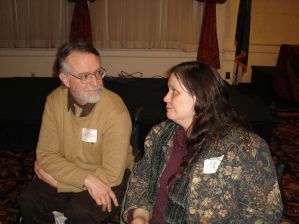
Paquin recalled Lisi-Baker’s work in the 1980s getting the Legislature to fund Vermont’s participant-directed attendant care program. The program allowed Vermonters with disabilities to receive funds to hire, train and manage their own care providers, helping them to continue with their daily lives and careers without moving to an assisted living facility.
Before the program, many Vermont residents relied on Medicaid to fund care providers, which meant they had to fall below a certain income threshold to obtain monetary support. That system sometimes disincentivized work, according to Paquin.
After the move to state funding, “it was a tremendous program and made the difference for people who could make a decent living. They could get the support to be able to physically participate in society, and particularly in the workforce,” Paquin said.
According to Paquin, Lisi-Baker was a powerfully intelligent and philosophical thinker who always sought to empower others.
“She had a quiet presence that could pull a group together and help us get thinking in a certain direction. And for that, I give her a tremendous amount of credit,” he said.
Another focus for Lisi-Baker was universal design: the idea that an environment — from conception to execution — can be created to be equally accessible to all people, rather than thinking about accessibility as an issue separate from the design itself.
While the concept applies to physical spaces, Paquin said Lisi-Baker took her advocacy a step further by applying universal design to education.
Amanda Garcés, the director of policy, education and outreach at the Vermont Human Rights Commission, worked with Lisi-Baker in implementing Act 1, a law that created the Ethnic and Social Equity Standards Advisory Working Group.
The 23-person group works to promote cultural competency and equality in education, with a focus on underrepresented communities.
“She embodies what we mean when we talk about intersectionality,” Garcés said. “She’s always thinking about all people, and how the work of disability rights is also the work of racial justice.”
According to Garcés, Lisi-Baker brought the expertise she’d gained through decades of work to the group’s education reform, acting as a mentor to younger advocates.
“She was a connector. She was also an educator, she wrote curriculum, she had a wealth of knowledge on disability rights.”
One of Lisi-Baker’s primary passions was poetry.
“My most favorite memory of her is just listening to her read her poetry and share it with other artists,” recalled Michele Bailey, senior program manager and ADA coordinator at the Vermont Arts Council.
Lisi-Baker’s experience living with a disability inspired and motivated her advocacy, and it did the same for her poetry.
Launderville, her longtime co-worker at the Center for Independent Living, remembered a poetry reading late last year Lisi-Baker did for a Vermont Commission on Women event. Lisi-Baker read her poem “Looking for Breakthroughs,” about advocating for attendant care.
“Everybody had tears in their eyes. I think it was just one of those beautiful moments,” Launderville said.